Monthly Archives: June 2023

The Most Important

Dear Folks,

Old Riddle: Where does an eight-hundred-pound gorilla sleep? Answer: Anywhere he wants to.

“Christianity, if false, is of no importance, and if true, of infinite importance, the only thing it cannot be is moderately important.” ― C.S. Lewis. We remember Jesus’ words in Revelation 3:15-16 (what He said about luke-warm Christians, ouch!). Either Jesus is the

ruling reality, the eight-hundred-pound gorilla in our lives, or we are not doing Christianity.

There are lots of factors in life we can’t control, but there are choices we can make, and how we make them tells the story. Life has hard choices. Sometimes it means choosing against something that is very, very good for the sake of something more important. What we tell ourselves we believe, what think we are like, what we claim to be about is one thing. What do our choices say about us? That is the reality (“By their fruits you shall know them [Matt 7:16]).”

One youth minister told me, “Never ask people to choose between God and sports, because God will lose every time.” What does that say about the culture of that parish, the beliefs that had come to be common there? Would Jesus be happy about how they were doing

church?

When there isn’t enough time to do everything, even everything really, really important (which is generally always) what gets cut and what gets protected? When there isn’t enough money for everything, even everything really important, what gets cut, and what gets protected?

Prayer is hugely important, and we would (I hope) agree that it is an essential part of being a disciple of Jesus. It is also the easiest thing to put off when the crunch comes. “Half an hour’s meditation each day is essential, except when you are busy. Then a full hour is

needed.” ― St. Francis de Sales

God calls us to work with less than perfect situations. If we wait until things are how we think they should be, it will never happen. If God asks us at the end of our lives how we have served the Kingdom, it would not be good to have to say, “I would have done great things, God, but I was just too busy,” or “the pastor was such a jerk,” or “the church had so many hypocrites,” or any such thing. I’m not envisioning that being a happy conversation.

In times and places where people are being put to death for being Christian, the choices can be clear and stark. At other times and places, it may make be easier to let it get fuzzy in our minds. If it has been a long time since we had to choose against something we really, really wanted for the sake of the Kingdom, maybe it’s time to do some inventory.

Is Jesus our 800-pound gorilla? Or is something else? There can only be one.

Blessings,

Fr. Jim
Being Christian in a Hostile World

Dear Folks,

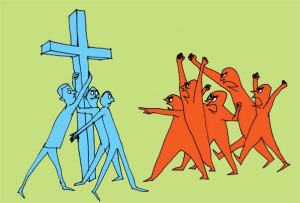
Matthew chapter 10 deals with the challenge of being Christian in a world hostile to Christianity. I have read that North Korea, Somalia, Yemen, Eritrea, Libya, Nigeria, Pakistan, Iran, Afghanistan, Sudan, and India are the most dangerous places just to be Christian. We need to pray for them.

In Europe and North America, it is not so dangerous just to be known as a Christian, but sometimes people get attacked for standing by Christian beliefs that are not popular. Those who hold to Christianity in general and Catholicism; in particular beliefs about the sanctity of life, sexuality, and family may get attacked verbally, have their property vandalized, and their careers be destroyed. Some people who are hypersensitive about how others talk

about things they hold dear will degrade and ridicule things precious to Christians and brush off any concerns. This leads to the question of where it will go from here.

Jesus said, “Behold, I am sending you like sheep in the midst of wolves; so be shrewd (wise, prudent, clever, cunning, crafty) as serpents and simple (innocent) as doves (Matthew 10:16).” I hold on to that verse tightly. We don’t know what the future will bring,

but there are some things we can do to prepare.

1. Know our story. One of the reasons so many are against the faith is that when they were told about it, it was told very poorly. There is a YouTube video “Bishop Barron on ‘Dumbed Down” Catholicism” https://www.youtube.com/watch?v=vZkPH1rOAG0 in which he speaks about Catholics being taught on a level far below the level of other subjects. There are some prominent Catholics who fiercely and aggressively oppose some aspects of Catholic teaching and

speak boldly about how devout they are.

2. Deepen the roots in our relationship with Jesus. We are not going to win this by our own power.

3. Practice choosing the Kingdom over the world. Prayer, fasting and almsgiving are all ways to choose the Kingdom over the world, and we can look at the practical decisions we make in life.

Not every Christian is called to be martyred for the faith, but every Christian is called to be ready to be martyred for the faith, and it starts with small decisions. “The person who is trustworthy in very small matters is also trustworthy in great ones; and the person who is dishonest in very small matters is also dishonest in great ones. What in our day-to-day decisions says that we are ready (or getting ready) to choose the kingdom over the world?

Bishop Barron also did a YouTube video “Why Modern Men Look Elsewhere for Spiritual Wisdom” https://www.youtube.com/watch?v=avROODXQlhE and he basically concluded that we have made Christianity too easy and convenient. The Gospel is meant to push us to greatness, and that can’t be done if you

shave off the difficult parts in the name of making it friendlier. If we read the Gospels and take them seriously, there can be no doubt that Jesus calls us to be willing to give our lives in one way or another, to be willing to suffer, to follow whatever the cost. We don’t know what will be asked of us tomorrow. How will we answer?

Blessings,

Fr. Jim

The Harvest is Abundant

Dear Folks

There are two essential thoughts in our Scriptures this Sunday: that God has given us many great gifts, and the harvest is abundant; laborers are few.

There are a number of sad conversations going on now. Churches are closing. Churches that used to have one or two priests are now sharing priests. Many churches can do less than they used to. Many are struggling.

Many people feel helpless. We are not helpless. God has given us many gifts, and there is so much we can do to make our churches thrive.

What if God is testing us, to see how we will respond to this challenge. To make church happen requires the participation of a lot of people. The question is, how many will respond

to this call? There are some who prioritize participation in the church, helping to make good things happen. The question is how many of our people are willing to do that? How many Catholics see themselves as customers and how many see themselves as coworkers in mission?

If a parish is truly building disciples, it will be common for people to see themselves as sharing responsibility for making church happen, and eagerly respond to God’s call. If people see that responding to God’s call is central to life, that the work of the Church is a huge part of responding to God’s call, and that their participation makes a difference, then a parish can thrive.

Trying to do good things in the Church can be frustrating, and I know that as well as anyone. That is part of the challenge. When we are faithful in the midst of obstacles (including annoying and infuriating obstacles), God uses those occasions to deepen our

commitment and our holiness. We are called to work with the Church we have, with all its flaws. That is part of discipleship.

As for more priests, we all have a role to play. I would suggest that if a young man grows up surrounded by adults (he sees more than his parents) who are zealously dedicated to growing in holiness, deeply in love with the Eucharist, ravenously hungry to learn more

about the faith, and energetic is supporting the mission of the Church, we will have to build a fence around the seminary to keep it from being overrun with applicants.

Part of this is helping direct people’s energy. Many do not read my bulletin articles (sigh), and so how others spread the vision is key. When people express complaints about the state of things or worry about the future, it is important to direct the conversation towards action that can help, even incrementally. Enough drops of water make an ocean.

The harvest is abundant. How many laborers will we have? Our future can be glorious.

Blessings,

Fr. Jim

Eucharist: Looking Beyond Appearances

Dear Folks,

The is the Feast of the Most Holy Body and Blood of Christ. You have heard a good deal (I hope) about the Eucharistic revival. We have heard about the majority of those who call

themselves Catholic who don’t believe in the Church’s teaching on the Real Presence. I consider this to be a part of a larger problem of so many Catholics being led to believe that the Catholic faith is much, much less than it really is. Given that, it should not surprise us that so many people stop going to church. Without much profound reason to come, a bad experience or just apathy can trigger a departure. I would suggest a lack of Catholic belief in the Eucharist has three causes: casual practice, careless talk, and mushy teaching. Many of us are trying to build a greater sense of reverence in our practice and how we talk about the mysteries, and today I want to address what we are taught.

Many people’s formation so emphasized Mass as our family meal, there was not much talk about what made it different from other meals, and how it is so much, much more than a meal.

Some of our Evangelical brothers and sisters say that we are mistaken in our belief and claim that Jesus was speaking metaphorically when He spoke of eating His body and drinking His

blood. They point to other times that Jesus used metaphors and say that this teaching follows that pattern. Since most Catholics (including priests) are not prepared to respond, that is often the

last word on the subject, and the skeptics feel confirmed, and the Catholics feel insecure. It is time for that to end. We can look closer at the Biblical text (something I’m always in favor of) and see how Jesus’ talk about the Eucharist is very, very different from His use of metaphors.

When Jesus used metaphors, they were in line with the Old Testament imagery. “I am the good shepherd (John 10; see Ezekiel 34 and also Psalm 95). “Rivers of living water (John 4; John 7;

Ezekiel 47; Psalm 1; Jeremiah 17).” “I am the vine; you are the branches (John 15:1-10; Isaiah 5).” By Contrast, the metaphor of eating someone’s flesh in the Old Testament is not about

believing in someone but conquering and destroying them. “When evildoers come at me to devour my flesh, these my enemies and foes stumble and fall (Psalm 27:2; see also Zechariah 9:15 and Ezekiel 39:17-20).” Jesus built His teaching on the Old Testament; he did not toss it out and start from scratch. Foreshadowing of the Eucharist can be found in the manna in the desert and the eating of the Passover lamb, and these are not metaphors but realities that meant life or death.

When there was confusion about Jesus’ figures of speech, either He or the Gospel writer would clarify. “Lazarus is dead (John 11:14).” “He was speaking of the temple of His body (John 2:21).” When Jesus speaks of giving living water (John 4 and John 7) it is clarified that “He said this in reference to the Spirit that those who came to believe in him were to receive (John 7:39a).”

Jesus never said, “I am this vine” or “I am this door” but He did say, “this is my Body” while holding it is His hands “Matt 26:26-28; Mark 14: 22-24; Luke 22:19-20; 1 Corinthians 11:24- 25).

None of the instances’ of Jesus metaphors lead to most of His followers who believed in Him walking away and not coming back (John 6:66). There is no parallel of disciples walking away

saying “This nut thinks he’s a sheepgate.”

The Bread of life discourse in John 6 bears closer examination. The guts of the talk is in two sections vv. 35-47 and vv. 48-58. The first emphasizes belief, and if that were all there was, I would say a case could be made that “I am the bread of life, whoever comes to me shall not hunger, and whoever believes in me shall not thirst (v. 35)” is a metaphor for believing in Jesus. The second section, however, responds to their skepticism by doubling down, and does not talk about belief but eating His flesh and drinking His blood (the blood came out of nowhere). He says, “My flesh is true food, and my blood is true drink.” (These two sections echo the liturgy of the Word and the liturgy of the Eucharist.). If one is still skeptical, I would ask, what could Jesus have said that would convince you that He really meant it?

It really is the Body and Blood of Jesus, as Bishop Barron teaches, not in “a reductive physicalist sense (we’re not talking about a piece of meat here)” but a more Jewish framework, in which the flesh and the blood are the person (hence Catholic teaching that every particle of the Eucharist is the complete Jesus, body, blood, soul, and divinity). We, of course, remember that Jesus is Jewish and not Greek.

Given how unique this teaching is, the price Jesus paid is losing most of His followers, and how it is referred to in all four Gospels and Paul, how important was it to Jesus? How important was it to the early Church? How seriously should we take it? What should our response be?

Blessings,

Fr. Jim