Monthly Archives: October 2025

Pope Leo and Care for the Poor Part I

Dear Folks,

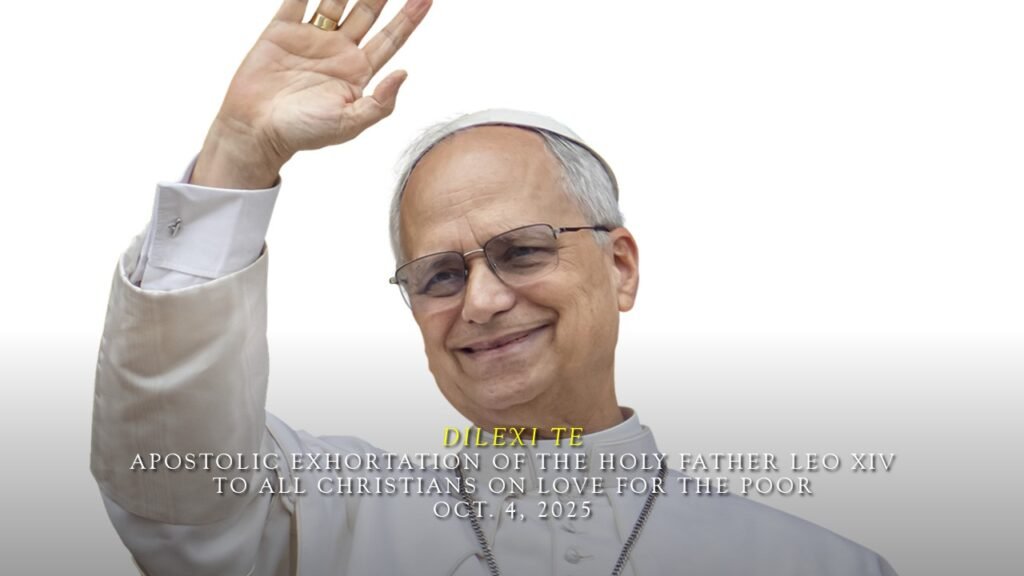
Pope Leo XIV has issued an Apostolic Exhortation called Dilexi Te about Christian love for the poor. Nothing in it will surprise anyone familiar with the Scriptures and what the Catholic Church has taught for 2000 years, but he is reminding us as we need to be reminded on a regular basis.

Pope Leo goes through the Scriptures and stories of Saints through the centuries who showed great love and care for the poor and emphasizes that care for the poor is not op-

tional for Christians, but an essential dimension of being Christian, and our Christianity is not authentic without it.

1 Corinthians 9:7 “God loves a cheerful giver.” I remember one church sign that said, “God loveth a cheerful giver, He accepteth from a grouch.” The saying has a more profound meaning than people think. Real generosity is not just giving but joyfully giving.

Our faith calls us not just to comply with commands but be transformed to our core. To be a Christian is to give ourselves to Jesus to transform us by the power of grace. The more we are transformed into the image of Christ the more we seek to give of ourselves, because that is who we are. Hence, the Holy Father warns that worship that is authentic is worship that moves us to care for the poor.

We should not approach them as if they were inferiors, but as brothers and sisters. We encounter Jesus in them, and we can learn from them. We are not only to offer material

help, but dignity and spiritual help gathering them into the community.

He says that giving material goods is meant to be a provisional solution, and better to help them get a good job by which they can earn a enough to live with dignity.

He talks about getting to the root causes. We could have a good deal of conversation about the root causes of poverty. I have heard that those who come from fatherless families are more likely to be poor. How can we address the issue of fatherless families? Helping people to produce more value so they could get good jobs seems important. Would school choice help people escape failing schools and be better prepared? Let’s look at who our celebrities are. What if we did more to lift up those people those people who worked hard and accomplished things that helped people. A culture that valued self-improvement and achievement over gratification of desire might produce fewer poor people.

He warned not to just let the government do it, but neither should we deny the government role in caring for the poor. There needs to be a lot of conversations about how that

all shakes out. One thing that doesn’t help is saying, “You don’t agree with what I think will help, so you don’t care about helping.” I see this again and again in different forms, and I think it is a serious obstacle to productive dialog. There’s a Youtube video called “Bishop Barron on Paul Ryan and Catholic Social Teaching” that talks about the coming together of subsidiarity and solidarity and how there can be different perspectives.

More on this next week.

Blessings,

Fr. Jim

Capital Punishment and Pope Leo

Dear Folks,

Recently, Pope Leo mentioned that those who favor capital punishment are not pro-life. This has confused many people, and I would like to offer some reflections.

First, remember that the term “pro-life” is not rigorously defined. In math, science, and philosophy they taught us to define our terms clearly so we know what they really meant so that everyone using them could understand them the same way. When we use terms that carry much emotional weight but are not rigorously defined, let us remember what is and what is not being accomplished.

Now let us consider capital punishment and respect for human life.

In the Old Testament, God mandated capital punishment, beginning with the covenant of Noah: “Whoever spills human blood, that person’s blood will be shed; for in the image of God has God made man (Gen 9:6).” This taught that all human life was sacred, whether an aristocrat or a peasant, man or woman, little baby, vigorous adult, or infirm senior citizen, their lives had a value that could not be compared with any other value. There was no amount of money, nothing on earth that could compare to the value of human life.

Remember, though, that was not the response to Cain when he killed his brother Abel (Gen 4). More on that later.

As we go through the Bible, we see that God teaches some things gradually, not because He is learning as He goes, but because people can only be brought along so fast. Our kindergarteners are bright and enthusiastic, but they are not learning calculus. They are not ready.

When some Pharisees asked Jesus about divorce and He said they should not be separated they were surprised. “They said to him, ‘Why did Moses command that a man give his wife a certificate of divorce and send her away?’ He replied, ‘It was because you were so hard-hearted that Moses allowed you to divorce your wives, but it was not like this from the beginning (Matthew 19:7-8).’” This suggests that God led His people along gradually, and some things they were not yet ready to receive, but that God wanted from the beginning. This may explain His treatment of Cain.

Around the time of the exile, there was more reflection on the individual, personal rights, and personal responsibilities. In Ezekiel 18 we see God reveals what He really wants.

“Do I derive any pleasure from the death of the wicked? Asks the Lord God. Would. I not rather rejoice to see them turn away from their wickedness and live (Ezekiel 18:23).”I would encourage reading the whole chapter. A very nasty Saul of Tarsus was responsible for the deaths of many Christians, but God did not strike him down but called him to repentance and sainthood. God wants everyone to be saved (1 Timothy 2:4).

We remember the one time when Jesus was presented with a question about capital crime, He didn’t want her killed; He wanted her to “go and sin no more (John 8:1-11).” This does not by itself resolve the issue, but it is worth considering in the discussion.

For many centuries, the Catholic Church held that capital punishment was a proper way to enforce the law and deter crime. Things started to shift starting with Pope Saint John Paul. As I remember it, he started by appealing to authorities not to execute particular criminals. He taught extensively about the culture of death, (which considered killing a way to solve problems) and how that contrasted with a culture of life. Toward the end of his papacy, after laying the groundwork, he taught that we can do better than capital punishment in most cases. Pope Francis pushed it farther. Now it appears that Pope Leo is

moving in that direction.

There are some arguments against capital punishment that I find unpersuasive to the point of being irritating. I saw a t-shirt that said, “Why do we kill people who kill people to show that killing people is wrong?”. I believe it is common to imprison kidnappers,

but I never saw a t-shirt that said, “Why do we lock up people who lock up people to show that locking up people is wrong?” When people claim it is inconsistent to be antiabortion and pro-capital punishment, that tells me that they have not taken the effort to understand the other point of view, and that is irritating. I’m reminded of the 5th amendment that says that no one can be “deprived of life, liberty, or property without due process of law.” Punishing convicted criminals calls for some things that we shouldn’t do to innocent people.

Do some people deserve to be put to death? I think so. In fact, one could make a case that there are some awful people who might deserve to die slowly and tortuously. Imagine, though, what it would do to our souls to inflict such a thing? What would it do to our society? Imagine having that job. I would be concerned about someone who is not repulsed at the thought.

Someone said, “if he took someone’s life should he be able to keep enjoying his life?” I say, “Who said he’ll get to enjoy it?” I’m not arguing this out of niceness. If I had my way a vicious murderer would be put in twenty-three hour a day lockdown, with Mother Angelica, Bishop Robert Barron, Trent Horn, and other such videos pumped into his room. I also have a recipe for brown rice and tofu. Let’s see how he does with fifty years of that. He might beg for a lethal injection. I recognize this idea would have to be adjusted by others who know more about this stuff, but you get the idea. If a few of those souls could be redeemed, that would be a good thing.

If we treat every human life from conception to natural death as sacred in a way that is deeper than human choice, deeper than our personal merits, and transcending all other categories, I suggest that we will be a better society and better people, and will put us in a better position to fight abortion, euthanasia, eugenics, and other manifestations of the culture of death.

Blessings,

Fr. Jim

Peace or Division?

Dear Folks,

It is the work of Satan to tear people apart. It is the work of Jesus to reconcile, and we have been entrusted with that work. “All this has been done by God, who has reconciled us to himself through Christ and entrusted us with the ministry of reconciliation. In other words, God was in Christ, reconciling the world to himself, and not holding people’s transgressions against them, and he committed us to the message of reconciliation (2 Corinthians 5:18-19”).

Here’s a twist: Jesus said, “Do you think that I have come to bring peace to the earth? No, I tell you, but rather division. From now on a household of five will be divided, three against two and two against three… (Luke 12:52-53).” But what about “Blessed are the peacemakers, for they will be called children of God (Matthew 5:9)” and “Peace I leave you, my peace I give you (John 14:27).” What are we to make of this?

What about this? In this world torn by sin and division, the only road to peace and unity begins by uncovering the division. Where Jesus went, there was division between those who accepted His teaching and those rejected it, often fiercely. I suggest that Jesus did not create the division, but He revealed the division that was already in their hearts.

There are many dysfunctional families in which problems are not addressed, they are not talked about, and people pretend they don’t exist. Then they get worse. This is not peace.

Avoiding conflict does not make it go away, and when it festers, sometimes there is ablowup.

When surgeons heal, they must first cut. To be sure, they cut very carefully and precisely; they don’t just slice haphazardly. It is all directed toward healing, and they know how to do it. Furthermore, they try to cut as little as possible, while doing the most healing. Incisions for the same kind of surgery gotten smaller as medical science has advanced.

I’ve seen a lot of conversation in social media that seems like just slicing haphazardly: lots of insults, name calling, and attacking.

If I criticize someone in a way that makes them think, “this person hasn’t tried to understand my position, and what he says misses the point” then it’s guaranteed that I will not be able to persuade him. In fact, I’ve reinforced his belief by my unpersuasive argument.

Imagine someone out there who disagrees with me but is open to reason. What in my words has a chance of getting him to think a new thought, ask a new question, or see things from a different angle? How would my words sound to that person?

Recognize there is a disparity between how I hear myself and how others hear me. Being attentive to people’s reactions can give us a hint of what they heard, and how it might differ from what we intended to say. We will make mistakes. It is hard. It can be painful.

Of course, reading the Gospels makes it clear there is no way to be a disciple of Jesus without some pain. It’s easy to complain, to insult people, to call names, but seriously engaging is hard work. Consider, if you could reduce the friction in your car’s motor so

that it went twice as far on a gallon of gas and the parts took twice as long to wear out, what would that be worth? How much more valuable with the members of society.

Blessings,

Fr. Jim

Missing the Big Picture

Dear Folks,

When we try to have productive dialog, there are some principles that might be useful.

Daniel Kahneman’s book “Thinking Fast and Slow” he says there are two kinds of thinking. One is faster and easier, but “knows nothing of logic or statistics” and has a tendency to believe that what we see is the whole picture. The other kind of thinking is slower and more work, so very often people don’t do it. It takes effort to think things through, to examine and question ideas critically. When I’m talking to someone, what kind of thinking am I using? What kind of thinking is the other person using? Both kinds of thinking are useful in their place, but it is useful to be aware.

Recognize that God sees everything (the whole picture) with direct apprehension. We do not. We, through our senses, collect bits of experience and weave them into a narrative. There is absolute truth, but our grip on it is limited. Two people can have very different narratives about the same situation and both be acting in good faith.

There are many people working very hard to feed us their narratives about how things are, and some people will hear the narrative, find it compelling, then accept it uncritically and never look back.

If you read “Unlocking Leadership Mindtraps” by Jennifer Garvey Berger (I’m currently listening to her “Simple Habits for Complex Times” and it is interesting), she describes one mindtrap as “The Simple Story.” We hear a simple narrative that seems compelling and decide that it explains everything, and we can miss complexity. Another mindtrap is “Agreement”. If everyone in our group agrees with an idea we tend decide that it’s enough and not to seek further perspective. There is an opposite in which whatever a certain person or group believes, we automatically believe the opposite. I saw someone talking about a politician (whose opponents really hated him) and this person suggested, “He should issue a statement in favor of air and watch his enemies suffocate themselves.” Nobody is always right (except God) and nobody is always wrong.

There is a dark triad: narcissism, psychopathy, and Machiavellianism, people who don’t care how they hurt you as they seek to get what they want. You can imagine the temptation to be quick to decide that anyone we disagree with is one of those, but that is lazy and unproductive. We need some really solid reason to write someone off like that. We also need to recog-

nize that having fruitful dialogue with people of other perspectives is more work than we are used to thinking.

In Matthew 10:14 (also Mark 6:11 and Luke 9:5) Jesus teaches that sometimes people will not

hear us, and we must “shake the dust” from our feet and move on. Jesus couldn’t reach everyone, and we are not going to do better than Jesus. Once again, it is important to beware of the

temptation to put people in that basket too quickly. This work is hard, harder than we tend to think, and if we give up too soon, we will make no progress but become more and more alienated.

All of this means that having good dialogue with other people is going to be hard work, patient work, frustrating work. The question is: are we willing to do that for the sake of a better world?

Blessings,

Fr. Jim