Category Archives: charity

Helping Those in Need Part II

Dear Folks,

There is serious concern that many things that are meant to help the poor are actually keeping them trapped in poverty. I’ve been told that these are hard to change because many people make money helping the poor to stay poor.

The books “Toxic Charity” by Robert D. Lupton and “When Helping Hurts” by Steve Corbett and Brian Fikkert and the documentaries at Povertycure.org and Povertyinc.org can shed some light on the disparity between good intentions and good results.

In the Greenville and Belding area we have programs that are worth looking at. IM Kids Third Meal makes portable meals for children in food insecure situations to have something

to eat in the evening. I’m not an educator, but even I know that children go through different stages of development, including their brains, at certain ages, and if they don’t have adequate nutrition during those times that development does not happen and can’t be made up for later.

Children must never go unfed. Some will say that the parents should be doing this and I agree, but I don’t know all their situations, and I’m not sure how to make it happen. One thing I’m not willing to do is let children go unfed to incentivize the parents to solve the problem.

Have Mercy helps the homeless to look for work and to find a stable home. They celebrate every time someone “graduates.”

Alpha Family Center and the Walking with Moms in Need ministry help families during pregnancy and when their children are little. This is a pivotal and especially vulnerable time for them, and so what they do is valuable beyond imagining.

Habitat for Humanity engages people and gives an assist as they work to better their own situation. It is known to make a lasting and profound difference in people’s lives, so they can move from squalor to flourishing.

Many churches have food pantries and make meals for people in the community, and these can help people through difficult times (eating has become an expensive hobby).

All these and other programs could use support, including financial and volunteers. Might God be calling us to reexamine how we could participate?

For us to answer this challenge, we the Church must grow stronger and sharpen our focus on caring for those in need. The more we do that, the more people may believe the Gospel that we preach with our words. We cannot do it by our own power, of course. Without God’s grace we are helpless; with God’s grace nothing is impossible. If we want a better world, thefirst step is falling more deeply in love with Jesus.

Blessings,

Fr. Jim
Pope Leo and Care for the Poor Part I

Dear Folks,

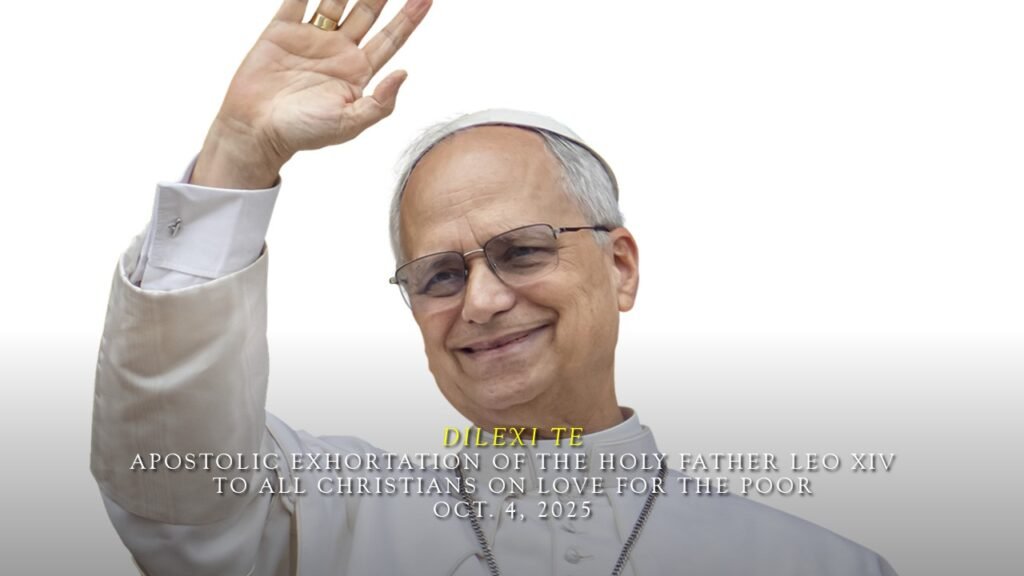
Pope Leo XIV has issued an Apostolic Exhortation called Dilexi Te about Christian love for the poor. Nothing in it will surprise anyone familiar with the Scriptures and what the Catholic Church has taught for 2000 years, but he is reminding us as we need to be reminded on a regular basis.

Pope Leo goes through the Scriptures and stories of Saints through the centuries who showed great love and care for the poor and emphasizes that care for the poor is not op-

tional for Christians, but an essential dimension of being Christian, and our Christianity is not authentic without it.

1 Corinthians 9:7 “God loves a cheerful giver.” I remember one church sign that said, “God loveth a cheerful giver, He accepteth from a grouch.” The saying has a more profound meaning than people think. Real generosity is not just giving but joyfully giving.

Our faith calls us not just to comply with commands but be transformed to our core. To be a Christian is to give ourselves to Jesus to transform us by the power of grace. The more we are transformed into the image of Christ the more we seek to give of ourselves, because that is who we are. Hence, the Holy Father warns that worship that is authentic is worship that moves us to care for the poor.

We should not approach them as if they were inferiors, but as brothers and sisters. We encounter Jesus in them, and we can learn from them. We are not only to offer material

help, but dignity and spiritual help gathering them into the community.

He says that giving material goods is meant to be a provisional solution, and better to help them get a good job by which they can earn a enough to live with dignity.

He talks about getting to the root causes. We could have a good deal of conversation about the root causes of poverty. I have heard that those who come from fatherless families are more likely to be poor. How can we address the issue of fatherless families? Helping people to produce more value so they could get good jobs seems important. Would school choice help people escape failing schools and be better prepared? Let’s look at who our celebrities are. What if we did more to lift up those people those people who worked hard and accomplished things that helped people. A culture that valued self-improvement and achievement over gratification of desire might produce fewer poor people.

He warned not to just let the government do it, but neither should we deny the government role in caring for the poor. There needs to be a lot of conversations about how that

all shakes out. One thing that doesn’t help is saying, “You don’t agree with what I think will help, so you don’t care about helping.” I see this again and again in different forms, and I think it is a serious obstacle to productive dialog. There’s a Youtube video called “Bishop Barron on Paul Ryan and Catholic Social Teaching” that talks about the coming together of subsidiarity and solidarity and how there can be different perspectives.

More on this next week.

Blessings,

Fr. Jim

How Deep is our Faith?

Dear Folks,
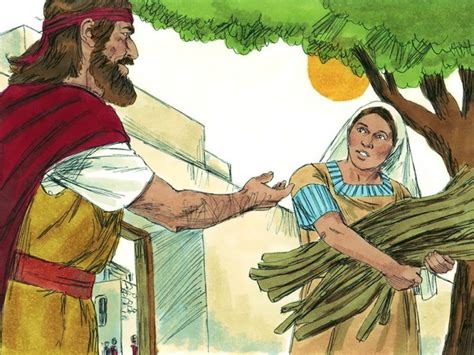
There are some people in the Bible who deserve more recognition than they usually get. Our first reading this Sunday; 1Kings 17:10-16, tell the story of the Widow of Zarephath, and I consider her one of the great heroes of the Bible.
Consider her situation. She had gotten married and had a son (I’m guessing recently, since the son was apparently still too young to help collect sticks). Her husband died. Widows didn’t have a lot of options financially, but she did the best she could. Then came the drought, and therefore the famine. She now had no one who would hire her, nothing left to sell, no one from whom she could beg anymore, and now her food was almost gone. She was getting ready for her and her son to have one last taste of food before they starved to death. Imagine the heaviness of her heart as she ponders all her hopes and dreams being crushed, the horrible fate that
was looming.
Then this scruffy looking strange man comes and asks for a drink of water. Immediately she goes to get it. Even in her current situation, her hospitality goes so deep that she doesn’t hesitate. The he calls after her asking for some food.
Oh.
Any other time it would not have been a question, of course she would feed a stranger. Not so easy today. She explains the situation, and the reasonable expectation was that he would respond, “I’m so sorry. I’ll go ask someone else.” Instead, he has the nerve to say okay fine but first feed me. I don’t imagine she put much stock in his promise “The jar of flour shall not go empty, nor the jug of oil run dry, until the day that the LORD sends rain upon the earth.” There was nothing about him to tell her he could work miracles, and it would be more likely he would say anything to get what he wanted, even scamming a starving widow. I expect she figured she and her son were going to starve to death and nothing could change that. She had one last decision to make in her life, and that was to be generous to a stranger. She chose to be generous. She had so little to give, but gave with great love. God rewarded her, and I consider her one of the underappreciated heroes of the Bible.
I would also mention Shiphrah and Puah (Exodus 1:15-21). They were Israelite midwives who were being oppressed in Egypt. They defied the mightiest king in the world to save the babies
from slaughter. They succeeded because they were clever and had tremendous courage. They had a terrible situation and responded in faith. Their faith went that deep.
In our Gospel this Sunday, we see the contrast between the Scribes and Pharisees, whose faith was just on the surface and the widow giving her small coins whose faith was deep enough to give when she had so little.
Challenge for us: how deep does our faith go? Will it still work when we are at the end of our rope, worn down to nothing, crushed by life? May God grant us the grace.
Blessings,
Fr. Jim 

What Does Jesus Mean?

Dear Folks,

The Gospel readings from last Sunday and this Sunday have Jesus issuing some serious challenges. How do we respond in practice? There are some big questions. People might look at His words and say they are not practical, and then they skip over them. That would be very bad. If we can be unaffected by Jesus’ words, we are a failing at discipleship.

Jesus talks about anger: “But I say to you, whoever is angry with his brother will be liable to judgment…(Matt 5:22).” Does this mean we should never be angry? We read what Jesus said in Matthew 23, and He sounds pretty angry to me. When Jesus flips over tables and drives the money changers out of the temple, He seems pretty angry then too. What are we to think? We read in Ephesians 4:26-27: “Be angry but do not sin; do not let the sun set on your anger, and do not leave room for the devil.” There is a right way to be angry, when it is based on love, and we see our loved ones doing self-destructive things. This leads to seeking to help if one can. In Matt 23, after Jesus is angry, He weeps over Jerusalem. Under loving anger there is profound sadness.

Jesus speaks about divorce, and we see parallels in Matt 19:1-12, Mark 10:1-12 Luke 16:18, and 1 Corinthians 7:10-11. Only Matthew has the clarification that it is not applicable to illicit unions, which we find expressed in the Church’s practice of declaring certain unions did not achieve a permanent sacramental bond. This happens when something was defective in the way the union was formed. It is controversial and very messy, but the best way we know to find justice and hold to the truth. The key takeaway is approach marriage with all the seriousness that can be mustered. It’s doing something that cannot be undone.

We come to the issue of self-defense. In Matt 5:39, Jesus says, “Offer no resistance to one who is evil…”. If we take it the way it first sounds, not only do we then renounce war and self defense, but never call the police, lock our doors, or use password on our computers, for they are

all resistance to those who are evil. This can’t be right. Letting the world be ruled by predators, terrorists, and bullies does not seem like loving all people. Not only does that mean a lot (awful lot) of innocents get hurt, but the perpetrators are encouraged to lose their souls.

In 1Samuel 25, Abigail prevents a war between David and her husband Nabal (Abigail is a Biblical heroine worth knowing about). In verses 33-35 David seems happy and relieved that he did not do all that killing. It sounds like he didn’t want to but felt compelled to. I think that was common in Biblical times (and is not unknown in our time) when the cycle of revenge did so much harm and neither side really gained. Jesus liberates people from that compulsion.

The Catholic Church has held the right of just war, of enforcing the law, and of sometimes a right, even a duty to defend self or another against an unjust aggressor. Violent defense is always the last resort, and we still have concern for the good of the unjust aggressor. That is why, when even the most horrible villains are caught, we must still respect their human dignity. Their lives are still sacred. We don’t torture them, whatever they have done. This is why the Church has been leaning away from capital punishment since the time of Pope Saint John Paul. It is better they be alive so they can repent (see Ezekiel 18). If I had my may, the worst criminals would be put into a cell and then pipe in EWTN, Word on Fire, and Augustine Institute videos. Victory over evil is greatest when a sinner becomes a saint. That is our goal.

Blessings, Fr. Jim

Ready for Jesus

Dear Folks,

Our Gospel today talks about being ready at any moment to meet Jesus. “Come now, you who say, ‘Today or tomorrow we shall go into such and such a town, spend a year there doing business, and make a profit’ – you have no idea what your life will be like tomorrow. You are a puff of smoke that appears briefly and then disappears. Instead you should say, ‘If the Lord wills it, we shall live to do this or that.’ But now you are boasting in your arrogance. All such boasting is evil (James 4:13-16).”

Life is full of things we can neither predict nor control. If things have been steady for a while, there is danger that we will think we can count on things just continuing. Life can change in an instant. Empires can rise and fall with amazing rapidity.

Two books come to mind. “Who Moved My Cheese?” by Spencer Johnson and Kenneth Blanchard talks about the human tendency to think we are entitled not to be affected by change, and how we can choose to stay stuck or to adapt. “Age of the Unthinkable” by Joshua Cooper Ramo speaks of how life is changing faster and faster, compared to previous centuries. He recommends resilience. St. Paul understood resilience: “I have learned, in whatever situation I find myself, to be self-sufficient. I know how to live in humble circumstances; I know also how to live with abundance. In every circumstance and in all things I have learned the secret of being well fed and of going hungry, of living abundance and in need. I have the strength for everything through him who empowers me (Philippians 4:11b-13).” Our relationship with God gives us something to cling to when the storm hits, and the stronger that relationship, the more powerfully it can carry us through the turmoil.

That brings us to Treasure in heaven. Luke 12 talks about giving alms and talks about a prudent (phronimos) steward who is found doing God’s work when the Lord comes (which could be any time).

Matthew 6 talks about prayer, fasting and almsgiving, and that we must be careful not to do it for the wrong reasons. Story of the rich young man Matthew 19:16-30; Mark 10:17-31; Luke 18:18-30 all tell of Jesus saying that giving alms will bring us treasure in heaven.

With all those in mind, it might be worth rereading the parable of the dishonest steward in Luke 16:1-13, and understand Jesus is talking about stewardship that builds treasure in heaven.

There is a point I want to emphasize really hard: this is not about buying heavenly bitcoin. If we ever reduce Christianity to a business transaction, we have missed the point. Christianity is a love relationship with God, and the more powerful the relationship, the more joyfully we encounter our beloved. Heaven is consummating our relationship with God, and the more our hearts are by our discipleship here, the more we are open to that love in heaven. How do we get our hearts widened? Love relationships stretch us by being attentive to the presence of our beloved (as in prayer), choosing our beloved over other goods (as in fasting), and doing things to please our beloved (as in almsgiving).

May our desire for God ever grow, and enable us to seek first His Kingdom.

Blessings,

Fr. Jim

Focus on Love

Dear Folks,

The essence of the Gospel is the gift of self. The Lord gave Himself completely for us, not withholding the last drop of His blood. By His Pascal Mystery, He empowers and invites us to receive that gift, and to give ourselves to Him in return. In this exchange of love is the fullness of life, the fullness of freedom, and the fullness of joy.

There are two problems. One, we are free simply to refuse. We can choose to live for ourselves and our desires alone. “For whoever wishes to save his life will lose it, but whoever loses his life for my sake will find it (Matthew 16:25; see Luke 17:33 and John 12:25).” The other problem is more insidious and more dangerous. It is the false gift of self. It allows us to tell others (and often ourselves) that we are really committing ourselves, but the reality is different.

We all know about people who claim to be your friend when it is convenient for them but ignore you when it is not. Sometimes people make a commitment and either never intended to keep it or change their minds when they find out it will be harder than they thought.

This can take many forms. In the Scriptures, there is a continual problem of false gifts to God. God teaches His people how to be in relationship to Him (in the Old Testament this is embodied in the Torah, and in the New Testament it is embodied in Jesus). People keep trying to make it something less. Isaiah 1 and Psalm 50 are about those who offer ritual sacrifices but do not follow God’s teaching, as if they could just buy Him off and continue to do what they wanted. The scribes and Pharisees in the Gospels were classic examples of those who went through the motions, but their hearts and minds did not belong to God, and they refused to be corrected.

The Scriptures make an analogy between our relationship with God and the relationship between husband and wife. The book of Hosea, Ezekiel 13 and 23, and other texts compare idolatry with adultery. God made sex as the ultimate gift of self between husband and wife and the power to generate life. People keep trying to make it something less, and that has caused serious harm to people’s lives, to families, and to society as a whole. People are exploited, children are neglected or considered disposable, and people lose the power to connect on a deep level. To use it as a toy, a sport, or a casual interaction harms the people involved. All of Catholic sexual morality is to preserve its power as authentic gift of self.

Some do charitable work but are less concerned about what will really help people than about feeling good about themselves or having other people praise them.

This Sunday we read the story of the Good Samaritan (Luke 10:29-37). This story, unique to Luke, is a story about authentic charitable work. It involved an emergency, and someone who helped with nothing to gain for himself. His friends would never praise him for helping a Jew, in fact, they would probably sneer in disgust (such was the hatred between Jews and Samaritans). The man he helped would probably be angry he was helped by a Samaritan, and there could not be expectation of gratitude from him. He took a risk stopping in a dangerous place, used his own resources, and now had to walk instead of ride. He even left himself open to extra cost. He probably even had to deal with a feeling of disgust himself for this victim.

We remember that Jesus Himself is the perfect model of selfless love. He was already on the highest throne in heaven, and had nothing to gain by saving us, but He did at great cost to himself. This is the challenge He gives us today.

Blessings,

Fr Jim

Pentecost and Peacemaking

Dear Folks,

This is Pentecost, the great feast of the Holy Spirit, and the birthday of the Catholic Church.

The Holy Spirit came and brought people together, breaking down barriers between people, and enabling them to have relationships. This is a path to peace. This is the path to peace.

With the recent shooting that was in the news, I think it is good to talk about some violence in our society. There has been so much lately, such increases in different kinds of violence and cruelty, from shootings to rioting, to assaulting people on the subway, to suicide. What has caused this? I think as a society we need to put our collective energy behind building some values, some norms, and some habits.

On is empathy, an awareness and attentiveness to the state of another person. Often, we are focused on how things affect us, but deep awareness of what’s happening in others is precious.

This is built in good relationships, interacting sharing, and working together (texting is not enough). Essential is good fathering and good mothering. Could we agree that fathering and mothering are crucial, heroic vocations that should be honored and celebrated? Could we work to develop respect for people when we disagree, and try to understand them rather than insult them? This requires recognizing that the way things look to us in not always how they look to others, and we can’t just demand they see things our way.

Humans have a desperate need for agency. I have observed that we humans have a real need to make a mark in the world, ideally to do great and noble things, but if we feel we cannot, it is easy to make a mark by being destructive. We must nurture the potential greatness in each person, so they can see themselves as heroes and not victims. We must build the fortitude to keep going when that road gets harder than expected (which it will). We must focus on strategy and tactics for making changes large and small.

We need reverence for boundaries. Because we think we are right does not give us the license to use tactics that we would condemn in the other side (they think they are right too). We must measure violence by those on our side with the same scale we measure violence by our opponents. We need support and for law enforcement and consistent enforcement of laws.

Some people have been proposing what they consider the solution, and berating those who do not agree. They do not make a case for their solution but seem to presume it is obviously the thing to do, and they say that those who don’t follow their plan do not care and do not love children. I think this is the exact opposite of what we need. What if there are intelligent people of good will who do care very much, but believe that this proposed solution will not help, but will in fact do harm? This approach is guaranteed to fail. It completely neglects to look at other people’s point of view. It makes both sides feel more helpless and pushes people farther apart. No amount of browbeating is going to make me accept a solution that I think will just make things worse. Let people make a case for their proposed solution, recognizing that their other side has their case too. We need to go through how it would be implemented in practice. We need to recognize that we are all biased in favor of our own arguments, and we need to work harder on making our case than we think we do.

As a Christian, I believe that the starting point is Jesus, and I highly (very highly) recommend getting to know Jesus better. However, if anything I’ve said resonates with you, my efforts have not been wasted. Let’s move the conversation forward. Let’s make the situation better.

Blessings,

Fr. Jim

Loving Those Hard to Love Part I

Dear Folks,

In our Gospel today, Jesus teaches us unconditional love, even our enemies. If people know anything about Christianity, they know we are to love one another. This is wonderfully easy to say. It is much harder to do. The first issue is spiritual. There are some

people it is easy to want to love, while others, who can be so aggravating, are much more difficult. It is hard to empathize with someone who has caused pain, difficulty, or harm, and seems not to care about it.

It helps to pray for such people. It always begins with seeking God’s help. It is good to remember the goal: not to destroy the person but purge the evil from them and rejoice with them in heaven. God says, “Do I find pleasure in the death of the wicked—oracle of the

Lord God? Do I not rejoice when they turn from their evil way and live? (Ezekiel 18:23; Ezekiel 33:11; Luke 15:7).” The more focused we are on the eternal goals the more we can handle worldly problems.

Another problem is practical. In Christianity love is not a feeling but a decision to seek the good of others for their own sake.

In Ann Garrido’s excellent book “Redeeming Conflict” habit #4 is “Undo the knot of intention.” Good intentions don’t necessarily mean good consequences, and bad consequences don’t necessarily mean bad intentions. It is harder. I have learned, again and

again, that I can intend to do good and have it not work well. Now, God will judge our hearts, and if we are doing our best, that is having a loving heart. That said, if we do less than our best to find out if we are really doing good, I don’t think that will go well.

Doing parish work, I’ve found that there are some people who focus their energy and skill in getting resources from helping agencies, and they can refine that to an art. I think about

what they could do if they put that intelligence and energy into doing something constructive. Some people say to just give them money, and if they misuse it, “that’s on them.” Is that really seeking others’ good, or is that about making ourselves feel good?

Someone referred to one such person as “he helps the poor to stay poor, because he needs them to be poor.” I know that sometimes I risk being taken. I’m quite sure I do get taken from time to time, but we can’t close our hearts in an effort to be safe. One thing I’m sure of, we don’t want to be in the position of explaining to God why we didn’t try (Matthew 25:14-46). Sometimes the aggravation is part of the price for loving our neighbor. Direct help in emergencies is great; helping people who cannot help themselves is great; when we can help people move themselves into a better situation where they can flourish, that is wonderful. I love our community dinners and our food pantries; sometimes getting a meal from someone who treats you with courtesy, kindness and respect can make all the difference. I love Habitat for Humanity, because people who participate in their program tend to flourish

more afterward. I love Have Mercy, the program for the homeless in Montcalm and Ionia counties. They give a great deal of immediate help and will regularly move homeless people into permanent homes. I love Alpha Family Center who help people in a uniquely vulnerable time in their lives, giving help they can be grateful for for the rest of their lives. There are some many good things being done, and I hope we can learn more and more ways to help people in need. We don’t ask if they deserve it; we ask what is truly helpful. How to be helpful is something we can spend the rest of our lives learning and practicing.

If we dedicate ourselves to helping people we don’t know and can do nothing for us, maybe that will strengthen our ability to love even the people who harm us.

Blessings,

Fr. Jim

Breaking Down Barriers

Dear Folks,In our Gospel today (Mark 7:31-37) Jesus heals a man who is deaf and has a speech impediment, thus enabling him to connect to other people. I would suggest that the biggest barrier to people connecting nowadays is not a problem with the ears but a problem between the ears. We have people talking at each other but not making sense to each other, and the more they talk the more alienated they become. This is a huge problem for the world, and it seems to be getting worse.As someone who has spent a large part of his life talking to people without connecting, I have worked very hard on this problem for a long time. While I have a long way to go, I can state confidently that I have made a great deal of progress from where I used to be (trust me, you are lucky you don’t have to deal with who I was in my teens and twenties). Things can get better if we want them to.I started with Dale Carnegie’s book “How to Win Friends and Influence People.” It was eye opening, for the first time introducing me to the idea of focusing on what the other person wants and what the other person is thinking instead of just what I want and what I’m thinking. This alone would be a huge improvement in a lot of conversations we are seeing today.If I could recommend one book for people, I would emphasize “Redeeming Conflict” by Ann Garrido. I have mentioned it before, but it is time to mention it again. It is about twelve habits that can transform conflict and make it a spiritual journey. The twelve habits are 1. Sidestep the triangle (go directly to the person with which you have the problem). 2. Be curious (what is happening with the other person? What is that person thinking? What is that person seeking? What might this person see that I don’t? Is there more to the situation than either of us sees?) That is related to 3. Listen to understand (We usually listen to refute their point of view, but remember their beliefs make sense to them, so how do they fit together in their mind?). 4. Undo the knot of intention (we tend to judge ourselves on our intentions and others on their results, but good intentions don’t guarantee good consequences, and we need to keep that in mind for both parties). 5 Welcome emotion (our emotions give us clues to what is really happening inside us, and what this situation means to us). 6. Speak your voice (while we emphasize hearing and understanding the other, the situation cannot truly be resolved without your side of the story being articulated). 7. Know and steady thyself (some issues trip our triggers, and we can go off and say things we will regret. It is good to know and compensate for such tendencies). 8. Pray to forgive (Forgiveness is essential to dealing with conflict, and the ability to do so is a gift from God, so we need to pray for it). 9. Repent (very often, both sides have contributed to the problem, at least somewhat, and we need to own our part). 10. Problem solve (It really helps to develop creative solutions where both sides win).11. Be trustworthy, not necessarily trusting (not everyone is trustworthy, but we need to be, and Christians are called to do right no matter how much others do wrong). 12. Practice prudence (knowing which of these habits to exercise and when is more art than science). It is a very Catholic book, but I don’t think there is anything there to offend our non-Catholic brothers and sisters.Jesus said, “Blessed are the peacemakers, for they will be called children of God (Matthew 5:9). Jesus took a whole beatitude to emphasize this point (I have a lot to say about how important the beatitudes are in the teaching of Jesus). If we want to follow Jesus’ teaching (we do, don’t we?) and we want to be called “children of God” (we do, don’t we), would we not be intentional about increasing our ability to be peacemakers?Blessings,Fr. Jim

Blessed Father Michael McGivney’s work

Dear Folks,

This Friday, August 13, we celebrate the feast day of Blessed Michael McGivney, parish
priest. He lived from 1852 to 1890, and those were difficult days to be Catholic. Many
were poor immigrants, and in those days, there were signs on businesses that said, “Irish
need not apply.” Italians were discriminated against as well. Many had to take the most
dangerous jobs in mines, railroads, and factories, and if a man who was husband, father and
breadwinner died on the job, there was no provision for the widow and children. It is easy
to imagine many families in dire straits.

The Ku Klux Klan was very powerful in the south, though it had reach up north as well
(we remember that they burned a cross on St. Charles’ lawn in 1924). There were various
other secret organizations, not necessarily violent, but many had beliefs and practices
contrary to Catholic principles. Many Catholic men, feeling hemmed in, were sorely
tempted to join one.

During these years, alcohol consumption was at its historical peak. Many, working in soulcrushingly tedious, meaningless, and stressful jobs in factories, would go to the taverns on
Friday, spend the rent and grocery money, and come home and beat up their wives. This is
how the temperance movement began. There was a great need for men to gather to
encourage each other in virtue and support each other emotionally and spiritually. There
was a great need to promote a positive vision of Catholic manhood.

To make a (very) long story (very) short, Fr. McGivney met with 24 Catholic men in the
basement of St. Mary’s Church in New Haven, Connecticut, and founded the Knights of
Columbus. In 2016, there were almost 2 million members who contributed more than 177
million dollars in charity and more than 75 million hours of charity.

Fr. McGivney died at age 38, having been a priest for only 13 years. I remember what I was
like after 13 years of priesthood, and with the skill level I had then, I could no more have
formed a such an organization than I could have jumped to Jupiter. What Fr. McGivney
had accomplished in such a short time leaves me awestruck. Not only that, he was also
known for his great compassion in helping those in need, and wonderful dealing with
troubled souls. He was beatified in 2020, and many are praying for his canonization.

If you want to learn more, there is an interesting book called: “Parish Priest: Father
Michael McGivney and American Catholicism” by Douglas Brinkley and Julie Fenster.
Don’t forget the prayer service Friday August 13 at 6:30 pm at St. Charles.

Blessings,
Fr. Jim