Category Archives: Religion

Strength in Weakness

Dear Folks,

In our Gospel today, Jesus speaks of the Father revealing to the childlike, things hidden from the learned and the clever. This reminds us that the Gospel is not just a call to be a

little nicer, a little kinder, and a little more virtuous. It is not just tweaking our lifestyle. It is turning our vision of life upside down. What seems obvious to the world is opposite in the Gospel. We see some examples in the Scriptures: 2 Corinthians 12:9-10 “but he said to me, “My grace is sufficient for you, for power is made perfect in weakness. I would rather boast most gladly of my weaknesses, in

order that the power of Christ may dwell with me. Therefore, I am content with weaknesses, insults, hardships, persecutions, and constraints, for the sake of Christ; for when I am weak, then I am strong.” Matthew 16:25 “For whoever wishes to save his life will lose it, but whoever loses his life for my sake will find it.” (See Mark 8:35 and Luke 17:33). Matthew 23:11 “The greatest among you must be your servant.” (See Luke 22:24-27) Matthew 23:12 “Whoever exalts himself will be humbled; but whoever humbles himself will be exalted.” (See Luke 14:11) In our second reading St. Paul speaks of flesh vs. Spirit. To live according to the flesh is to do what seems natural for fallen humanity: seeking power, pleasure, wealth, and honor. To live according to the Spirit means seeking the cross, seeking to be servants, considering it a privilege to be persecuted for the sake of the Gospel. To do this, we need to be transformed

by grace: “I urge you therefore, brothers, by the mercies of God, to offer your bodies as a living sacrifice, holy and pleasing to God, your spiritual worship. Do not conform yourselves to this age, but be transformed by the renewal of your mind, that you may

discern what is the will of God, what is good and pleasing and perfect (Romans 12:1-2).”

When we are so transformed, we don’t entirely fit in this world. “Beloved, I urge you as aliens and sojourners to keep away from worldly desires that wage war against the soul. Maintain good conduct among the Gentiles, so that if they speak of you as evildoers, they may observe your good works and glorify God on the day of visitation (1 Peter 2:11-12).”

Michael Frost (an evangelical Protestant) wrote a couple of short but interesting books, “Surprise the World” and “Keep Christianity Weird”. He suggested we be careful about the desire to fit in. We are called to be misfits.

Blessings,

Fr. Jim

The Most Important

Dear Folks,

Old Riddle: Where does an eight-hundred-pound gorilla sleep? Answer: Anywhere he wants to.

“Christianity, if false, is of no importance, and if true, of infinite importance, the only thing it cannot be is moderately important.” ― C.S. Lewis. We remember Jesus’ words in Revelation 3:15-16 (what He said about luke-warm Christians, ouch!). Either Jesus is the

ruling reality, the eight-hundred-pound gorilla in our lives, or we are not doing Christianity.

There are lots of factors in life we can’t control, but there are choices we can make, and how we make them tells the story. Life has hard choices. Sometimes it means choosing against something that is very, very good for the sake of something more important. What we tell ourselves we believe, what think we are like, what we claim to be about is one thing. What do our choices say about us? That is the reality (“By their fruits you shall know them [Matt 7:16]).”

One youth minister told me, “Never ask people to choose between God and sports, because God will lose every time.” What does that say about the culture of that parish, the beliefs that had come to be common there? Would Jesus be happy about how they were doing

church?

When there isn’t enough time to do everything, even everything really, really important (which is generally always) what gets cut and what gets protected? When there isn’t enough money for everything, even everything really important, what gets cut, and what gets protected?

Prayer is hugely important, and we would (I hope) agree that it is an essential part of being a disciple of Jesus. It is also the easiest thing to put off when the crunch comes. “Half an hour’s meditation each day is essential, except when you are busy. Then a full hour is

needed.” ― St. Francis de Sales

God calls us to work with less than perfect situations. If we wait until things are how we think they should be, it will never happen. If God asks us at the end of our lives how we have served the Kingdom, it would not be good to have to say, “I would have done great things, God, but I was just too busy,” or “the pastor was such a jerk,” or “the church had so many hypocrites,” or any such thing. I’m not envisioning that being a happy conversation.

In times and places where people are being put to death for being Christian, the choices can be clear and stark. At other times and places, it may make be easier to let it get fuzzy in our minds. If it has been a long time since we had to choose against something we really, really wanted for the sake of the Kingdom, maybe it’s time to do some inventory.

Is Jesus our 800-pound gorilla? Or is something else? There can only be one.

Blessings,

Fr. Jim

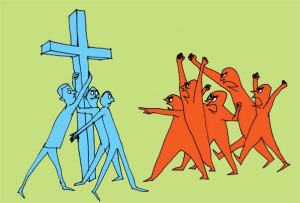
Being Christian in a Hostile World

Dear Folks,

Matthew chapter 10 deals with the challenge of being Christian in a world hostile to Christianity. I have read that North Korea, Somalia, Yemen, Eritrea, Libya, Nigeria, Pakistan, Iran, Afghanistan, Sudan, and India are the most dangerous places just to be Christian. We need to pray for them.

In Europe and North America, it is not so dangerous just to be known as a Christian, but sometimes people get attacked for standing by Christian beliefs that are not popular. Those who hold to Christianity in general and Catholicism; in particular beliefs about the sanctity of life, sexuality, and family may get attacked verbally, have their property vandalized, and their careers be destroyed. Some people who are hypersensitive about how others talk

about things they hold dear will degrade and ridicule things precious to Christians and brush off any concerns. This leads to the question of where it will go from here.

Jesus said, “Behold, I am sending you like sheep in the midst of wolves; so be shrewd (wise, prudent, clever, cunning, crafty) as serpents and simple (innocent) as doves (Matthew 10:16).” I hold on to that verse tightly. We don’t know what the future will bring,

but there are some things we can do to prepare.

1. Know our story. One of the reasons so many are against the faith is that when they were told about it, it was told very poorly. There is a YouTube video “Bishop Barron on ‘Dumbed Down” Catholicism” https://www.youtube.com/watch?v=vZkPH1rOAG0 in which he speaks about Catholics being taught on a level far below the level of other subjects. There are some prominent Catholics who fiercely and aggressively oppose some aspects of Catholic teaching and

speak boldly about how devout they are.

2. Deepen the roots in our relationship with Jesus. We are not going to win this by our own power.

3. Practice choosing the Kingdom over the world. Prayer, fasting and almsgiving are all ways to choose the Kingdom over the world, and we can look at the practical decisions we make in life.

Not every Christian is called to be martyred for the faith, but every Christian is called to be ready to be martyred for the faith, and it starts with small decisions. “The person who is trustworthy in very small matters is also trustworthy in great ones; and the person who is dishonest in very small matters is also dishonest in great ones. What in our day-to-day decisions says that we are ready (or getting ready) to choose the kingdom over the world?

Bishop Barron also did a YouTube video “Why Modern Men Look Elsewhere for Spiritual Wisdom” https://www.youtube.com/watch?v=avROODXQlhE and he basically concluded that we have made Christianity too easy and convenient. The Gospel is meant to push us to greatness, and that can’t be done if you

shave off the difficult parts in the name of making it friendlier. If we read the Gospels and take them seriously, there can be no doubt that Jesus calls us to be willing to give our lives in one way or another, to be willing to suffer, to follow whatever the cost. We don’t know what will be asked of us tomorrow. How will we answer?

Blessings,

Fr. Jim

The Harvest is Abundant

Dear Folks

There are two essential thoughts in our Scriptures this Sunday: that God has given us many great gifts, and the harvest is abundant; laborers are few.

There are a number of sad conversations going on now. Churches are closing. Churches that used to have one or two priests are now sharing priests. Many churches can do less than they used to. Many are struggling.

Many people feel helpless. We are not helpless. God has given us many gifts, and there is so much we can do to make our churches thrive.

What if God is testing us, to see how we will respond to this challenge. To make church happen requires the participation of a lot of people. The question is, how many will respond

to this call? There are some who prioritize participation in the church, helping to make good things happen. The question is how many of our people are willing to do that? How many Catholics see themselves as customers and how many see themselves as coworkers in mission?

If a parish is truly building disciples, it will be common for people to see themselves as sharing responsibility for making church happen, and eagerly respond to God’s call. If people see that responding to God’s call is central to life, that the work of the Church is a huge part of responding to God’s call, and that their participation makes a difference, then a parish can thrive.

Trying to do good things in the Church can be frustrating, and I know that as well as anyone. That is part of the challenge. When we are faithful in the midst of obstacles (including annoying and infuriating obstacles), God uses those occasions to deepen our

commitment and our holiness. We are called to work with the Church we have, with all its flaws. That is part of discipleship.

As for more priests, we all have a role to play. I would suggest that if a young man grows up surrounded by adults (he sees more than his parents) who are zealously dedicated to growing in holiness, deeply in love with the Eucharist, ravenously hungry to learn more

about the faith, and energetic is supporting the mission of the Church, we will have to build a fence around the seminary to keep it from being overrun with applicants.

Part of this is helping direct people’s energy. Many do not read my bulletin articles (sigh), and so how others spread the vision is key. When people express complaints about the state of things or worry about the future, it is important to direct the conversation towards action that can help, even incrementally. Enough drops of water make an ocean.

The harvest is abundant. How many laborers will we have? Our future can be glorious.

Blessings,

Fr. Jim

Eucharist: Looking Beyond Appearances

Dear Folks,

The is the Feast of the Most Holy Body and Blood of Christ. You have heard a good deal (I hope) about the Eucharistic revival. We have heard about the majority of those who call

themselves Catholic who don’t believe in the Church’s teaching on the Real Presence. I consider this to be a part of a larger problem of so many Catholics being led to believe that the Catholic faith is much, much less than it really is. Given that, it should not surprise us that so many people stop going to church. Without much profound reason to come, a bad experience or just apathy can trigger a departure. I would suggest a lack of Catholic belief in the Eucharist has three causes: casual practice, careless talk, and mushy teaching. Many of us are trying to build a greater sense of reverence in our practice and how we talk about the mysteries, and today I want to address what we are taught.

Many people’s formation so emphasized Mass as our family meal, there was not much talk about what made it different from other meals, and how it is so much, much more than a meal.

Some of our Evangelical brothers and sisters say that we are mistaken in our belief and claim that Jesus was speaking metaphorically when He spoke of eating His body and drinking His

blood. They point to other times that Jesus used metaphors and say that this teaching follows that pattern. Since most Catholics (including priests) are not prepared to respond, that is often the

last word on the subject, and the skeptics feel confirmed, and the Catholics feel insecure. It is time for that to end. We can look closer at the Biblical text (something I’m always in favor of) and see how Jesus’ talk about the Eucharist is very, very different from His use of metaphors.

When Jesus used metaphors, they were in line with the Old Testament imagery. “I am the good shepherd (John 10; see Ezekiel 34 and also Psalm 95). “Rivers of living water (John 4; John 7;

Ezekiel 47; Psalm 1; Jeremiah 17).” “I am the vine; you are the branches (John 15:1-10; Isaiah 5).” By Contrast, the metaphor of eating someone’s flesh in the Old Testament is not about

believing in someone but conquering and destroying them. “When evildoers come at me to devour my flesh, these my enemies and foes stumble and fall (Psalm 27:2; see also Zechariah 9:15 and Ezekiel 39:17-20).” Jesus built His teaching on the Old Testament; he did not toss it out and start from scratch. Foreshadowing of the Eucharist can be found in the manna in the desert and the eating of the Passover lamb, and these are not metaphors but realities that meant life or death.

When there was confusion about Jesus’ figures of speech, either He or the Gospel writer would clarify. “Lazarus is dead (John 11:14).” “He was speaking of the temple of His body (John 2:21).” When Jesus speaks of giving living water (John 4 and John 7) it is clarified that “He said this in reference to the Spirit that those who came to believe in him were to receive (John 7:39a).”

Jesus never said, “I am this vine” or “I am this door” but He did say, “this is my Body” while holding it is His hands “Matt 26:26-28; Mark 14: 22-24; Luke 22:19-20; 1 Corinthians 11:24- 25).

None of the instances’ of Jesus metaphors lead to most of His followers who believed in Him walking away and not coming back (John 6:66). There is no parallel of disciples walking away

saying “This nut thinks he’s a sheepgate.”

The Bread of life discourse in John 6 bears closer examination. The guts of the talk is in two sections vv. 35-47 and vv. 48-58. The first emphasizes belief, and if that were all there was, I would say a case could be made that “I am the bread of life, whoever comes to me shall not hunger, and whoever believes in me shall not thirst (v. 35)” is a metaphor for believing in Jesus. The second section, however, responds to their skepticism by doubling down, and does not talk about belief but eating His flesh and drinking His blood (the blood came out of nowhere). He says, “My flesh is true food, and my blood is true drink.” (These two sections echo the liturgy of the Word and the liturgy of the Eucharist.). If one is still skeptical, I would ask, what could Jesus have said that would convince you that He really meant it?

It really is the Body and Blood of Jesus, as Bishop Barron teaches, not in “a reductive physicalist sense (we’re not talking about a piece of meat here)” but a more Jewish framework, in which the flesh and the blood are the person (hence Catholic teaching that every particle of the Eucharist is the complete Jesus, body, blood, soul, and divinity). We, of course, remember that Jesus is Jewish and not Greek.

Given how unique this teaching is, the price Jesus paid is losing most of His followers, and how it is referred to in all four Gospels and Paul, how important was it to Jesus? How important was it to the early Church? How seriously should we take it? What should our response be?

Blessings,

Fr. Jim

Holy Spirit bringing Peace

Dear Folks,

This is Pentecost! Along with Easter and Christmas, it is one of the three biggest days of the year, but is often neglected. It is the great feast of the Holy Spirit and the birthday of the Catholic

Church. If Pentecost was in A.D. 33, as many scholars believe it is, then this is the 1990th birthday of the Church (we should be planning for a really big monster of a party in ten years, when it turns 2000. I’ve suggested to some of our school kids that an interesting math problem would be: how much cake do you need to hold all those candles?).

We start with Genesis 11:1-11, the story of the Tower of Babel. It is a story of sin dividing people with confused language as they try to attain heaven on their terms rather than receiving the gifts that God wants to give them. Acts 2:1-11 is the story of Pentecost, which is God undoing the effects of Babel, enabling people of different languages to understand each other.

The Holy Spirit communicates the fruit of the Pascal Mystery that undoes the power of sin. He also formed the disciples into the Church. Without losing our individuality, we become parts of

one another, as parts of a body (1 Corinthians 12 and Romans 12) and become more fully alive, as we have no trouble seeing ourselves as a higher form of life than amebae (and see John

10:10).

In the Gospel of John, Jesus speaks of living water (John 4:4-16 and 7:37-39), and it is explained that this refers to the gift of the Holy Spirit, who would only be sent after Jesus was glorified.

This image is brought to fullness in Revelation 21:1-2, in which we see the Trinity together: God (the Father) and the Lamb (Jesus) are on the throne, and from the throne flows life-giving water

(the Holy Spirit).

The Holy Spirit saves us from “the works of the flesh.” “In contrast, the fruit of the Spirit is love, joy, peace, patience, kindness, generosity, faithfulness, gentleness, self-control (Galatians 5:22-

23a, but it’s worthwhile reading vv. 16-26). Jesus said, “By their fruits you will know them (Matt 7:16).” I don’t know about farming, but I figure the measure of success for a farmer is less

about how much he sweats, and more about what crops are produced. If we want some sense if we are growing as disciples, are we growing in these qualities? What signs are there in our

behavior that we are showing fruit? Many judge a worship service by how the “experience” made them “feel.” Better questions might be, “Did it help me focus on God rather than myself?” and “Afterwards, did I exhibit more fruit of the Holy Spirit in my

behavior?” Obviously, this is not just the work of the worship leaders, but also how the individuals give themselves to participate, both internally and externally. A useful thing to do would be to review the gifts of the Holy Spirit, and ask ourselves, “what behaviors are we growing in that show the Spirit bearing fruit?” Another good thing to do is pray for the Holy Spirit:

Come, Holy Spirit, fill the hearts of your faithful and kindle in them the fire of your love. Send forth your Spirit and they shall be created, and you shall renew the face of the earth.

Let us pray.

O God, who have taught the hearts of the faithful by the light of the Holy Spirit, grant that in the same Spirit we may be truly wise and ever rejoice in his consolation.

Through Christ our Lord. Amen.

This is Pentecost! Let us Celebrate!

Blessings,

Healthier Brain, More Peaceful World

Dear Folks,

In discussions about making this a less violent world, the subject of mental health comes up. Then it usually vanishes, and people move on. Partly, I think people get uncomfortable dealing with this subject, as if it is somehow shameful. We need to get over this. The brain is an organ and gets sick like any other organ. I would also think it is a big issue without a simple solution, and we like quick and simple solutions. How can we keep the conversation going?

How can we have some fruitful discussion about our mental health system, and how does our system need restructuring? What resources would be needed for some good outcomes? People who know more than I do need to be pushing these questions.

Of course, just as we know that heart health is not just a matter of thoracic surgeons, cardiologists and statins, but also fruits, vegetables, and exercise, so we recognize that mental health is not just about the mental health professionals, but healthy practices. As we think about how people are taught to brush and floss their teeth, and how we are taught nutrition principles, should we not be trying to develop some more common mental hygiene practices?

My training in psychology is pretty rudimentary, but there are some places to start.

One place is in relationships. So many are lonely now. So many describe the pain of toxic relationships. Can we talk about what makes a healthy relationship, and how to form them?

Another place is how we react to events in our lives and how we weave them into a narrative.

What meaning we can find in our good experiences and bad experiences? Viktor Flankl, in his wonderful book, “Man’s Search for Meaning,” talks about the human response to suffering. As a Psychiatrist and a survivor of Nazi concentration camps, he has a special authority to talk. He said that people who are more resilient in horrible situations are people who find meaning in them.

Many today do not have a strong enough vision of life to help them find meaning in bad situations. Many would agree with Macbeth: “Life’s but a walking shadow, a poor player that struts and frets his hour upon the stage and then is heard no more: it is a tale told by an idiot, full of sound and fury, signifying nothing (Macbeth Act 5 Scene 5).” Or, as Monty Python said so eloquently, “Is life just a game where we make up the rules as we’re looking for something to say? Or are we just really spiraling coils of self-replicating D.N.A.?” Not a strong vision to give you hope when life gets really hard, and our hearts get broken.

This is a good time to talk about Christianity. A relationship with Jesus and discipleship in the Gospel is the most powerful approach I’ve found, not only to find meaning in suffering, but even power in suffering. We see our lives woven into a larger story of salvation, and that casts a different light on everything, the bad and the good. Many who go to church, and many who have wandered away from church, have not found that to be the case. I would suggest that many have been taught an enfeebled, mush version of Christianity that is has no power to transform lives. It is for those who take Jesus seriously to help others find what Jesus is really about. As Peter Kreeft said in “Jesus Shock”: “If you think Jesus is boring you have the wrong Jesus.” The better we know Jesus, the better we can share Jesus. If you want a better world, the best first step is always to fall more deeply in love with Jesus.

Blessings,

Fr. Jim

Build a Better World

Dear Folks,

Talking about developing a less violent world, I think we need to look at the power of personal agency. So often, it can feel like what we do doesn’t make much difference in the larger world. It is a terrible feeling to think that the world and other people can make marks on us quite easily, but there is nothing we can do to make our mark on the world. This is a feeling I lived with for a lot of years, and it can lead to desperation. If we can help people learn better to channel that energy, that can lead to lead to more productive activity and less desperation.

This can involve developing a vision. If things are not good as they are now, what improvement do we want? It is good to be specific. Then we need a path between here and there.

We need to learn skills: learn to make a case for what we think should happen and making it effectively, both for the goal and the way to get there. Just because it seems painfully obvious to us doesn’t mean it will be obvious to others, in fact, we can count on someone thinking it is completely wrong, and that can be frustrating. Seeing things from others’ point of view is a good first step. We need to recognize that if people do change the way they think, it can be a slow process, and we need patience. I find however much patience I think I’ve learned God seems to think I need more. If we get attention, it needs to be in a way that helps people see things from our point of view.

We can cultivate more realistic expectations. This can keep people from giving up when things take a long time and get difficult. I don’t know much about farming, but I think people take for granted that when they plant seeds, it will take months for the crop to be ready. On the other hand, if I put coffee in the microwave and it takes months for the coffee to get hot, I’m throwing that microwave away. Making profound, meaningful changes in society is long, slow work, often spanning generations. Getting people to change the way they think takes time, especially when ideas are deeply rooted and intertwined with their basic world view. I suggest lower expectations short term, higher expectations long term. Before we try to justify quick and dirty tactics, remember the other side might use them too, and they tend not to win people over.

Boundaries are essential! Just because we have good intentions does not mean our behavior is justified. We as a society need to reject excusing people’s bad behavior because we think it is for a good cause (remember, everyone thinks they have a good cause). If protesters behave badly, it hurts the credibility of their cause. Jesus said, “Behold, I send you forth as sheep in the midst of wolves. Be as clever as serpents and innocent as doves (Matt 10:16).”

We must support those who help make it a less violent world. This starts with law enforcement. We need to recognize the great risks and sacrifices that they make, and how much we depend on them. We need to remember many of the decisions, especially shoot/don’t shoot situations, must be made in a fraction of a second, and if they get it wrong, they often die. They want to go home at the end of their shift like everyone else. Yes, we need to get rid of bad actors, but when there is an incident, we need to give the officer the same benefit of the doubt that we would want for ourselves. When people commit a crime, there should be quick and consistent consequences as much as possible. Lax or selective enforcement encourages more crime.

Let’s not disparage thoughts and prayers. Yes, they are not a substitute for action, but action can follow from focusing our hearts. We can always invite people to action, and this is an opportunity to make our case.

Blessings, Fr. Jim

Families Building Civilization

Dear Folks,

If we are serious about building a less violent world, we need to take a look at fatherless families. According to everything I’ve read (see fatherhood.org for some data), children who grow up without their fathers are significantly more likely to live in poverty, have

behavioral problems, become drug addicts, commit crimes, and many other things. I’ve been told that boys learn from their fathers how to be men and how to treat women, while daughters learn from their fathers what to expect from men.

There are many single parent families that are doing great things, and there are some fathers that are not doing a good job, but it can still be true that encouraging families with both the father and mother present and engaged can build a better world.

Someone told me that her observation was that some parents see their children more as accessories than as their central life vocation. Such parents drop off their kids at school, and maybe at church, and act as the primary teachers of their children. However, many parents are taking their responsibility very seriously and see themselves as the first mentors, protectors, and advocates for their children. How can we help and encourage them?

I’ve heard some voices that suggested that parents shouldn’t have a say in (or even know) what their children are getting taught because they weren’t trained like teachers are. However, I’ve heard some teachers saying please, please, please would parents be

more involved in their children’s education. How can we help and encourage them?

For many years it was clique that in movies and TV shows the father of the family was either a doofus or a jerk, and everyone knew better than him. How might that have helped form the notion that fathers were not that important to have around. I’ve been told by a

number of sources that the way the welfare system is structured, it is actually encouraging the mother to raise children without the presence of the father. If that is true, how can that be changed? How can it be structured to encourage active presence and participation of both parents? I have been told it will never be changed because keeping people poor and dependent is big business. I figure systematic change can only happen when enough people rise up and decide not to stand for it. I don’t know where to start, but I refuse to believe it is impossible.

It has been said that “Love is love.” It is a true statement, but not all love relationships are the same. The relationship between husband and wife is different from father and son, from mother and daughter, between cousins, between brothers, between brother and sister, between two good friends, and so on. Each has a different nature, makes a different contribution to society, and is expressed differently. I would suggest that the relationship

between a man and a woman, committed to a permanent exclusive relationship of love that is ordered toward the generation and nurturing of children makes a unique contribution. If

that is true, how can society privilege this relationship, encourage it, strengthen it, and value it? Our future, and our hope for a better world, may depend on it.

Blessings,

Fr. Jim

Want a Better World? Start with “what does ‘better’ mean?

Dear Folks,

This is the second of a series of articles on building a less violent world. If we want a better world, we need to have an idea of what “better” means. You may think this is obvious, but I challenge you to think again. What seems obviously true to me might seem obviously false to someone else.

The book “Why Johnny Can’t Tell Right from Wrong” by William Kilpatrick tells of values clarification in some school programs, where they teach children to form their own value system. He mentioned how shocked teachers were by the value systems they came up with.

“The Abolition of Man” by C. S. Lewis describes how, back in the 1940’s, people were already working to deconstruct our value system without considering the results (“They laugh at honor

and are shocked to find traitors in their midst”). Since then things have gotten stranger.

Imagine a society where most people have a fuzzy, undefined, inconsistent view of right and wrong, and when something happens that feels wrong to them, they scream, and if they can get

enough people to scream with them, they can dominate the conversation. Now stop imagining, because I think we have arrived. Why are we surprised that such a society has so much violence? If people excuse violence when they are sympathetic to the cause, why should they be surprised that people will use violence on the other side? If we believe in standards of behavior, it needs to be consistent with our allies and our opponents. It is easy to call out our opponents; it is more important to call out our allies and remind them they are hurting the cause.

When we disagree and are angry, we need to reject violence. We need to reject name calling. If we need to avoid reading people’s hearts, and saying because they disagree with us, they don’t

care about goodness. If we are frustrated that they reject our position, we need to make a better case for our position. We may think we’ve made a good enough case to convince any

reasonable person, but they clearly don’t think so. We can insult the other people, or we can make a better case. We need to do things that will move the conversation forward.

So often we see people talking past each other. When I see someone saying, “I long for a country where people love their children more than their guns.” I know that moves us away

from anything constructive. The very people they most want to convince are going to read that and say, “they have not even tried to understand our point of view. We need guns to protect our

children.” On the other hand, simply posting, “What part of ‘shall not be infringed’ don’t you understand?” is not going to help. It reinforces their opponents’ belief that they don’t care about

stopping violence. Wouldn’t it be so much more helpful to make a better case, that our proposed solution would actually make things better. Once again, it may seem obvious to us, but the opposite might be obvious to other intelligent people of good will. Our reasoning seems to us to be more reasonable, but we all have an unconscious thumb on the scale pushing us in that

direction. It will take much patient, persistent work to develop common messages about behaviors that build a better society.

Imagine a society where parents, teachers, entertainers, political leaders, and church leaders all reinforced a common message to reject violence and destruction to make our points, to build

constructive and respectful dialog, to value growing in virtue over gratifying desire, to value problem solving over complaining, and to respect the law and law enforcement? Would that be

a less violent society?

Blessings,

Fr. Jim