
Tag Archives: religion

Weaving Together Our Picture of Reality

Dear Folks,

We all take in bits of information and weave them into a story that makes sense to us. Sometimes we can take the same set of information and come up with different narratives, and that

can make all the difference. I notice Democrats and Republicans can look at the same event and come up with wildly different narratives about what happened. It would be funny if it weren’t so serious.

At some of the Masses this Sunday, we are doing the cycle C readings, including the story of the prodigal son (Luke 15). Where we are doing scrutinies, we are using the cycle A readings with

the story of the man born blind (John 9). I suggest it would be a good exercise to look at those stories and ask, at each point what narrative is each character believing about what is happening?

Stepping back, there are different narratives about fundamental reality.

One is the atheist materialist view. The universe is self-existing, though it seems to be made entirely of contingent beings. The ultimate reality is impersonal, and personhood and consciousness are blips in the interplay of matter and energy. Love, in this view, is just a byproduct of the drive for chromosomes to replicate themselves. Moral right and wrong do not exist, and the only value is making me feel good. When I die, I will cease to exist, and it will not matter what I believed or what I did.

The Christian view is that the ultimate reality is love in the deepest sense. The Father is eternally giving Himself in love to the Son, who is eternally receiving and returning that love to the Father, and the Holy Spirit is the love that passes between them. God is not one contingent being among many, but Being Himself, the source of all being. Love is by nature fruitful, and so God, though not needing anyone or anything, created the universe out of pure love. We were made to receive and give ourselves in love, and hence are made in the image and likeness of God. There is goodness, which is what serves giving ourselves in love, and there is evil, which is counterfeiting giving ourselves in love or refusing the invite all together. The things of the world pass away, but that which is love lasts forever.

One might object that that many atheists do much good and many Christians are less than moral. This, I suggest, is because we do not always act consistently with our professed beliefs.

There is one more narrative that I find interesting, and that is the Boltzmann brain theory. Ludwig Boltzmann was a physicist, who proposed that if a universe produced a self-aware brain, it

was more likely to produce one brain that hallucinated experiences than produce many brains that have real experiences. That means I am the only one who really exists, and you are all a figment of my imagination. There was once a Dilbert comic strip about this. I reject this theory, fun though it is, because it makes life trivial, and goes against my deep sense that life, the universe and everything have deep meaning. I reject the atheist, materialist view for similar reasons. We have a deep sense that personhood, consciousness, and love mean more than blips in the motion of matter and energy as the mindless universe unfolds. That’s my story and I’m

sticking to it.

Blessings,

Fr. Jim
Catholic Truth

Dear Folks,

How to think about people who seek God but are not Catholic? First, there is the question of Christians who are not Catholic, and the Second Vatican Council’s Decree on Ecumenism (Unitatis redintegratio) talks about our relationship with them. Second, there are nonChristian religions and Vatican II deals with that in Declaration on the relations of the Church to non-Christian Religions (Nostra aetate). They are both worth a read.

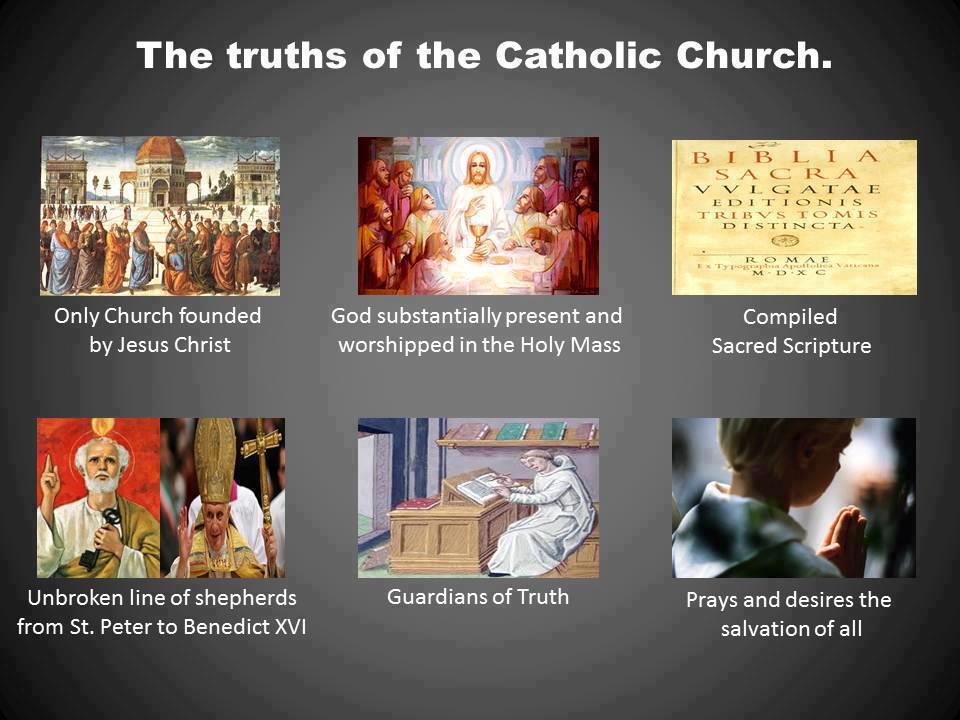
The Catholic faith is the fullness of truth about Jesus, but there is much that is true that our Protestant brothers and sisters teach, and some things that are true as taught by other religions. God gives everyone the light of natural reason, and so it is not surprising that some true things are taught by groups like Hindus, Buddhists, and Muslims. Christians and Jews have received special revelation in addition, and it is completed by the Jesus event.

All who are saved, all who get to heaven, do so by the power of the Sacrifice of Jesus, whether they understand it explicitly or not. “And this is the verdict, that the light came into the world, but people preferred darkness to light, because their works were evil (John

3:19).” Our salvation is God’s work, not ours. Those who understand who Jesus is and what He is about and choose not to follow Him will be condemned. Those who had not heard about Him, or were taught the Gospel so badly that they could not recognize Him as

the light are another story (and I suggest that latter group is huge). That said, we must not get complacent. We don’t get to sit back and relax. If you read the Gospels (which I highly recommend!) and take them seriously (which I very highly recommend!!) we are warned that we don’t just coast into heaven (See, for example Matt 5:29-30; 7:13-14; 1 Corinthians 9:27).

Jesus wanted His people to be one (John 17:22). I think Satan laughs himself silly every day that Christians are divided and teaching contradictory things. We speak of God’s ordaining will, and God’s permissive will. His ordaining will is that everything and everyone be all good, but He permits us to do evil, and He will bring good from it.

Other religions can be a gift in certain ways: they can help people whom we have not yet reached (though we need to get on that); they provide a challenge for us to better witness to the goodness, beauty and truth of the faith (easy to get complacent when everyone agrees); they can remind us of aspects of our faith that perhaps we have been neglecting.

For example, a few generations back, people told me the Catholic Church did not encourage them to read the Bible. Our Protestant brothers and sisters reminded us of the importance and benefits of reading and being familiar with the Scriptures (and, if you look at

Church documents and history, it is a strong part of the Catholic faith).

Having all of these gifts of the Catholic Church is not a privilege that occasions pride, but a responsibility. “Much will be required of a person entrusted with much, and still more will be demanded of the person entrusted with more (Luke 12:48).” Think of all the gifts

we have been given. What will God expect from us?

Blessings,

Fr. Jim

Seeds of Change

Dear Folks,

Today in Mark 4:26-34 we hear the parable of the seed that grows mysteriously without us knowing how (unique to the Gospel of Mark). This points to a major paradox in Christianity: We are called to effort, but it is God who accomplishes things.

We do not bring about the kingdom of God. We are called to work for a better world but God is the One who makes the kingdom happen.

People like Hitler, Stalin, and Mao thought they could build an ideal society by their own wisdom and skill. They wound up doing horribly evil things because they were sure it served this great vision, but they failed to produce the result. Instead, they left the people in misery. If God brings about the kingdom, we know our part is smaller, so we are not important enough to think we can decide that killing millions of innocent people is within our scope. We know if we obey God, great things will happen, even if we don’t live to see them (John 4:37-38).

This also means that in spite of how much of a mess the world is in, and how small our abilities are in comparison, we can face the world boldly We can be bolder in our aspirations and at the same time more humble in how we seek them.

Perhaps the two most influential people I can think of in the last thousand years were St. Francis of Assisi and St. Theresa of Calcutta (Mother Theresa). They dedicated themselves to service, sacrifice, caring for the sick and proclaiming the truth. They had no political

power. They were willing to do the humblest jobs. They both suffered from great inner darkness but saw much joy and beauty in God’s creation. They focused more on their own sins than the sins of others (Matthew 7:4-5). St. Francis saw his order change his rule, and he couldn’t stop them. His order has thousands of people all over the world, and his example has inspired and influenced countless people, including non-Catholics, including nonChristians. Does anyone doubt that the same will be said of Mother Theresa a thousand years from now?

We are called to action, but God will make things happen. We can do small things, but if they are done with love, they can, over time, have great effects. Do not get discouraged by anything.

Blessings,

Fr. Jim

Love and Baloney

Baloney.jpg[1]

Love and Baloney

Imagine a young man and a young woman.  They have very little money, but he goes out into the fields and collects some flowers.  He makes them baloney sandwiches and puts them in a paper bag.  He spreads out the picnic on newspaper, and says to her, “I love you more than the sun, the moon, the stars, brook trout and the Green Bay Packers. Will you be with me for the rest of our lives?”  She melts.

Now, it is their fiftieth anniversary.  Even though they live in an upscale condo in the center of a large city, he drives to the country and picks wild flowers.  He makes baloney sandwiches, and puts them in a paper bag.  He spreads newspaper on the table, and says to her, “I love you more than the sun, the moon, the stars, brook trout and the Green Bay Packers. Will you be with me for the rest of our lives?”  She melts.

Someone who didn’t know the history might say to him, “Are you crazy? Your fiftieth anniversary, you could easily afford roses and catering, and you do this?”  It is the connection to the history of the relationship that gives it meaning that it would not otherwyse have. In relationships, rituals, signs and symbols can have a power beyond what they are because of what they mean. (I suspect he also took her out to a nice restaurant, but that is another story.)

In religion, there are a lot of signs, symbols and rituals. Many who don’t know their meaning will disparage them and say they have nothing to do with God.  Many times they are practiced by those who don’t know or don’t care about their meaning, and then they fail in their purpose, and can even do harm (see I Corinthians 11).

There are many who say that a personal relationship with God is something separate from religion, and that they love God but have no use for religion.  I suggest that they either do not understand how ritual, structure, sign and symbol can be a key part of a relationship, have never been taught the meaning of these activities, or experienced people who went through the motions without attending to what they meant.  A kiss is meant to be a sign of affection and caring.  If someone gives you a kiss and then treats you like garbage, that sign is worse than useless.  It even does harm.

Many have left the Catholic Church or are minimally connected because they have not experienced it as a powerful encounter with the love of God. However, if they could only understand that every aspect of the Catholic faith is about encountering, walking with, and loving God.

A next step is with the book A Biblical Walk through the Mass by Dr. Edward Sri, or even his video study program:

http://ascensionpress.com/t/category/study-programs/the-mass/biblical-walk-through-the-mass

And that’s no baloney.

Unholy Holes

Hole.jpg[1]

Many years ago, I heard the story of a beautiful summer day in a downtown, when a truck pulls up to the side of the road. Two guys get out and dig a hole. Then two other guys get out and fill in the hole.  They get back in the truck and drive forward twenty feet.  The first two guys get out and dig a hole, and then the second two guys fill in the hole.  This goes on for a while. Finally, people ask, “What is going on?” They said, “We work for the city. The guy who plants the trees is sick today.”

You can have a lot of activity without accomplishing your primary purpose.  This leads to a key question for Church work: Are we fulfilling our primary purpose?  Having a lot of good activities does not, in itself, answer the question. Of course, to do that it would help to know what that purpose is.

I have asked a number of practicing Catholics “What is religion?”  Many have a hard time coming up with an answer.  Some say it is a belief.  Some say it is a set of practices. Is that all it is?

I suggest that religion at its core is a love relationship with the God who loves us very much.  Everything is about that.  A love relationship is different from anything else that is, and nothing can substitute for it. A collection of beliefs and tasks is much, much less than an all-transforming love relationship.

Some people have told me that their relationship with God is one thing, and their religion is something else.  But then what is religion?  If it is not our relationship with God, then why do it?  If we do it to please God, to express our love, devotion and obedience to Him, to encounter Him, then is it not our relationship with God? There may be aspects of our relationship with God that are informal and don’t directly involve Church, but I suggest that in religion there is love relationship with God, and there is nothing else.

According to Sherry Weddell’s Forming Intentional Disciples, only 60% of Catholics believe in a personal God at all, and most Catholics are not certain that they can have a personal relationship with God. If so few Catholics understand what I had thought was the most basic of truths about the faith, then how well have we been communicating the faith?

If we are bringing people into the Church and getting them involved in activities, that is good. But if we are not leading them to an all –transforming love relationship with God, then I suggest that we are not fulfilling our central function. Our tree planting guy is sick.

According to Forming Intentional Disciples, only 30% of those raised Catholic in America are currently coming to Mass once a month or more.  Maybe people have stopped coming because they have not found the Church to bring them to a love relationship with God. In any case, these numbers suggest to me that we need a serious re-examination of how we look at Church and how we do Church. What do you think?