Category Archives: Catholic

Peter Reconciled

peterdoyoulove

Dear Folks,

As we continue to celebrate Easter, we look at the resurrection accounts in the Gospels. This Sunday we look at the Gospel of John, and Jesus appearing to His disciples. As we join the story (John 20:19-31), Peter and the beloved disciple (generally believed to be John) had seen the empty tomb, and the risen Jesus had a very nice chit chat with Mary Magdalen. The disciples are in a locked room, cowering in fear, but He appears to them and says, “Peace be with you.” Clearly, no lock-down can keep Jesus out now.  His greeting of peace is important for several reasons. Since they didn’t do such a hot job on Good Friday, they would naturally wonder if Jesus was going to be mad at them, and perhaps give them a serious smiting.  Jesus is here to bring peace. This seems very much like what He would do, but we need to consider something He had said earlier, “Do not think that I have come to bring peace upon the earth. I have come to bring not peace but the sword.  For I have come to set a man against his father, a daughter against her mother, and a daughter-in-law against her mother-in-law; and one’s enemies will be those of his household (Matthew 10:34-36).”  So what are we to make of that?

I would suggest that real peace comes from facing division and healing it, rather than covering it over.  That sometimes means that an absence of visible conflict may just mean that there is a problem, but it is kept hidden and not acknowledged. In the Gospels, refusal to recognize one’s sinfulness is a very serious thing.  We remember at the end of the story of the man born blind: “Some of the Pharisees who were with him heard this and said to him, “Surely, we are not also blind, are we?’ Jesus said to them, ‘If you were blind, you would have no sin; but now you are saying, “We see,” so your sin remains.’ (John 9:40-41).” We also remember the parable of the Pharisee and the tax collector (Luke 18:9-14). The Pharisee did lots of good stuff, but because of that, he didn’t see a need to change, or even acknowledge his sinfulness. The tax collector had probably committed a lot more sins, but recognized his sinfulness and was repenting an on the road to doing better.  He came out justified but the Pharisee did not.  It’s okay to be where we are, but it’s not okay to stay where we are.

Looking at John 21, we see Jesus and Peter having an important conversation. They have had breakfast, and are sitting by a charcoal fire.  This reminds us that on Good Friday, Peter was standing next to a charcoal fire to keep warm when he denied Jesus (John 18:18 and 18:25) We are taught that the sense of smell is the most powerful sense for evoking emotional memories, so imagine Peter, his mind right back there to his moment of failure.  Jesus asks three times, “Do you love me?” and counterpoint to Peter’s threefold denial.  We notice Jesus didn’t need to rub his face in it (“Gee, Peter, remember when you said you would lay down your life for me and I told you…”). Peter knows, and Jesus knows he knows.  Jesus is not looking to prolong the hurt, but to bring reconciliation.  He had to recognize where he was, but didn’t need to spend time wallowing in guilt. He would need that energy for doing the work that Jesus was giving him to do.  That was where his focus needed to be.  A surgeon must cut in order to do good, but tries to cut as little as possible and do the most amount of good.

Jesus brings the gift of peace.  We will not know its fullness until the end of our journey (1Peter 1:3-9), but we can get a taste of it when we encounter Jesus. We all are sinners, and we all suffer from others sins.  We can look from that pain and say, “Jesus, you can make me whole; you can bring me to peace.” We can live in hope for the complete peace of heaven, and strive for peace now. “Blessed are the peacemakers, for theirs is the kingdom of heaven (Matthew 5:9).”

Blessings, joy and peace,

Fr. Jim

Something New on Earth

Resurrection

Dear Folks,

Today is Easter and the Lord has risen!  He has risen indeed!

Yes, we are still on lockdown, and we are still dealing with the pandemic, but that cannot stop Easter. We remember what when Jesus rose, the Romans still ruled in Israel, and they were just as nasty as they were before.  We remember the chief priests, the scribes and the Pharisees that Jesus had encountered in the Gospels were just as stubborn as they were before. When the disciples encountered the risen Jesus, he would forgive them for their failures on Good Friday, but they would still have to forgive themselves, and many of us find that the hard part.  They were still facing a very dangerous future, one that would call them to deal with many kinds of suffering and death.

But Jesus had risen.  Because they encountered the risen Jesus, nothing the world could throw at them could defeat them.  No pain or deprivation could kill their joy.

Jesus doesn’t really do much that’s new, but the power of being in His presence is what makes the difference.  He demonstrates that He is real, and explains that He had to suffer and die. He also sends them on mission.

Brant Pitre in his (excellent) book The Case for Jesus mentions there are three things we know about the resurrected Jesus: He has a body and is not a ghost, that He has the same body (still has wounds, but they seem not to hurt), and that it is a transformed body.  It is clear that He is not just like He was before, but has become something more. In 1Corinthians 15, St. Paul talks about the resurrection of the body, and compares the difference between the earthly and resurrected bodies as being like the difference between the seed and the full grown plant. In any case, He was not just resuscitated like Lazarus, but was (and is) more amazing than they could put into words. This experience was powerful enough to change everything.

It was only when Jesus appeared to them and explained why things happened as they did that they understood, at least somewhat.  He had, of course, explained a good deal before but they didn’t get it. I find that I’m often going through things that make no sense at the time, but later on I can see how God was at work, and how this served a greater purpose. Often things have been explained to me but I still did not understand until later.  The Risen Jesus helped them see the bigger picture.

They were not yet ready to go out to the world and transform it.  They still awaited the coming of the Holy Spirit at Pentecost. Once again, even though Jesus had explained it, I figure they really didn’t have much of an idea what it would be like. Until then, they continued to hide, to keep to themselves, to gather carefully.

We are, of course, immensely frustrated with the current situation, with cancellation of liturgies extended through the end of April. Some people believe that is the wrong decision. Some people believe it is the right decision, but are still ready to tear their hair out.  Whatever happens, two things are absolutely true: First Jesus is risen.  Second, wherever we are at, whatever our circumstances, this is where we are called to serve God.  No power on earth can take either of those away.

We are a people of the resurrection. Let us rejoice and let us answer Jesus’ call.

Blessings,

Fr. Jim

Being Present

Being present to another

One of the key factors in any friendship, in any love relationship, is how we are present to each other. What is it like to have someone give you their full attention, to act like you are important to them, that they are focusing on you? We also know what it is like to have someone act like they are barely aware of you, that their minds are elsewhere, that they are just doing what they need to do to get on to something else. It makes a big difference. And let’s be honest, there might have been some times when we were dealing with someone that we didn’t want to deal with, and we let it show.  How did we act then? When we are with someone who is precious to us, how do we act.

Some moments are more crucial than others.  Sometimes we might be doing different things, but generally aware of the other person, and that is good. Two guys in the same boat fishing, not speaking, not looking at each other, letting their minds drift, but it’s okay. It’s good to be together, but don’t need to do much. If, on the other hand, someone important to you comes and says, “After what has just happened, I’ll never be the same.”  This is not a good time to say, “Go ahead, I can listen and watch TV at the same time.”  A couple can be sitting in the same room, one reading a book, one catching up on the news, but if they are doing that during their wedding, there is a problem. Sometimes people are chattering for the joy of it, and what they talk about is not that important.  Sometimes people are sharing their most precious secrets, thing close to their hearts, and it takes a lot of trust to do that.  Then it is most important to be especially attentive.  To do that poorly with harm the relationship, but to do it well can strengthen the relationship a great deal.

God is always reaching out to us, but very often we don’t respond well. “I was ready to respond to those who did not ask, to be found by those who did not seek me. I said: here I am! Here I am! To a nation that did not invoke my name. I have stretched out my hands all day to a rebellious people, who walk in a way that is not good, following their own designs (Isaiah 65:1-2).”

“After six days Jesus took Peter, James, and John his brother, and led them up a high mountain by themselves. And he was transfigured before them; his face shone like the sun and his clothes became white as light. And behold, Moses and Elijah appeared to them, conversing with him. Then Peter said to Jesus in replay, ‘Lord it is good that we are here. If you wish, I will make three tents here, one for you, one for Moses, and one for Elijah.’ While he was still speaking, behold, a bright cloud cast a shadow over them, then from the cloud came a voice that said, ‘This is my beloved Son, with whom I am well pleased; listen to him.’ When the disciples heard this, they fell prostrate and were very much afraid. But Jesus came and touched them, saying, ‘Rise, and do not be afraid.’ And when the disciples raised their eyes, they saw no one else but Jesus alone (Matthew 17:1-8).” We get a rare moment in which the Father speaks from heaven, and His message is the importance of listening to Jesus.  Of course, these were Jesus’ disciples, and the inner circle of His disciples at that. They probably thought they were already listening, and that this message should be for others (fortunately, they had the sense not to argue).  I would suggest that we often do not listen as well as we think we do.  It is something we can grow in.

During the agony in the garden (Matthew 26:36-46), Jesus brings His closest friends, Peter, James and John, and asks them to keep watch and pray.  They fall asleep. Jesus didn’t need them to do anything except be present and attentive.  He was having a really difficult time, and needed some friends’ support.  I’m sure it hurt that they failed, and it will be remembered until the end of time how they failed.

At the Last Supper, and during the celebration of the Eucharist ever since, Jesus is sharing Himself most intimately, Who He really is, body, blood, soul, divinity. He draws us into His death and resurrection, His ultimate sacrifice of love. During this time in which people are separated from the Mass, we may want to reflect on how we tend to respond to God’s gift. It is almost a universal problem that our minds wander during Mass, but within the limits of our fallen human ability, how do we treat this holiest of moments? How might we grow in our response?


Holy Week

holyweek

Dear Folks,

We begin Holy Week. It is a different Holy Week from anything we have ever celebrated. This week brings all of our faith life into focus, so if there is any time to be connected to our faith, it is this week. Our current lockdown presents a challenge and an opportunity.  The challenge is that it is so hard to connect and so easy to disconnect.  Some are not even looking at calendars, just checking to see if they have milk and bread.  The opportunity is that we can approach it from a different angle than we ever have before, which will enable us to see it with new eyes and get a deeper insight and connection than we had before.
The diocese has given us directions for celebrating the liturgies of Holy Week. We are to celebrate with no more than 10 people gathered (that includes the priest), and only those who have ministries at that liturgy.  We will be attempting to livestream the celebrations for everyone who can watch.

The first thing to recognize is this is unfair. Unfortunately, there has been a lot that has been unfair about this from the beginning. I have been very much aware that I have been able to celebrate Mass and receive Holy Communion every day, while my parishioners have not been able to participate. That has been humbling, and it has given me a great sense of responsibility.  If I am doing this for the whole parish, I’d better be focused and pray hard.  Many have had to grieve for lost events and participation.

As things have been changing week by week, this has made communication a challenge. We are finding the internet more important than ever.  I think when this business is over, we shall be better at using it, and that will be a useful thing.  I think we will also have an increased sense of the importance of being physically present to other people, and how valuable it is to be together (the old-fashioned way). This also makes more serious those who do not have internet access and those who have limited access.  Our dependence on the internet during this time has left a number of people out.  We shall have to find a way to connect to those people as best as we can.

This has been an opportunity to reflect on what is truly important. We see we can do without a lot of things, but there are some that really matter. Many have been experiencing in a new way that the people whom we love and who love us are more precious than we often realize, and many are learning they have been taking them for granted. We have also been getting a better sense on how we are connected, and how we affect one another.

As people have been deprived of Eucharist, this has been a time to consider how precious it is, how amazing it is, how easy it has been to take it for granted. It would be a good time to renew and deepen our understanding of and love for the Eucharist. During this time, watching Presence and Lectio Eucharist on Formed will be very helpful.  As we are getting a reminder of the power of the presence of other people, we can reflect on the power of God being present to us and giving Himself to us in the Blessed Sacrament, as well as how we can be more present to Him and more fully give ourselves to Him. Jesus promises it brings an intimacy with Him beyond our understanding (He said, “Whoever eats my flesh and drinks my blood remains in me and I in him [John 6:56].”) None of us treat this as it deserves to be treated. That is not a criticism; it is a given with our fallen, limited understanding.  Is there anything more worthwhile than growing in this?

As we go through Holy Week, let us notice how this central part of our story pivots around the Last Supper.

Blessings,

Fr. Jim

Being Where We Are

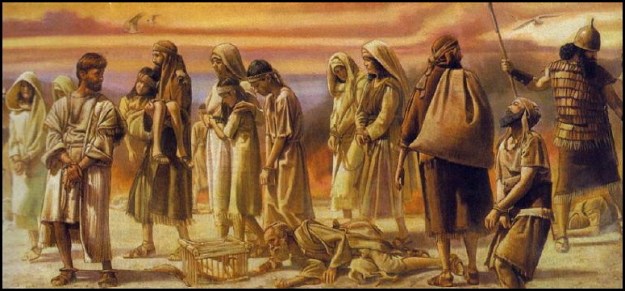
exilesIn 587 BC the people of Judea were taken into exile by the Babylonians. The prophets, who had been berating them for their bad behavior, shifted to be agents of comfort and encouragement.  Isaiah did some really beautiful writing on this (see chapters 40-55, for example “But Zion said, ‘The Lord has forsaken me, my Lord has forgotten me.’ Can a mother forget her infant, be without tenderness for the child of her womb? Even should she forget, I will never forget you [Isaiah 49-14-15]”), but today I want to point to a bit of Jeremiah.  “Thus says the Lord of hosts, the God of Israel, to all the exiles whom I exiled from Jerusalem to Babylon: Build houses and live in them; plant gardens and eat their fruits. Take wives and have sons and daughters; find wives for your sons and give your daughters to husbands, so that they may bear sons and daughters. Increase there; do not decrease. Seek the welfare of the city to which I have exiled you; pray for it to the Lord, for upon its welfare your own depends (Jeremiah 29:4-7)”.
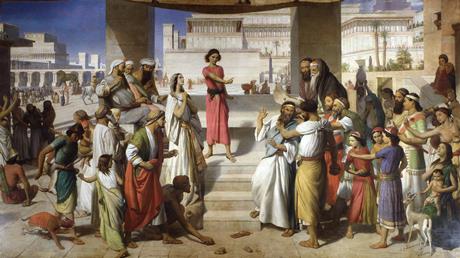
Jeremiah is talking to a people who were going into exile, and going to be there a long time.  There wasn’t a lot of hope that they would ever be a nation again, at least, not hope based on anything in the world. God was challenging them to embrace their situation and not give up but live to the full and be good residents.  They would not see the day they could return, but there would come a time that Israelites would come back and rebuild.  What was essential was that they not give up and not stop being who they were. They were called to be faithful to God in this foreign land, and do the best they can where they were at with what they had to work with.

One of the really hard things was they had no access to the temple, where they would be able to offer sacrifice.  We read in the Book of Daniel (in Catholic editions of the Bible): “For we are reduced, O Lord, beyond any other nation, brought low everywhere in the world this day because of our sins. We have in our day no prince, prophet or leader, no burnt offering, sacrifice, oblation or incense, no place to offer first fruits, to find favor with you. But with contrite heart and humble spirit let us be received; as though it were burnt offerings of rams and bulls, or tens of thousands of fat lambs, So let our sacrifice be in your presence today to find favor with you; for those who trust in you cannot be put to shame. And now we follow you with our whole heart, we fear you and we seek your face. Do not let us be put to shame, but deal with us in your kindness and great mercy (Daniel 3:37-43).”

The book of Daniel as a whole is a good book to read to understand the challenge of being faithful in exile.  Some of the book is what we call apocalyptic writing, like the book of revelation.  It involves visions of strange beasts and lots of numbers.  It is usually written in times of terrible suffering, and seeks to reach beyond our intellect to give us a deep down sense that in the midst of the chaos, God is at work. “Apocalypse” is from the Greek for “removal of the veil” (as “revelation is from the Latin). To veiled eyes, it can look like life makes no sense and is going nowhere. To the clear eyes of faith, we see that God is at work.

There was a TV show called Firefly, and the theme song went: “Take my love, take my land, Take me where I cannot stand. I don’t care, I’m still free, You can’t take the sky from me. Take me out to the black, Tell them I ain’t comin back. Burn the land and boil the sea, You can’t take the sky from me.”

This is where we are called to serve God with all our hearts.  If we keep faith, nothing can take God from us. By God’s grace, we can echo the words of River from Firefly: “No power in the ‘verse can stop me.”

Suzanna

suzanna

Today’s first reading is the story of Suzanna in Daniel 13. This is one of the stories that our Protestant brothers and sisters do not have in their Bibles but call it “apocrypha.” It is the story of a woman of courage and faith and a boy detective who used tree-mendous reasoning.  It teaches that what God knows about us is more important than what people think about us, and warns of being careful about believing everything we are told.

Life

Dear Folks,

This week we read the story of Lazarus and we touch on the central mystery: Life

Our readings (Ezekiel 37:12-14; Psalm 130; Romans 8:8-11; John 11:1-45) talk about God bringing life where life is thought to be impossible.

Jesus came after everyone thought it was too late for Him to do anything.  I find that trials often go on longer than we thought reasonable, and we have a tendency to wonder why God doesn’t act sooner.  Jesus teaches us that the wait is part of something greater happening.

Jesus talks with Martha about Lazarus rising. Martha is thinking of the resurrection at the end. Jesus tell her that new life is now.  If Jesus is at work in us, we are already participating in new life. It is one thing to survive, to be biologically alive.  Jesus tells us there is something greater. Earlier in the Gospel, Jesus says something worth special note, “A thief comes only to steal and slaughter and destroy; I come so that they might have life and have it more abundantly (John 10:10).”

Some people believe that Christianity is about living a diminished, constricted life that is all about Thou Shalt Not’s so that a harsh and judging God will reward us with heaven afterward.  No, no, no!  If that is what they learned they did not learn Christianity. Jesus gives us a more abundant life on earth, and if we accept that life, we are open to the abundant afterlife.  Christianity contends that a materialistic life, a life dedicated to power, pleasure, wealth and fame is a diminished life, and when God says no to something, it’s because that something would interfere with us finding that fullness of life. We read in the Second Vatican Council’s Constitution on the Church in the Modern World: “Indeed, the Lord Jesus, when He prayed to the Father, ‘that all may be one…as we are one” (John 71:21-22) opened up vistas closed to human reason. For He implied a certain likeness between the union of the divine Persons, and in the union of God’s sons in truth and charity. This likeness reveals that man, who is the only creature on earth which God willed for itself, cannot fully find himself except through a sincere gift of himself (Gaudium et Spes #24).”

The essence of the Gospel is the gift of self. The Lord gives Himself to us completely, not even withholding the last drop of His blood. He invites us and enables us to receive Him and give ourselves in return, not that He needs or even could benefit from the gift, but that we might have the fullness of life and joy (see John 17:13). Everything about Christianity, every aspect of our belief and practice, is about receiving that gift from Jesus and giving ourselves to Him in return. To do it, we must follow His teachings, but we cannot do it without His grace. It is for us to go deeper and deeper into life with Jesus so that we can live this more abundant life, and that will enable us to witness to others the wonder gift that Jesus brings. An abundant life is not dependent on our circumstances, but our openness to Jesus.  Let us live life to the full.

Blessings,

Fr. Jim

Now

Image courtesy of [contributor name] / FreeDigitalPhotos.net

Reflection March 28

Working together, then, we appeal to you not to receive the grace of God in vain. For he says, “In an acceptable time I heard you, and on the day of salvation I helped you.” Behold, now is a very acceptable time; behold, now is the day of salvation (2 Corinthians 6:1-2)

I’ve recently seen on Facebook, “I’ve been saying for years that I’ll get the house cleaned up when I have time.  Now, I see that wasn’t it.”  I’ve also seen, “Some will come out of this lock down wonderful cooks, and some will come out with a drinking problem.”  There is a sense that this time brings opportunity, but not a guarantee. I think that is spot on, and St. Paul would have applauded the insight.

Pope Francis in his urbi et orbi talk said, “Why are you afraid? Have you no faith?” Lord, you are calling to us, calling us to faith. Which is not so much believing that you exist, but coming to you and trusting in you. This Lent your call reverberates urgently: “Be converted!”, “Return to me with all your heart” (Joel 2:12). You are calling on us to seize this time of trial as a time of choosing. It is not the time of your judgement, but of our judgement: a time to choose what matters and what passes away, a time to separate what is necessary from what is not. It is a time to get our lives back on track with regard to you, Lord, and to others.

We have been dealing with our coronavirus lockdown situation for a bit now, and we can take a moment to step back and look at what we have done.  Different people are in different situations. Some have had to spend more time and energy at work to deal with the practicalities of keeping society going and meeting people’s needs. Some are at home and getting cabin fever. Some are trying to help their families work together to cope with this reality.  Most of us have had some major changes in how we do things.

Whenever our lives change, there is an opportunity to form some new habits.  Just the fact that our usual routine is disrupted makes it easier to change some of the ways we have done things.  Unfortunately, I find that it is easier to form and harder to break bad habits than good ones, so when that opportunity arises, it is essential to be deliberate about what we are going to do.

I suggest we need to look at the problem on two levels, the most abstract and the most concrete.  In the abstract, what are the principles that are most important? What are the qualities that we most like to admire, that we would like to gain?  How would we like to be described?  What would we like people to say about us, and what would we like God to think of us? More importantly, what kind of person is God calling us to be? I have found, of course, that leaving it in the realm of ideas means nothing will really happen. We must also examine and strategize our most specific behaviors. What behaviors move us toward being the kind of person we are called to be? How have we been using this time?  What behaviors have we started?  What have we stopped?  Did we make grand plans and have them not work out?

I would suggest at this point, deciding a few small things to do differently could be powerful. The smaller and more consistent we are, the more we have something we can build on. What would we be glad to have done during this time? What habit will be helpful to us?  What will we be glad we have learned? What is God calling us to do at this point?

The best time to do this in now.