Category Archives: Church

Pentecost

pentecost

Dear Folks,
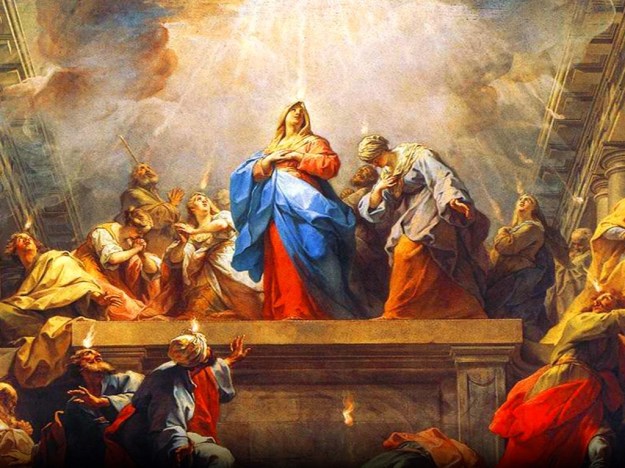
This is the Solemnity of Pentecost the great feast of the Holy Spirit, the birthday of the Catholic
Church, one of the three biggest celebrations of the Church year. The story of Pentecost is in Acts
chapter 2, but the other readings in the lectionary give us a lot to flesh out the story.
We have a lot of choices for the first reading on the Vigil, but the most well-known one is the story
of the Tower of Babel in Genesis 11. It starts with people united, but then trying to attain heaven
by their own power (similar to the sin of Adam and Eve). Their pride winds up dividing them.
Their languages got confused and they couldn’t communicate anymore, so they dispersed. Such is
the power of sin. This is undone by the power of the Holy Spirit at Pentecost, which allowed
people of all different languages to understand each other. The Holy Spirit unites and heals
division. Such isthe power of the Holy Spirit.
There is more.
The other possible first readings for the vigil include Exodus 19, which shows God revealing
Himself in thunder and lightning, smoke and fire. Ezekiel 37 is the story of Ezekiel preaching to
the dried bones that came together, were covered with flesh and sinews, then came back to life.
This was a sign that the people of Israel, scattered by the exile, were considered dead as a people,
and God was going to bring them back home. Joel 3 talks about God pouring out His spirit “upon
all flesh. Your sons and daughters shall prophesy, your old men shall dream dreams, your young
men shall see visions; even upon the servants and the handmaids, in those days, I will pour out my
spirit.” No one is too humble to receive this gift. There is a sense that God is going to do great
things, greater than people would expect or imagine.
The second reading is Romans 8:22:27. St. Paul speaks of creation “groaning in labor pains (an
image used a number of times in the Bible, for example Romans 13:8 and John 16:21).” This
encouragement says to people that are going through overwhelmingly difficult times that the gift of
God will make it worth it.
The Gospel for the vigil is John 7:37-39, in which Jesus calls those who thirst to come to Him and
drink, and He will make rivers of living water flow from us (remember the conversation with the
woman at the well in John 4), and we are reminded that this refers to the Holy Spirit, which will
only be given after Jesus has been glorified. To a desert culture (in contrast to a dessert culture),
water was very powerfully seen as the power of life where there is otherwise death. Notice that this
speaks of us not only receiving this living water, but being a source of it for the world.
On Pentecost Sunday, the first reading is, of course, the story of Pentecost. The second reading is
the image of the Church being the Body of Christ, and we members of the Church are parts of this
body. We are connected, and share common traits (like needing a compatible blood type), but
must also be very different. It is very good that feet and livers are different. I’m not a biologist, but
I know they are not interchangeable. We, members of the Church, have all been given gifts from
God, and these gifts, though different, are all needed and valuable. Such is the power of the Holy
Spirit.
Finally, the Gospel is John 20:19-23, in which the Risen Jesus give the disciples the Holy Spirit to
enable them to forgive sins. I can’t imagine unity in the body without forgiveness. The Spirit that
unites us and makes us one is the one at work to heal sin and division. One of the signs that the
Holy Spirit is at work in our community is our ability to come together, work together, and get
along with each other. One of the signs that the community is not open to the work of the Holy Spirit is factions and divisions between people.
This should give us much food for thought on Pentecost, and I highly recommend taking some
time with some of these Scriptures. I also recommend Dove Bars.
Blessings,
Fr. Jim
And two extra notes:
With all that is happening now, I need to say that if people use others’ bad behavior to excuse their own bad behavior, things will not get better. We need them to get better. This is a time to build up and not tear down. Remember, two wrongs don’t make a right, but two Wrights make an airplane. Let us do what is Wright.
I am willing to learn from anyone who says something I find worth learning. I never expected to learn something prophetic from Wesley (no, not John Wesley, but Wesley from the Princess Bride): https://www.youtube.com/watch?v=1HnvQM465zM

Preserving Us in Truth

gifts of Holy Spirit

Dear Folks,
Jesus speaks of sending another Advocate. The word is Paraclete, meaning comforter or
advocate.
We find in Matthew 5:4 “Blessed are they who mourn, for they will be comforted.”
Looking in the Greek, we find it says that they will be paracleted. However, Bible scholars
say in the text here in John, the meaning is an advocate, one who speaks for another, as a
prophet speaks for God. Jesus, of course, was speaking about the will of the Father (in the
Gospel of John, we see very strongly that Jesus was about doing the will of the Father), and
so He speaks about sending another Advocate who will keep them (and us) on track with
His teaching.
There is a very powerful reason to believe that the Holy Spirit is at work in the Catholic
Church: If you look at our history, it is very clear that there have been times of deep
corruption, terrible leadership, and awful decisions. Reading Karl Adam’s book The Roots
of the Reformation, a short book with a lot of information, we see a very bad situation at the
end of the Middle Ages. If the Holy Spirit weren’t keeping the Church together, the Church
would have shut down centuries ago. It probably wouldn’t even have lasted ten years. In
Acts 5:34-39, a respected rabbi named Gamaliel gives some provocative thoughts along
those lines. Lots of folks tried to start movements, but it’s not that easy to keep them going
for millennia, especially when so many things go wrong.
The fullness of truth about God, and the meaning of what it is to be human, was revealed in
Jesus. We believe it makes no sense that God would give such a gift at one moment in time
and then allow it to be lost by human error and corruption. Jesus gave us the Holy Spirit to
preserve the truth in the Church. Given the messy history, how that is done is not simple.
First, there is arguing, lots of it. We see that in the first century there was a huge dispute
about whether justification (being in right relationship with God) comes from following the
Law of Moses or from faithfulness to Jesus. This was decided in the Council of Jerusalem
(see Acts 15), which laid the pattern for later councils that clarified teaching (think of the
Council of Nicea in 325, which gave us the bulk of the Nicean Creed). The Holy Spirit does
not make things neat and tidy, but keeps us from going off track.
Secondly, doctrine develops over time. The word “Trinity” is not in the Bible. The Canon
of Scripture is not listed in the inspired text in the Bible (the footnotes, table of contents,
and the like are not part of the inspired text). This has led to much confusion, with some
thinking that if it’s not explicit in the Bible it can’t be true and others thinking that we can
change whatever we want when fashion of thought changes. G. K. Chesterton talks about
development in these terms: “when we say that a puppy develops into a dog, we do not
mean that his growth is a gradual compromise with a cat; we mean that he becomes more
doggy and not less. Development is the expansion of all the possibilities and implications of
a doctrine, as there is time to distinguish them and draw them out…(from his book on
Thomas Aquinas).” The Second Vatican council’s Constitution on Divine Revelation puts it
a bit differently: “This tradition which comes from the apostles develops in the Church with
the help of the Holy Spirit. For there is a growth in the understanding of the realities and the
words which have been handed down. This happens through the contemplation and study
made by believers, who treasure these things in their hearts (cf. Lk. 2:19; 51), through the
intimate understanding of spiritual things they experience, and through the preaching of
those who have received through episcopal succession the sure gift of truth. For as the
centuries succeed one another, the Church constantly moves forward toward the fullness of
divine truth until the words of God reach their complete fulfillment in her (Dei Verbum 8).”
G. K. Chesterton was asked why he became Catholic. His answer was simple: “Because it’s
true.” That’s my reason for remaining Catholic. Others might have different starting points,
but for me, everything else follows from that.
As we await Pentecost, let us ponder the work of the Holy Spirit in our lives, in our work,
and in our history.
Blessings,
Fr. Jim

Living Stones

livingstones

In our Gospel today, Jesus begins His farewell discourse, His last talk to the disciples
before he goes to be crucified. This will take chapters 14-16, and then there will be the
Great Priestly Prayer of chapter 17, in which He consecrates His Church. He starts with
“Do not let your hearts be troubled” and then says something strange. It is so familiar that I
didn’t think until recently how strange it is. When Jesus says, “In my Father’s house there
are many dwelling places…and if I go and prepare a place for you, I will come back again
and take you to myself, so that here I am you also may be (See John 14:1-3).” It leads to the
question, “Prepare how? Does heaven need work? What does He have to prepare?” Of
course, He will be preparing us. There is something else going on. Brant Pitre, in his book,
Jesus the Bridegroom, points out that this is what a bridegroom does. He gets betrothed,
then he goes and prepares a home for them (usually on his father’s estate), and then comes
and takes the bride to live there.
In the Gospel of John, we see John the Baptist introducing Jesus, and he uses two images to
describe Him: the Lamb of God, and the Bridegroom, and there will be subtle references to
these roles throughout the Gospel. John the Evangelist will bring these two together at the
end of the Book of Revelation in the Wedding of the Bride (the Church) and the Lamb.
Between the time when Jesus Ascends into heaven and the time when He comes back to get
us, to bring the relationship to its fullness, we are being prepared. That brings us to our
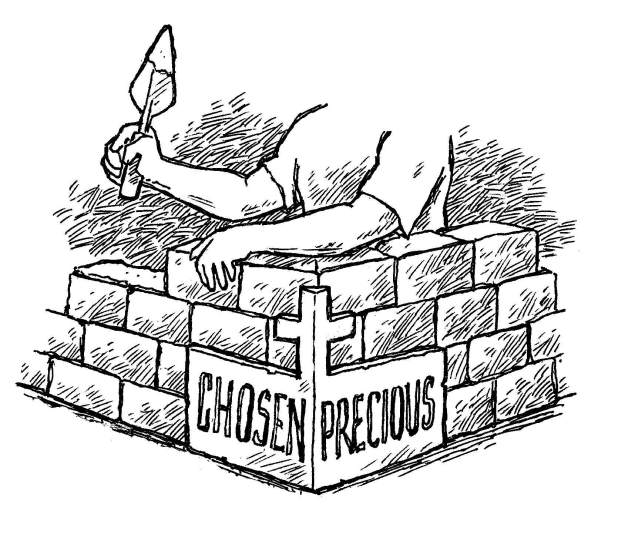
second reading, where St. Peter talks about us being living stones being built into a spiritual
house. The more familiar image is members of the Church being members of the Body of
Christ (1 Corinthians 12; Romans 12 and Ephesians 4), so we can take this opportunity to
linger over St. Peter’s image. “Come to him, a living stone, rejected by human beings but
chosen and precious in the sight of God, and, like living stones, let yourselves be built into
a spiritual house to be a holy priesthood to offer spiritual sacrifices acceptable to God
through Jesus Christ (1 Peter 2:4-5).”
In the course of doing church work, I’ve learned that some bricks are stronger and more
durable than others, and if you are unfortunate enough to have a church with low quality
bricks they will crumble relatively easily. I do believe that some stones are stronger than
others, and sandstone is not nearly as durable as granite. If we want our Church to be
durable, the first step is to be stronger stones, and that happens by deepening our
relationship with Christ. Any time we want to make a better world, the first step is always
to fall more deeply in love with Jesus. We can get so focused on things that need to be
done around us that we can forget that part, and we can become like sandstone that takes
itself for granite. We also remember that each stone is a small part of the building, so it is
less about us than about the purpose of the building.
This building is not just to sit there, but “offer spiritual sacrifices” and we are called to be a
“holy priesthood.” It is worth looking at this alongside a text from St. Paul: “I urge you
therefore, brothers, by the mercies of God, to offer your bodies as a living sacrifice, holy
and pleasing to God, your spiritual worship. Do not conform yourselves to this age but be
transformed by the renewal of your mind, that you may discern what is the will of God,
what is good and pleasing and perfect (Romans 12:1-2).” According to our baptismal
priesthood we are called to offer sacrifice. Since there is only one sacrifice, the sacrifice of
Jesus on the cross that occurred once in history but whose power is eternal, our sacrifices
must be a participation in that action. This is done in the sacrifice of the Mass, and in the
sacrifice of our lives, as we give ourselves to service.
We see the call to service in the first reading from Acts 6, and call of the first deacons (the
word “deacon” comes from the Greek word for “servant”). This house becomes more of
what it is meant to be when no one in need is neglected, and when everyone’s gifts are fully
brought to service. Sometimes we do this better than others, but it is what we are always
seeking.
Much to do to prepare for the final celebration.
Blessings,
Fr. Jim