Category Archives: Religion

From Cain and Abel to a More Peaceful World

Dear Folks,

As we celebrate the Easter season, we remember it is a time of new hope and new possibilities. As we read Acts of the Apostles, we see things happening that the early Christians would not have thought possible at first.

There is so much violence in our world. I sure would like for there to be less. When there is a particularly horrific incident it will often dominate the news for a while. Then different people will repeat their usual talking points. Various groups will talk past each other, and then nothing changes. I think we could do better. Short term, we can harden targets and make them less vulnerable. The deeper solution is not being so good at creating savages.

We have to have a less violent culture, a more peaceful culture, or no law can save us, and civilization itself is in the balance. I think there are some concrete things we can do. We have to decide what kind of people we want to be. It would involve looking at our own behavior (let none of us assume we are guiltless). It will involve what kind of messages that we send, and what kind of messages we encourage (calling out people on our side would likely be more effective than calling out our opponents; the other side is easy to dismiss). It will require considerable thought on how we as a society encourage good behaviors and discourage bad behaviors.

Particular issues would include:

• Support law enforcement, and value law and order.

• Build a strong sense of right and wrong.

• Combat fatherlessness.

• Stop talking past each other.

• Don’t condemn or demean our opponents; make a better case for our position.

• Keep our feelings and thoughts in perspective: just because I’m angry about something important doesn’t give me license to be destructive. Just because my cause is right doesn’t mean I have license to be destructive. We can work toward a better world, but we can’t expect to fix everything in our time. Building a better world is an intergenerational project.

• Build empathy, especially with people who see things differently, and reject objectifying groups or individuals. Avoid ridiculing people we disagree with.

• Reject using others’ behavior as an excuse to misbehave ourselves.

• Have the same standard of behavior for those we agree with and those we don’t; not condemn destruction when we disagree with their cause, and condone or dismiss it when we agree with the cause.

• Value growing in virtue over gratifying desire.

• Have some serious humility about how much we understand and how much we don’t: maybe even people we disagree with have some things to teach us.

In the weeks to come I’ll try to expand on these issues. I hope it may stimulate some thought and some discussion. Civilizations do rise and fall, but when they fall, it causes much suffering. It would be worth a lot to keep ours going.

Blessings,

Fr. Jim

Abandon all Hopelessness

This is Easter!

“Christ’s resurrection was not a return to earthly life, as was the case with the raisings from the dead that he had performed before Easter: Jairus’ daughter, the young man of Naim, and Lazarus. These actions were miraculous events, but the persons miraculously raised returned by Jesus’ power to ordinary earthly life. At some particular moment they would die again. Christ’s resurrection is essentially different. In his risen body he passes from the state of death to another life beyond time and space. At Jesus’ resurrection his body is filled with the power of the Holy Spirit: he shares the divine life in his glorious state, so that St. Paul can say that Christ is “the man from heaven” (1 Corinthians 15:35-50). (Catechism of the Catholic Church #646).”

We humans tend to think that the best we can hope for is more of the same, but a little nicer. Many eastern religions envision an eternal cycle of reincarnation, and the best that you could hope for is being reincarnated in a higher caste, and there was always a chance that you could be reincarnated as a dung beetle. On rare occasions, television and movies would give some vision of heaven, not intending it be serious, of course, but what you’d see is pretty pathetic. In fairness, one could never do justice to heaven in a movie, not only our technology but our minds are far too feeble for such a task.

Part of having faith in God is trusting Him to keep His promises, including the promises we don’t completely understand and that He will not disappoint those who hope in Him.

In my office I have a sign that says, “Abandon all hopelessness, ye who enter here.” The greater our faith, the more we can endure the world disappointing us, because the One in whom we trust will come through. The less we trust the world to make us happy, the more we trust in God, the more we can endure the world failing us, whether in the form of other people, including people in the Church, our government, our society, our families, our health, our money, even our own wills (I continue to be a sinner, and much as the devil would like me to give up, God invites me to keep trying to be faithful). We still have to grieve loss; our faith does not make it easy but does prevent us from giving up. Jesus received the full force of the evil in the world and emerged triumphant. He can conquer the evils that threaten and attack us. During Easter we are called to celebrate. As we fasted and did penance during Lent, so we feast during Easter. Our goal, of course, is not just partying for partying’s sake (though it is a good thing) but witnessing to the world our joy in God’s great victory over evil. We also seek to deepen our confidence in the Jesus’ victory, so we can live as victorious people. We will read a lot of Acts of the Apostles during the Easter season. We think of Acts as the sequel to the Gospel of Luke and the history of the early Church. It is also about how people act when they believe in the power of the resurrection. They were a tiny group, had few resources, and were surrounded by a very hostile culture. No one could stop

them.

Alleluia!

Blessings,

Fr. Jim

The Holiest Week

Dear Folks,

Today we begin Holy Week. Holy Week is the super bowl of the Catholic faith, and we get to the center of the Christian story. It begins with the triumphal entry into Jerusalem, the last

supper, the crucifixion, the time in the tomb, and the resurrection. Everything before this is leading up to this, and everything after this is because of this. During this week we try, as much as we possibly can, to avoid other meetings and other projects so that we can focus on this, our central mystery.

It begins with Palm Sunday. Jesus comes into His city as a triumphant king amid hosannas, but humbly, on a donkey instead of a mighty horse. We bless palms to be used throughout the year,

a sign of praise to Jesus, and for next Ash Wednesday we will burn them, a reminder of the fragility of our devotion (how quickly humans can go from “Hosanna” to “Crucify Him”). We

read the passion narrative from the Gospel for the year (this year, of course, is Matthew).

On Tuesday at the Cathedral, we will celebrate the Chrism Mass. Traditionally this was done on Holy Thursday morning, but it is celebrated on Tuesday evening so that more people can

participate. Even so, we can only have a cathedral full of people attending (as a priest, I get an automatic seat; it’s one of the perks of being a priest). We will bless the holy oils we use throughout the year. We have three holy oils (Don’t let anyone tell you they are WD40, 10W30, and Oil of Olay: that is not true). The oil of the sick is a sign of God’s healing, and is used for anointing the sick, and I keep a small container of it in my car just in case. The oil of

catechumens is a sign of God’s strength to fight evil and is used for people preparing for baptism. The Sacred Chrism is the holiest of the oils and is a mixture of olive oil and balsam perfume. It is a sign of the Holy Spirit, and is used at baptism, confirmation and the ordination of priests. During the Chrism Mass, the priests renew their priestly commitment, and the bishop reminds the people that priests need lots of prayers (he is not wrong).

On Holy Thursday we begin the Triduum, and that is one celebration that takes place over three days. It begins with Mass of the Lord’s Supper, celebrating the institution of the Eucharist, as

well as the institution of the priesthood. The Gospel is the washing of feet, and often the celebrant washes people’s feet at Mass. After the prayer after communion, we usually have a procession with the Blessed Sacrament, place it in a reserve chapel, adore Him, and leave in silence (don’t forget the silence). We don’t have a closing blessing because the liturgy does not end; it simply pauses until the next day.

Good Friday is the one day of the year we don’t have Mass. We begin in silence. We read the passion narrative from the Gospel of John. We have solemn intercessions. We show special respect and affection for the cross upon which Jesus won our salvation. We have a communion service with hosts that were consecrated on the previous day. We depart in silence. Then on Saturday we have the Easter vigil. By Church law it begins after sundown. I shall not

describe it; one should witness it, if at all possible. It’s the greatest night of the year.

I encourage as strongly as possible, for everyone to attend to Holy Week as best as their situation allows. What we celebrate is the center of everything.

Blessings,

Fr. Jim

Watching the “Jesus Revolution”

Dear Folks,

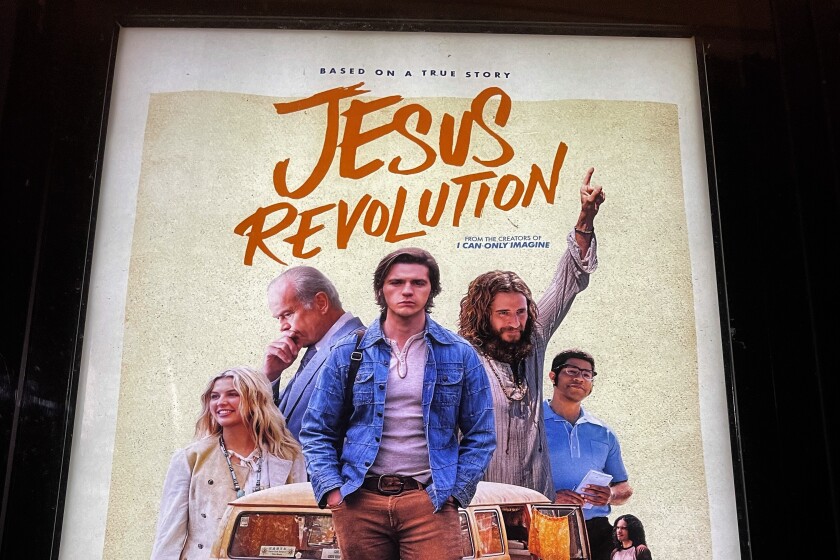
I recently saw the movie “Jesus Revolution.” It’s a fictionalized documentary of a real event, a Christian revival in the 1960s. It involved a Baptist Church that has grown stagnant, and then some hippies showed up. The pastor embraced their presence and sought to connect with them and involve them. This upset some of the long-standing members of the Church who liked things the way they had been. The pastor chose to keep connecting with the newcomers and working with a hip young preacher (played by Jonathan Roumie, the guy who plays Jesus on “The Chosen”), and some of the long-standing parishioners left. They chose their comfort zone over evangelization. The Church gradually grew

enormously, though not without difficulty (of course).

The movie makes the point that the young people had been lied to. They were told that casual sex would bring them love and that LSD would connect them to transcendence (LSD, Lysergic Acid Diethylamide, was a powerful and dangerous hallucinogenic, and we were all amazed that one drop would be a dose. We had no idea that fentanyl would be coming). When some found that it didn’t work, they were open to another message. Many were brought to embrace Jesus.

Now comes the question, what should we do today. We know that young people have been lied to, being told that casual sex and drugs will make them happy, that feelings are the highest measure of reality, and the meaning of life is something they make up for

themselves. Many are depressed, many are lost, and there are an alarming number of suicides. It sure would be nice to bring more of them to Jesus.

An important thing to note is that modern young people are not hippies. They are children and grandchildren of hippies, and they have very different perspectives. It would be a terrible mistake to assume that we can attract them by doing what we think we would have wanted when we were their age.

A lot of young families are drawn to more traditional, more reverent liturgies. If you go to where the Old Latin Mass in celebrated, you will find lots of young people. I don’t suggest

that the solution is that we all go back to the Missal of 1962 (I don’t know how to do it, and I never studied Latin in the seminary), but I suggest that what we were taught in the ‘70s, ‘80s and ‘90s could stand to be questioned, and that being willing to move out of our

comfort zone for the sake of the mission of the Church.

I’m not arrogant enough to say I’ve figured out exactly what will bring in droves of young people (and why should you believe me anyway?). I am bold enough, however, to suggest some principles:

• We accept that being a parishioner does not mean being a customer, but a coworker in mission.

• Therefore, it is not about our preferences, at least not primarily.

• Programs and gimmicks have not succeeded in making deep change. We need to examine our own behavior, and how we act as ambassadors of Jesus.

• As I’ve said before, we can all work on doing a better job of telling the Gospel story (learning in practice what is effective in connecting to people), working together as community (welcoming, inviting, and reconciling), worshipping God (yes, we can get better), and helping people in need.

• We can start small. We can learn something new about our faith and share it. We can tell someone something good about our faith community. We can introduce ourselves to someone in church that we don’t know. We can create a holy moment (show someone a bit of the love of God).

• Laughing at the pastor’s jokes is encouraged but not required.

If we do what we can, God will use us.

Blessings,

Fr. Jim

Jesus Is More Than They Thought

Dear Folks,

Today we our Gospel talks about the Transfiguration.

The Bible looks at mountains as a place to encounter God and especially receive instruction. “The Lord said to Moses, ‘Come up to me on the mountain and, while you are there, I will give you the stone tablets on which I have written the commandments for their

instruction”, Exodus (24:12). We remember he also goes back up the mountain for backup copies after Moses smashes the originals in response to the Golden Calf business (Exodus 34). Elijah gets marching orders on Mount Horeb (Mount Horeb is another name for Mount Sinai) in 1 Kings (19:8). Isaiah prophesied that “the mountain of the Lord’s house” will be a place of instruction (see Isaiah 2:2-3). Jesus goes up the mountain to give the Sermon on

the Mount (Matthew 5:1).

We see that Jesus only takes Peter, James, and John up the mountain. It appears that not all disciples are equal, and certain gifts are given to some and not others. Galatians 2:9 tells us

that Peter (“Cephas” is Aramaic for “rock”), James, and John were considered the “pillars” of the early Church. We see that they get special moments with Jesus, but we also see particular stories of their failures. Only Peter, James, and John were brought to witness the raising of the daughter of Jairus (Mark 5:37). Peter gets out of the boat when Jesus is walking on water (score one for him), but his faith wavers and he fails (Mat 14:28- 31). Jesus rebukes James and John for wanting to call down fire on an inhospitable Samaritan town (Luke 9:54-55). Right after the third prediction of the passion (!) James and John want the best seats next to Jesus in the Kingdom (Mat 20-28). They still didn’t get it.

We all remember Peter’s denial of Jesus three times on Good Friday (Mat 26:69-75). Peter, James, and John are the three that Jesus takes with Him to the Garden of Gethsemane (Matthew 26:36-46), and they fall asleep. Once again, they fail. We learn that some gifts and some spiritual experiences are given to some but not others. If

we see others getting things we didn’t get, we have no cause to be jealous: they don’t necessarily have an easier road. We have no cause to be ashamed either: it doesn’t mean we have failed. If we get some great mystical experience or some great gift, we have no cause to be proud: we didn’t earn it. We just follow Jesus however we can (see John 21:18-23).

What is this great instruction that is given on this great occasion? First of all, it is the appearance of Jesus Himself, shining like the sun and clothes unnaturally white (Mat 17:2). A voice from the cloud says, “This is my beloved son, with whom I am well pleased; listen to him (Matthew 17:5).” That’s it. The great revelation is Jesus Himself. He is the new Torah, the new Law, the great revelation of God, the way to live in covenant with God.

How does this fit into our Lenten journey? During Lent, we want to focus especially on Jesus. We can spend extra time reflecting on the Gospels. We can spend extra time before the Blessed Sacrament. We can spend extra time reflecting on Jesus’ presence in the midst

of our activities through the week, as we try to make what we do acceptable gifts to offer through Him. However important we thought Jesus was, He’s more important than that.

Blessings,

Fr. Jim

Into the Desert

Dear Folks,

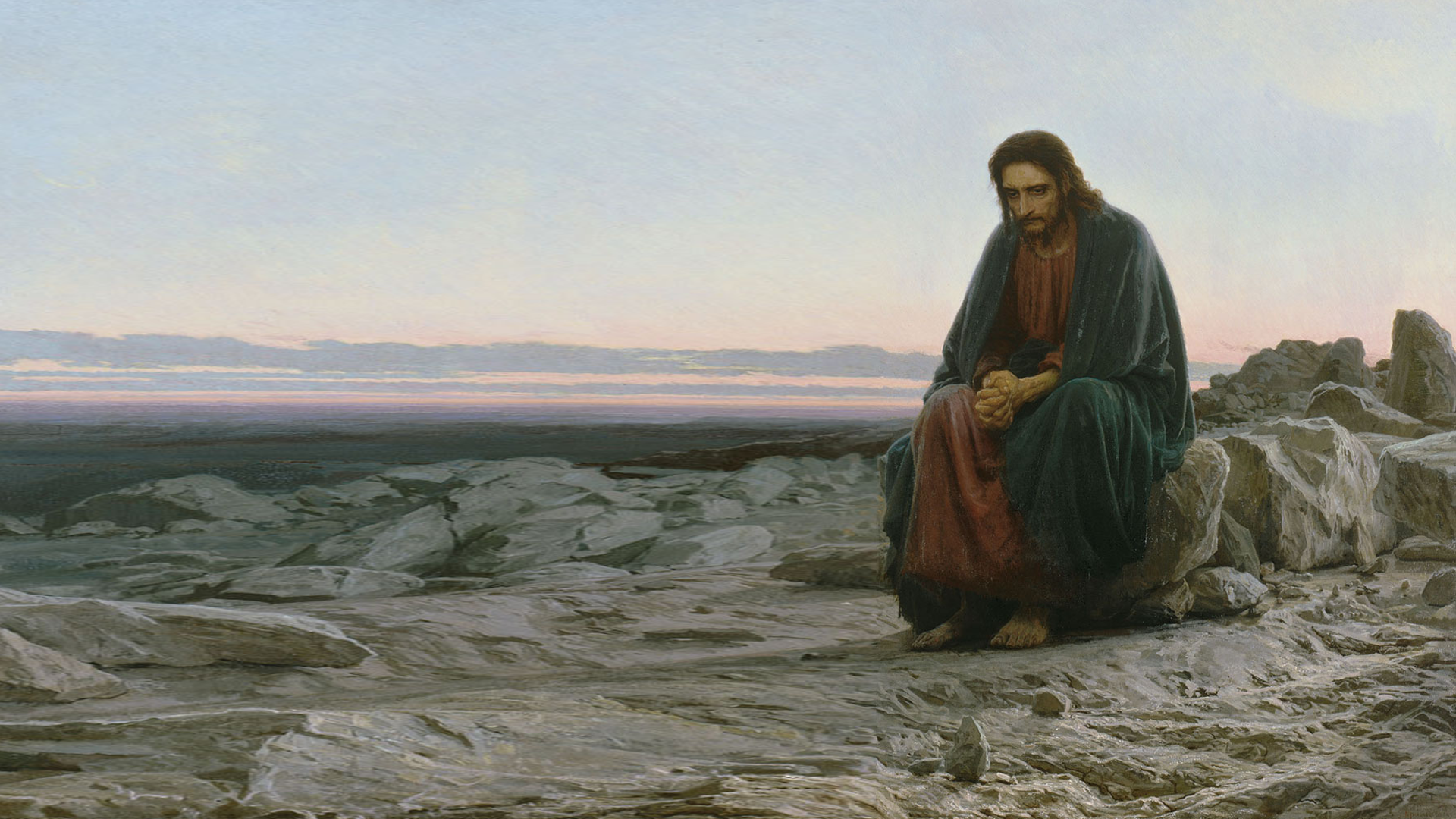
On the first Sunday of Lent, we encounter Jesus in the desert for forty days. This echoes the story of Moses and the Israelites in the desert for forty years before they entered the

promise land.

We also remember that after the golden calf incident, Moses was fasting for forty days on Mount Sinai while God was renewing the covenant. Hosea uses the image of an adulterous wife to teach about Israel’s relationship with God. Hosea takes her out into the desert to help her remember their love (Hosea 2:16). Elijah had a good meal and then fasted for forty days while walking in the desert (1 Kings 19). He sorted through the noise and heard God’s

whispering to him. This pulled him out of his despair and renewed his sense of purpose.

During Lent we are to find a bit of desert, clearing out some of the usual stimuli and the usual pursuits to hear the quite call of God. The world works hard to addict us to its stimuli so that we never have a chance to think, to step back, to question our direction.

In Daniel Goleman’s book “Emotional Intelligence” he mentions one of the components of emotional intelligence is self-awareness. This was the first time I realized that selfawareness is something that some people have more of, and some people have less of. I

think we humans have a dangerous tendency to presume we are completely self-aware and how can we not be? I suspect a lot of it has to do with being distracted by other things. We are constantly bombarded by messages and stimuli; we have so many tasks nibbling at our ankles, and we are constantly drawn toward our desires. Looking to things outside ourselves, we lose track of what is happening inside.

If we live in a house that regularly has certain odors, we soon stop smelling them. When we go out, we can lose the habituation, and returning we become more aware. Whatever we do this Lent, let us step away from what we usually do, and refresh our perception, so

we can go back and see things in a new light.

Fasting and abstaining remind us that we can say no to our desires by God’s grace when we choose to. We can easily get in such a deep habit of saying yes, we lose the ability to say no, and this makes us less free (see John 8:31-34). Too much attachment to the things of this world can make us lose our desire for the presence of God.

If we do Lent well, we can come out of it seeing things (including ourselves) more clearly, more free to choose things that really matter over lesser things, renewed in our sense of purpose, more keenly desiring the presence of God, and bolder in serving Him.

Blessings,

Fr. Jim

What Does Jesus Mean?

Dear Folks,

The Gospel readings from last Sunday and this Sunday have Jesus issuing some serious challenges. How do we respond in practice? There are some big questions. People might look at His words and say they are not practical, and then they skip over them. That would be very bad. If we can be unaffected by Jesus’ words, we are a failing at discipleship.

Jesus talks about anger: “But I say to you, whoever is angry with his brother will be liable to judgment…(Matt 5:22).” Does this mean we should never be angry? We read what Jesus said in Matthew 23, and He sounds pretty angry to me. When Jesus flips over tables and drives the money changers out of the temple, He seems pretty angry then too. What are we to think? We read in Ephesians 4:26-27: “Be angry but do not sin; do not let the sun set on your anger, and do not leave room for the devil.” There is a right way to be angry, when it is based on love, and we see our loved ones doing self-destructive things. This leads to seeking to help if one can. In Matt 23, after Jesus is angry, He weeps over Jerusalem. Under loving anger there is profound sadness.

Jesus speaks about divorce, and we see parallels in Matt 19:1-12, Mark 10:1-12 Luke 16:18, and 1 Corinthians 7:10-11. Only Matthew has the clarification that it is not applicable to illicit unions, which we find expressed in the Church’s practice of declaring certain unions did not achieve a permanent sacramental bond. This happens when something was defective in the way the union was formed. It is controversial and very messy, but the best way we know to find justice and hold to the truth. The key takeaway is approach marriage with all the seriousness that can be mustered. It’s doing something that cannot be undone.

We come to the issue of self-defense. In Matt 5:39, Jesus says, “Offer no resistance to one who is evil…”. If we take it the way it first sounds, not only do we then renounce war and self defense, but never call the police, lock our doors, or use password on our computers, for they are

all resistance to those who are evil. This can’t be right. Letting the world be ruled by predators, terrorists, and bullies does not seem like loving all people. Not only does that mean a lot (awful lot) of innocents get hurt, but the perpetrators are encouraged to lose their souls.

In 1Samuel 25, Abigail prevents a war between David and her husband Nabal (Abigail is a Biblical heroine worth knowing about). In verses 33-35 David seems happy and relieved that he did not do all that killing. It sounds like he didn’t want to but felt compelled to. I think that was common in Biblical times (and is not unknown in our time) when the cycle of revenge did so much harm and neither side really gained. Jesus liberates people from that compulsion.

The Catholic Church has held the right of just war, of enforcing the law, and of sometimes a right, even a duty to defend self or another against an unjust aggressor. Violent defense is always the last resort, and we still have concern for the good of the unjust aggressor. That is why, when even the most horrible villains are caught, we must still respect their human dignity. Their lives are still sacred. We don’t torture them, whatever they have done. This is why the Church has been leaning away from capital punishment since the time of Pope Saint John Paul. It is better they be alive so they can repent (see Ezekiel 18). If I had my may, the worst criminals would be put into a cell and then pipe in EWTN, Word on Fire, and Augustine Institute videos. Victory over evil is greatest when a sinner becomes a saint. That is our goal.

Blessings, Fr. Jim

Reaching for the Sky

Dear Folks,

There has been a lot of conversation about the relationship between the Old Testament and the New Testament. Some have even claimed that the Old Testament has a God of wrath, and the New Testament has a God of love, even though there is a good deal of love in the Old Testament and a good deal of wrath in the New Testament.

There is also paradox about the Law. Jesus says in our Gospel this Sunday, “Do not think that I have come to abolish the law or the prophets. I have come not to abolish but to fulfil (Matthew 5:17),” but the letter to the Ephesians says, “For he is our peace, he who made both one and broke down the dividing wall of enmity, through his flesh, abolishing the law with its commandments and legal claims, that he might create in himself one new person in place of two, thus establishing peace (Ephesian 2:14-16).” Does this pit the Gospels against the epistles? No. A paradox is an invitation to look deeper into the texts and the issues they are dealing with so we can have a deeper understanding.

We remember that God started with a very rough, barbaric tribe and formed them over time. We see development of thought in the Old Testament from earlier writings to the later ones. In the earlier writings, there is an emphasis on being separate from the other nations so as not to be contaminated by their evil ways and being very harsh about it. Later writings would talk about compassion for other peoples, and Mount Zion being a beacon for all the nations (See the book of Jonah, Isaiah 2, and Psalm 87).

When a plant takes root underground, it is preparing for what is to come. When it breaks out above the ground, it is not abandoning its root, but building on it. Jesus’ teaching on the Mount was built on Old Testament foundations. For example, if we read Psalm 24, we see that “Blessed are the clean of heart, for they will see God” was not an entirely new idea. Reading Psalm 37 we see that “Blessed are the meek, for they will inherit the land” was also familiar.

The law says that parents are required to feed their children and are sanctioned if they neglect to do so. The parents I know, however, aren’t motivated by the law or its sanctions, but by love for their children, and it would be unthinkable not to feed them. They are beyond they law, not that they would break it, but because they are following a higher, even more demanding principle.

We remember the Old Testament and the New Testament are the work of the same God and part of the same plan of salvation. It does not represent God changing His mind, but rather Him taking us to a new level of development. We start out learning very basic principles, and expectations get greater as we grow. In Jesus, God’s plan is unveiled, and we are called to something that is humanly impossible. It is literally impossible to live the Christian life by our own power. We are completely dependent on God’s grace. We must come to Him constantly to transform us, and then it is wonderfully possible (see Matthew 19:25-26). In that way, we can reach for the sky.

Blessings,

Fr. Jim

Being Salty and Shiny

Dear Folks,

In our Gospel this Sunday Jesus says, “You are the salt of the earth. But if salt loses its taste, with what can it be seasoned? It is no longer good for anything but to be thrown out and

trampled underfoot (Matthew 5:13).” If we take this seriously, it should disturb us. If we can read Jesus’ words and be unaffected, something is very, very wrong.

There has been conversation about lower church attendance, and we are hearing about churches closing in our diocese (and I’m quite sure there will be more). Other churches have been getting

clustered and Mass schedules have been getting reduced.

Do people see that the Church is making a difference? If they don’t see that it matters, it won’t take much for them to leave. We can talk about how so many stopped because of the Covid

lockdowns, and we can talk for years about what the bishops should have done differently, but it has really only exposed how thin and fragile so many people’s motivation was. There are some

who do not come because of legitimate concerns about how their health is. Prudence is a virtue, and it is good to stay safe. We don’t want people coming to church with the flu either. But

when people go to other gatherings but do not come to Mass every Sunday, or they decide they like it better watching Mass on TV in their pajamas with their hot chocolate, what does that say

about how we have taught the meaning, the power, and the value of the Mass? I’m not saying this to blame them, but rather ask how good a job have we been doing conveying why the Mass

matters, why it should be a priority.

We are called by Jesus to transform the world by the power of the Gospel. The Gospel is the most powerful transformative message in the universe. If we truly answer that call, the Church will flourish, even in the harshest of environments. The early Church did, and they had much less to work with than we did.

How salty and shiny should we be? What is the necessary level? How much do we need to do? The short answer is “I don’t know.” If we are doing what we are supposed to be doing, would

we not be drawing in more people than we are losing? Would we not be transforming the world? Each of us has a role, and God knows what we are capable of. The story of the widow’s mite (Mark 12:41-44; Luke 21:1-4) teaches us if we can only do a teeny bit, but do it with all our hearts, it is huge in God’s eyes. We need to let go of the idea that we are helpless, but also that we cannot do it alone. God calls us to work together.

I suggest the future of the Catholic Church in America will be determined by how salty and shiny we choose to be. How to do that is a big question. I plan to spend the rest of my life

working on it. I’m fond of thinking that what I have been teaching has helped somewhat in that direction.

Here are some thoughts moving forward:

• Recognize that parishioners are not customers in the Church but coworkers in mission. How do our approach to Church, our expectations of the Church and our expectations of ourselves reflect that?

• Consider that the way we have been doing Church isn’t getting us where we need to go, so we can’t evaluate our Church the way we are used to. What we have thought of as doing well may not really be doing well. As someone said recently, “Get used to different.”

• When people want to talk at length about what the Pope or the bishop should be doing about it, or what should have been done differently in the past, it would be useful to redirect the conversation toward how we can better be salt and light.

• This is not about us. It is about drawing people to Jesus. It is God’s work, and He is calling us to cooperate.

• The best-case scenario involves things getting worse before they get better. The New Testament continually calls us to persistence and not getting discouraged. If we are faithful during this time, we can boldly hope for a glorious future.

Blessings,

Fr. Jim

The Torah and the Sermon on the Mount

Dear Folks,

Our Gospel today is the Beatitudes, the beginning of the Sermon on the Mount. This opens Jesus’ public teaching in the Gospel of Matthew and sets the stage for what follows.

To appreciate how the Sermon on the Mount is presented in Matthew, we need to talk about the Torah, which is the term the Israelites use for the first five books of the Bible. The word is usually translated “law”, but a rabbi told me that didn’t convey the meaning well. He said, “Sin is missing the target, and Torah means hitting the target. However, when you go through the Bible and see references to “statutes”, “ordinances” or “decrees” they are talking about the Torah. Psalm 1 and Psalm 119 are both hymns in honor of the Torah and say that it is the way to true blessedness. The Torah was the foundation of the nation of Israel and their relationship with God. Being in right relationship with God came

from doing the works of the law of Moses, the Torah. To this day, Jewish people revere the Torah and treat Torah scrolls with great reverence. They are kept in a cabinet called an “ark” (think ark of the covenant, not Noah’s ark), and taken out and carried in procession when read in prayer services.

Exodus 20 is a classic presentation of the giving of a new Torah. Moses goes up a mountain to receive it from God. It begins with the 10 Commandments (the pocket-sized version) and then expands on them. In the Sermon on the Mount, Jesus goes up the

mountain. He starts with the Beatitudes, the pocket-sized version, and then expands on them.

We, of course, would not call the Sermon on the Mount the new Torah. We would say that Jesus himself is the new Torah. Pope Benedict makes this point in his “Jesus of Nazareth”

book when referring to another mountaintop experience where Jesus in transfigured, and the Father speaks from a cloud and says, “This is my beloved Son, with whom I am well pleased; listen to him (Matthew 17:5).” St. Paul will argue extensively, especially in Romans and Galatians, that for Christians, being in right relationship with God is no longer works of the law of Moses, but about faithfulness to Jesus.

From now until Lent, we will take our Sunday Gospel readings from the Sermon on the Mount. I would challenge everyone to read Psalm 1, and then read Matthew chapters 5-7, and maybe even spend some time wrestling with them. As we go through the Gospel of Matthew this year, it would be useful to look for echoes from this sermon in Jesus’ teaching throughout the Gospel. I suggest that if people reflect on it from time to time, they could

find deeper insights on different parts of their Christian journey. A key concept to keep in mind is that this is not just a list of rules, of things to do and things not to do but a vision of total transformation, changing us to the core. The process is not done until we are fully perfected at the end of our journey (Mat 5:48).

Blessings,

Fr. Jim