Category Archives: Uncategorized

Living Stones

livingstones

In our Gospel today, Jesus begins His farewell discourse, His last talk to the disciples
before he goes to be crucified. This will take chapters 14-16, and then there will be the
Great Priestly Prayer of chapter 17, in which He consecrates His Church. He starts with
“Do not let your hearts be troubled” and then says something strange. It is so familiar that I
didn’t think until recently how strange it is. When Jesus says, “In my Father’s house there
are many dwelling places…and if I go and prepare a place for you, I will come back again
and take you to myself, so that here I am you also may be (See John 14:1-3).” It leads to the
question, “Prepare how? Does heaven need work? What does He have to prepare?” Of
course, He will be preparing us. There is something else going on. Brant Pitre, in his book,
Jesus the Bridegroom, points out that this is what a bridegroom does. He gets betrothed,
then he goes and prepares a home for them (usually on his father’s estate), and then comes
and takes the bride to live there.
In the Gospel of John, we see John the Baptist introducing Jesus, and he uses two images to
describe Him: the Lamb of God, and the Bridegroom, and there will be subtle references to
these roles throughout the Gospel. John the Evangelist will bring these two together at the
end of the Book of Revelation in the Wedding of the Bride (the Church) and the Lamb.
Between the time when Jesus Ascends into heaven and the time when He comes back to get
us, to bring the relationship to its fullness, we are being prepared. That brings us to our
second reading, where St. Peter talks about us being living stones being built into a spiritual
house. The more familiar image is members of the Church being members of the Body of
Christ (1 Corinthians 12; Romans 12 and Ephesians 4), so we can take this opportunity to
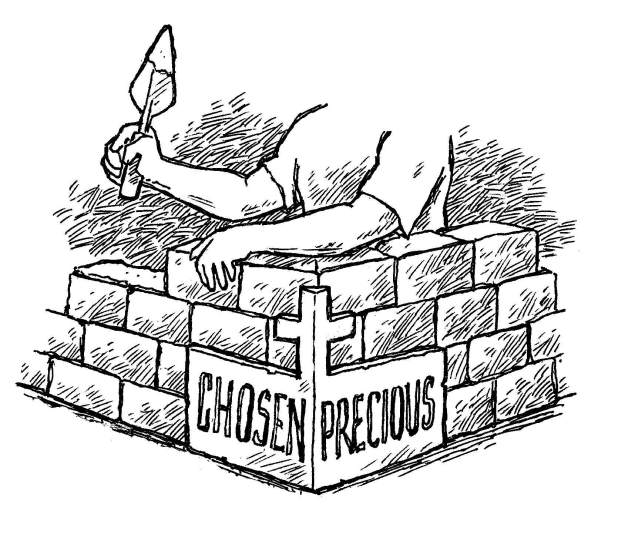
linger over St. Peter’s image. “Come to him, a living stone, rejected by human beings but
chosen and precious in the sight of God, and, like living stones, let yourselves be built into
a spiritual house to be a holy priesthood to offer spiritual sacrifices acceptable to God
through Jesus Christ (1 Peter 2:4-5).”
In the course of doing church work, I’ve learned that some bricks are stronger and more
durable than others, and if you are unfortunate enough to have a church with low quality
bricks they will crumble relatively easily. I do believe that some stones are stronger than
others, and sandstone is not nearly as durable as granite. If we want our Church to be
durable, the first step is to be stronger stones, and that happens by deepening our
relationship with Christ. Any time we want to make a better world, the first step is always
to fall more deeply in love with Jesus. We can get so focused on things that need to be
done around us that we can forget that part, and we can become like sandstone that takes
itself for granite. We also remember that each stone is a small part of the building, so it is
less about us than about the purpose of the building.
This building is not just to sit there, but “offer spiritual sacrifices” and we are called to be a
“holy priesthood.” It is worth looking at this alongside a text from St. Paul: “I urge you
therefore, brothers, by the mercies of God, to offer your bodies as a living sacrifice, holy
and pleasing to God, your spiritual worship. Do not conform yourselves to this age but be
transformed by the renewal of your mind, that you may discern what is the will of God,
what is good and pleasing and perfect (Romans 12:1-2).” According to our baptismal
priesthood we are called to offer sacrifice. Since there is only one sacrifice, the sacrifice of
Jesus on the cross that occurred once in history but whose power is eternal, our sacrifices
must be a participation in that action. This is done in the sacrifice of the Mass, and in the
sacrifice of our lives, as we give ourselves to service.
We see the call to service in the first reading from Acts 6, and call of the first deacons (the
word “deacon” comes from the Greek word for “servant”). This house becomes more of
what it is meant to be when no one in need is neglected, and when everyone’s gifts are fully
brought to service. Sometimes we do this better than others, but it is what we are always
seeking.
Much to do to prepare for the final celebration.
Blessings,
Fr. Jim

Getting Things Sheep Shape

shepherd

Dear Folks,
Jesus is the Good Shepherd, and we have cause to feel sheepish.
In John 10, Jesus tells us He is the good shepherd. This chapter is well worth reading
completely. A good shepherd lays down his life for his sheep. Some have pointed to this
text and suggested that priests should not be participating in the lockdown, but facing the
danger. It would be a different thing if we were just putting ourselves in danger, but if we
kept visiting people, we could be unknowingly infecting others. That is the truly dangerous
factor, how long we can be asymptomatic and contagious. There can (and will) be a lot of
conversation about where to draw that line, but it is not simple. Let us reflect on shepherds:
We all know Psalm 23, the great psalm about the Lord our shepherd. Reflecting on that
short text can give us a sense of what Jesus was talking about, what He does for us.
Isaiah 40:11 Tells of the shepherd’s tender care for the sheep as an image of God’s tender
care for His people (just what you would expect from Isaiah): “Like a shepherd he feeds his
flock; in his arms he gathers the lambs, carrying them in his bosom, leading the ewes with
care.”
Isaiah 56:11; Jeremiah 3:15; 23:4; 50:6 talk about bad leaders of the Israelites who were
like bad shepherds, but the big example of that is in Ezekiel 34. It is worth reading in
entirety. If you only look up one of my references besides John 10, this would be the one to
read. In the Office of Readings (of the Liturgy of the Hours) there is a section in the fall
where we go for days with a chunk of this chapter as the first reading, and a message from
St. Augustine developing the concept further. Neither one pulls any punches. It usually
comes up pretty close to when we have the priests’ conference for the diocese (I think God
did that on purpose). It is a challenge for anyone in a leadership position.
One can also read: Luke 15:1-7 Parable of the lost sheep; John 21:15-19 Mandate to Peter:
if you love me, feed my lambs tend my sheep; Acts 20:25-35: St. Paul talking to the priests
of the church of Ephesus.
The image of the Lord as shepherd goes deep in the scriptures, and it is very apt. In ancient
Israel, shepherds were very common, and everyone was familiar with the concept.
Shepherds lead the sheep to food, water and shelter, and protect them from predators. The
sheep, left to themselves would tend to wander off and get in trouble.
We may pride ourselves on our independence and our common sense, but we need help and
we do tend to wander from what is good for us. In our better moments, we all know this to
be true.
In John 10:10, Jesus says, “A thief comes only to steal and laughter and destroy; I came so
that they might have life and have it more abundantly.” Those who seek to lead us into sin
(and that includes the voice of temptation within us) regularly tell us that to obey God is to
accept a diminished life, and sin will give us a fuller life. This is one of the most horrible
lies in the history of lies, and yet, it is so easy to believe. We tend to wander from the very
things that will make us the happiest. Sin leaves us with a life so much less than what it
could be and in the cruelest of prisons. That is what gives us cause to feel sheepish. Jesus
leads us to the fullest, most abundant life. We will see this image taken up again most
powerfully in Revelation 7:9-15.
Jesus said the sheep know the voice of the Good Shepherd, and that He will lead them and
they will find pasture. We can get to know His voice better by reading the Scriptures, by
spending time in His presence (including time spent with the Blessed Sacrament), and by
seeking His face in those in need.
We need a shepherd. Let us take some time to listen to His voice.
Blessings,
Fr Jim

Know by the Fruits

fruitsof the Spirit

We are coming up on Pentecost, one of the three biggest celebrations of our liturgical year.

We are told there is an inheritance waiting for us in heaven, but for now we have been given the Holy Spirit as a “first installment” (Ephesians 1:13-14; 2 Corinthians 5: 1-5). So what does it mean that we have been given the Holy Spirit?

I want to emphasize that the answer must not be primarily about feelings. I have heard many people who talk about “feeling close to God” as their primary test for their practice of the faith. This is dangerous.  I would suggest our Scribe and Pharisee friends in the Gospels got into trouble when they confused feeling holy with being holy. Daniel Mattson in his book Why I Don’t Call Myself Gay shares a lesson his father taught him: “In the planetarium where he worked, I would often sit next to him as he gave presentations to visiting school children.  My favorite part of every program was the moment when he made the star projector spin speedily, round and round, making it feel as if all of us in the auditorium were spinning. The dome of the planetarium filled our vision, and though we knew we were seated firmly in our chairs, it felt as if we were dizzily careening through space. As the gathered children enjoyed the experience, my father would use the moment to teach them about Nicolas Copernicus’ revolutionary discovery that the earth revolves around the sun, not the other way around, as most men had believed throughout history. ‘Feeling are important,’ he would say, ‘but they don’t always tell us the truth.’”

What should we look for as a sign that the Spirit is working in our lives?  It is always a good thing to start with Jesus, who said, “So by their fruits you will know them (Matthew 7:20; see Luke 6:43-46).”

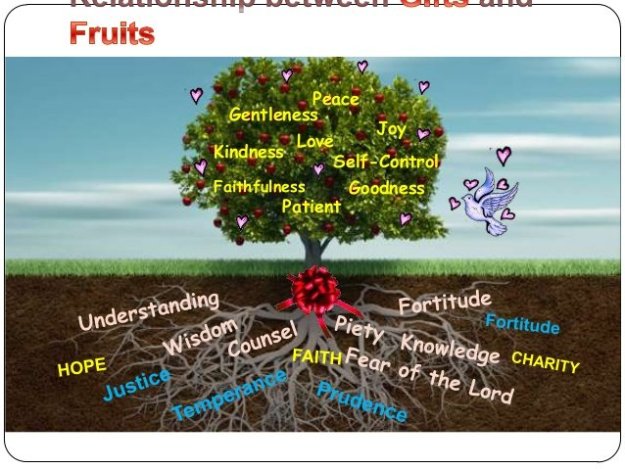
What are the fruits of the Holy Spirit? St. Paul teaches they are “love, joy peace, patience, kindness, generosity, faithfulness gentleness, and self-control (Galatians 5:22-23, and memorizing that list would not be a bad thing).”  If the Holy Spirit is at work in us and if we are cooperating with that work, we should demonstrate an increase in those qualities.  We all fall short, but we can be headed in the right direction.

However, it would be a grievous error to focus our faith life only on our personal development. I suggest that what Jesus said about fruit and harvesting has more to do with gathering people to Him as He has commanded us to do.  If we read the following texts from that lens I think they will make the most sense: “At the sight of the crowds, his heart was moved with pity for them because they were troubled and abandoned, like sheep without a shepherd. Then he said to his disciples, ‘The harvest is abundant but the laborer are few; so ask the master of the harvest to send out laborers for his harvest (Matthew 9:36-37).’” “After this the Lord appointed seventy-two others whom he sent ahead of him in pairs to every town and place he intended to visit. He said to them, ‘The harvest in abundant but the laborers are few; so ask the master of the harvest to send out laborers for his harvest. Go on your way; behold, I am sending you like lambs among wolves (Luke 10:1-3).’” We see in John 4:35-36 Jesus talks about seeing the fields ripe for the harvest and that “one sows and another reaps.” In John 15: 1-17 He talks about us being branches on the vine and remaining on Him in order to bear fruit that will remain.

Acts of the Apostles has been called “The Gospel of the Holy Spirit.”  We see the work of the Spirit most memorably in the story of Pentecost in Acts 2. The celebration of Pentecost in the Jewish calendar was the feast of first fruits. That will wait for a future article.

Charitable Discussion

venn diagram

Right now there’s some really important conversation going on, and I am distressed that it is not being done well in many corners. There are three concerns: the spread of the virus, the destruction of the economy, and the deterioration of civil liberties.  They are all huge, and how we navigate the current situation is going to be enormous for human well-being in the future.

We must work together and follow proper procedures to defeat this virus.  It is only with the cooperation and sacrifices of all of us that this can be dealt with.  We remember that our actions impact many other people we cannot see.

Poverty kills. We cannot keep food coming without an economy. We cannot keep our healthcare system going without an economy.  When people bring up the economy, some will accused them of prioritizing money over human lives and being willing to kill people for their greed.  Wait a minute here. Think of how we usually work. Can there be any doubt that if we made all cars so they couldn’t go faster than 25 miles per hour that would save lives? Think of how many terrible accidents would be avoided.  It would inconvenience us and slowly reduce productivity, but it would save lives. Why haven’t people made the same case?  Life does have some risk, and absolute security does not exist on this planet.  We can have the discussion of how we balance the risks and the harms of the decisions involved. We don’t have to rule the discussion off limits.

If we are going to destroy someone’s life’s work, hope and dreams, and reduce them to poverty, they are going to want to ask if the particular rules that do it are necessary for our safety, or if they were just put together arbitrarily. When people think that rules are made that are inconsistent to the point of being capricious, that concern needs to be addressed. When someone says, “You are just being inconvenienced” they are demonstrating a lack of awareness and sensitivity. Some people are being inconvenienced. Some people’s lives are being destroyed.

I’m not a historian, but as I understand it, totalitarian governments often start during a crisis, and, of course take extraordinary steps to deal with it (so far so good).  But then, there continue to be more and more authoritarian decisions that seem less and less necessary to deal with the crisis, but if you question them, you are immediately attacked for being unconcerned about the crisis and the well-being of the nation. It is the nature of human beings that people in power tend to think they should have more power. Our country was founded on limited government with checks and balances to keep this in check, and many countries that did not do this fell into totalitarianism. This was dramatized in George Orwell’s book Animal Farm. If it ever becomes out of bounds to challenge government practices, we are in dangerous territory.

That said, I cannot overemphasize the importance of being responsible when challenging. When people who are protesting details of the lockdown leave their cars and gather close together closely without masks, they are making their opponents’ case for them. When someone says, “If you are afraid you can stay inside, but don’t make everyone else do it.” They are not taking into account that they are affecting more than themselves and risking more than themselves.  They are risking other people they come into contact with. We think of the people who work in grocery stores who can’t control who they come into contact with. We think of the health care workers who have been working long hours and who have not been seeing their families for fear of infecting them.  These are unprecedented times, and strong action is called for, so it would be good to be careful about assuming the worst too easily about our elected officials.

How we deal with this time will have deep and lasting effects on our future. The conversations we have are essential to that.  If we want others to take our concerns seriously, it would help to take their concerns seriously. If we want them to give our motives the benefit of the doubt, it would help to give their motives the benefit of the doubt. May charity rule our hearts.


Something New on Earth

Resurrection

Dear Folks,

Today is Easter and the Lord has risen!  He has risen indeed!

Yes, we are still on lockdown, and we are still dealing with the pandemic, but that cannot stop Easter. We remember what when Jesus rose, the Romans still ruled in Israel, and they were just as nasty as they were before.  We remember the chief priests, the scribes and the Pharisees that Jesus had encountered in the Gospels were just as stubborn as they were before. When the disciples encountered the risen Jesus, he would forgive them for their failures on Good Friday, but they would still have to forgive themselves, and many of us find that the hard part.  They were still facing a very dangerous future, one that would call them to deal with many kinds of suffering and death.

But Jesus had risen.  Because they encountered the risen Jesus, nothing the world could throw at them could defeat them.  No pain or deprivation could kill their joy.

Jesus doesn’t really do much that’s new, but the power of being in His presence is what makes the difference.  He demonstrates that He is real, and explains that He had to suffer and die. He also sends them on mission.

Brant Pitre in his (excellent) book The Case for Jesus mentions there are three things we know about the resurrected Jesus: He has a body and is not a ghost, that He has the same body (still has wounds, but they seem not to hurt), and that it is a transformed body.  It is clear that He is not just like He was before, but has become something more. In 1Corinthians 15, St. Paul talks about the resurrection of the body, and compares the difference between the earthly and resurrected bodies as being like the difference between the seed and the full grown plant. In any case, He was not just resuscitated like Lazarus, but was (and is) more amazing than they could put into words. This experience was powerful enough to change everything.

It was only when Jesus appeared to them and explained why things happened as they did that they understood, at least somewhat.  He had, of course, explained a good deal before but they didn’t get it. I find that I’m often going through things that make no sense at the time, but later on I can see how God was at work, and how this served a greater purpose. Often things have been explained to me but I still did not understand until later.  The Risen Jesus helped them see the bigger picture.

They were not yet ready to go out to the world and transform it.  They still awaited the coming of the Holy Spirit at Pentecost. Once again, even though Jesus had explained it, I figure they really didn’t have much of an idea what it would be like. Until then, they continued to hide, to keep to themselves, to gather carefully.

We are, of course, immensely frustrated with the current situation, with cancellation of liturgies extended through the end of April. Some people believe that is the wrong decision. Some people believe it is the right decision, but are still ready to tear their hair out.  Whatever happens, two things are absolutely true: First Jesus is risen.  Second, wherever we are at, whatever our circumstances, this is where we are called to serve God.  No power on earth can take either of those away.

We are a people of the resurrection. Let us rejoice and let us answer Jesus’ call.

Blessings,

Fr. Jim

What Can we Control?

didntwashhands

March 21

There are some things we can control and some things we can’t
The Letter of James has a good deal of practical advice. The current situation made me think of this tidbit:
Come now, you who say, “Today or tomorrow we shall go into such and such a town, spend a year there doing business, and make a profit” – you have no idea what your life will be like tomorrow. You are a puff of smoke that appears briefly and then disappears. Instead you should say, “If the Lord wills it, we shall live to do this or that.” But now you are boasting in your arrogance. All such boasting is evil. So for the one who knows the right thing to do and does not do it, it is a sin (James 4:13-17).
In theory we know that there are a lot of things that happen that we can neither predict nor control, but it can be so easy to go through our day as if we could be sure of how things would be. It is so easy to forget that the things we take for granted can change in a heartbeat. Now we have a much stronger awareness that is true.
When Jesus said, “Blessed are the poor in spirit, for theirs is the kingdom of heaven (Matt 5:3),” we know that the poor are aware that they are constantly dependent on what they receive, that their own resources will not get them through the day, and how much they are not in control. Whether we have few material resources or many, we are called to be aware that we are not powerful enough to control the future, that we are constantly dependent on God, and that all things that are of the earth are subject to change without notice. No material thing is guaranteed to be here tomorrow. It is not guaranteed that civilization will be here tomorrow. It is not guaranteed that there will be tomorrow. Jesus said, “Therefore, stay awake! For you do not know on which day your Lord will come. Be sure of this: if the master of the house had known the hour of night when the thief was coming, he would have stayed awake and not let his house be broken into. So too, you also must be prepared, or at an hour you do not expect, the Son of Man will come. Who, then, is the faithful and prudent servant, whom the master has put in charge of his household to distribute to them their food at the proper time? Blessed is that servant whom on his arrival find doing so (Matt 24:42-46).”
In C. S. Lewis’ excellent book The Screwtape Letters, he portrays letters from a senior devil to his nephew, giving advice on how to lead a soul to hell. Letter #6 begins: “I am delighted to hear that your patient’s age and profession make it possible, but by no means certain, that he will be called up for military service. We want him to be in the maximum uncertainty, so that his mind will be filled with contradictory pictures of the future, every one of which arouses hope or fear. There is nothing like suspense and anxiety for barricading a human’s mind against the Enemy [meaning God]. He wants men to be concerned with what they do; our [the devils’] business is to keep them thinking about what will happen to them.” While we want to prepare for possibilities, we don’t want to waste a lot of energy stewing over what might happen. When we are tempted to do that, it would be good to focus on what we can do, however little it is. As Martin Luther King Jr said, “If you can’t fly then run, if you can’t run then walk, if you can’t walk then crawl, but whatever you do you have to keep moving forward.” Christians are never completely helpless; if we can’t do anything else, we can pray.
Predictions are very slippery these days, so I suggest the key question is: “Right here, right now, with what I have to work with, how can I best serve God and witness to God?”

St. Paul speaks from prison

stpaulinprison

Reflections March 20
I would like to share with you some words from St. Paul
Rejoice in the Lord always. I shall say it again: rejoice! Your kindness should be known to all. The Lord is near. Have no anxiety at all, but in everything, by prayer and petition, with thanksgiving, make your requests known to God. Then the peace of God that surpasses all understanding will guard your hearts and minds in Christ Jesus. Finally, brothers, whatever is true, whatever is honorable, whatever is just, whatever is pure, whatever is lovely, whatever is gracious, if there is any excellence and if there is anything worthy of praise, think about these things. Keep on doing what you have learned and received and heard and seen in me. Then the God of peace will be with you.
I rejoice greatly in the Lord that now at last you revived your concern for me. You were, of course, concerned about me but lacked opportunity. Not that I say this because of need, for I have learned, in whatever situation I find myself, to be self-sufficient. I know indeed how to live in humble circumstances; I know also how to live with abundance. In every circumstance and in all things I have learned the secret of being well fed and of going hungry, of living in abundance and of being in need. I have the strength for everything through him who empowers me. Still, it was kind of you to share in my distress (Philippians 4:4-14).
Consider: St. Paul wrote this in prison. As unpleasant as modern prisons are, then they were much worse. There was no air conditioning, nor screens. I’m not sure if the bathroom was a bucket, a trench, or a hole in the ground. It is a given there was no toilet paper (!). I don’t want to try to imagine the bugs and other vermin. Food would be iffy, especially if you didn’t have friends to bring you things. It is in the midst of this that St. Paul says to rejoice always.
Wow.
His walk with Jesus was so strong that it was more important than all he was enduring. The fact that he was doing God’s work, the fact that this moment was an opportunity to encounter Christ overshadowed the weight of the circumstances. This is breath-taking. To be sure, St. Paul had his crabby days. The letter to the Galatians demonstrates that. Even then, his frustration is with the Galatians’ failure to stay with the truth of the Gospel, and not his own circumstances.
Notice also that rejoicing is immediately followed by how their kindness should be known to all. Rejoicing and being kind seem to be closely connected. It is certainly easier to be kind when we are rejoicing than when we are crabby. Just as “misery loves company,” surely it is true that joy wants to be shared.
This leads just as quickly to “the Lord is near.” His nearness gives us reason to rejoice, and a reminder that we shall be held accountable for how much kindness we share.
We are told not to be anxious about the future but give our requests to God by prayer and petition. Of course, He already knows what we want and what we need, even before we do, but we are encouraged to come to Him with petitions as a part of our relationship with Him. We remember that we are dependent on Him for everything. And we do it with thanksgiving, before we even know what the results will be. This requires a level of trust that says whatever happens, we believe He is at work for our good, and there will be cause to be grateful. The more we grow in that trust, the more we will have a peace that does not depend on what happens. We are encouraged to direct our minds toward many different kinds of good things. We often tend to dwell on bad things, so it can require deliberate intent to focus on good things. Think of the list of things to think about. True, honorable and just have a different feel than pure, lovely, and gracious. Perhaps one is left brain and one is right brain. He seems to be encouraging us to find good things to ponder for every aspect of ourselves. What would that be like for each of us?
Then St. Paul switches gears (sort of) and rejoices that the Philippians are helping him in his imprisonment. He emphasizes that he would be fine either way, once again that he is adaptable and can deal with good times and bad. He is glad because the Philippians are exercising the Gospel, and that is what matters to him, especially since he has taught them the faith. It is also a reminder that some people are dedicated to serving others and do not want to accept help from anyone. Sometimes God puts us in a position where we must, in humility be served, and rejoice in the goodness of others.
I suggest that reflecting on this text, bit by bit, for a while is a worthwhile exercise.
Blessings
Fr. Jim

Now just for fun: https://www.youtube.com/watch?v=LtqBt3RbZfs

March 15: Woman at the Well

Thoughts for today
In our first reading (Exodus 17:3-7) the people are grumbling. The lack of water has put their lives in danger, and they feel helpless to do anything about it. They turn on Moses (it was no fun being Moses). The last line caught my eye, “The place was called Massah and Meribah, because the Israelites quarreled there and tested the Lord, saying, ‘Is the Lord in our midst or not?’” “Massah” means “the place of test” and “Meribah” means “the place of strife/quarreling.” When hardship hits us, we are tested, and how we respond tells much. If we respond with quarreling and greater selfishness that says something about what kind of faith we had. If we respond with greater devotion and compassion that says something very different. Superficial faith is destroyed by hardship; deep faith is strengthened by hardship.
Psalm 95 reflects on this.
Our Gospel (John 4:5-42) Jesus meets the woman at the well. The encounter begins with a concern for a basic, everyday physical need, water. It very quickly becomes more than that.
She has had five husbands, and is now living with a man without even being married. What kind of relationships would those have been? Would they have involved a lot of caring, mutual respect, kindness? I tend to doubt it. I imagine her being quite emotionally needy, and ready to accept a toxic situation than none at all. Consider all the people in the world who have no access to clean, safe drinking water, and are forced to drink dirty, contaminated water. Jesus treated her with care and respect. How long might it have been since she had experienced that? When Jesus points out the reality to her, she accepts it. She then had to share.
When we are focused on day to day basic needs, there is an opportunity to encounter Christ. When we encounter Christ that helps us see ourselves more clearly. That gives us something to share.
Blessings

Martian potatoes

marspotato

Dear Folks,

While on vacation, I saw the movie, “The Martian” and then read the book.  Some have praised the story for showing the importance of learning science and technology. Bishop Robert Barron wrote a very nice article for the Boston Pilot on how it was a statement of the importance of each and every human life.  What struck me the most is how the hero faced some insurmountable obstacles, amazing obstacles, and worked to get over them. Some things that are easy for us were huge tasks for him.  Sometimes things would go very wrong, and what he tried didn’t work.  He kept going, figuring out solutions to the problems, and moving forward.  His goal was to survive, and he was determined that Mars was not going to kill him. It was also important that he had skills in botany and mechanical engineering, which meant also knowing some chemistry and some math. In the book, he was described as being “particularly resourceful and a good problem-solver.”

This means he had both the will and the skill to deal with his situation.

When there was a problem he focused his energies toward solving it.  Of course, since there was no one else on the planet that he could expect to do anything, and that made it very clear that it was up to him.  How often is the temptation to put our best energy in to complaining and blaming about the problem, rather than channeling that energy into a solution?

He would face problems with no immediate solution, but he worked at it until he found the solution, and sometimes that made another problem for which he had to find a solution. He just kept problem solving.

Of course, this was only possible because he had spent many years building the tools to make this happen.  Without all his knowledge of science, he could not have done what he did.  He also had the habit of working at a problem until he could come up with a solution. There are many people who, when seeing a problem and not immediately seeing a solution with simply give up. What we do again and again throughout our lives becomes deeply ingrained.  Our hero had a lifetime of tackling problems and persevering. Therefore, he was determined to grow potatoes on a planet where nothing grows.

When we face a problem, how much energy and time is expended uselessly in complaining and blaming, and how much is spend in working toward a solution to the problem? I find it can be easy to lose track of the distinction between complaining about a problem and working to fix the problem. This has challenged me to try to channel as much energy and possible into what will really help, and be wary of wasting it.