Tag Archives: Catholic

Pope Leo and Care for the Poor Part I

Dear Folks,

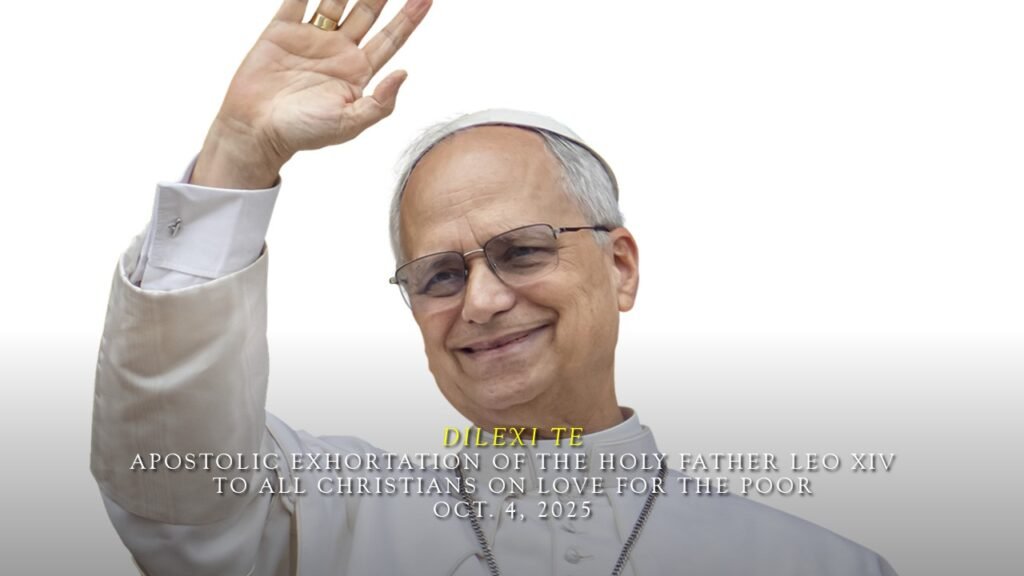
Pope Leo XIV has issued an Apostolic Exhortation called Dilexi Te about Christian love for the poor. Nothing in it will surprise anyone familiar with the Scriptures and what the Catholic Church has taught for 2000 years, but he is reminding us as we need to be reminded on a regular basis.

Pope Leo goes through the Scriptures and stories of Saints through the centuries who showed great love and care for the poor and emphasizes that care for the poor is not op-

tional for Christians, but an essential dimension of being Christian, and our Christianity is not authentic without it.

1 Corinthians 9:7 “God loves a cheerful giver.” I remember one church sign that said, “God loveth a cheerful giver, He accepteth from a grouch.” The saying has a more profound meaning than people think. Real generosity is not just giving but joyfully giving.

Our faith calls us not just to comply with commands but be transformed to our core. To be a Christian is to give ourselves to Jesus to transform us by the power of grace. The more we are transformed into the image of Christ the more we seek to give of ourselves, because that is who we are. Hence, the Holy Father warns that worship that is authentic is worship that moves us to care for the poor.

We should not approach them as if they were inferiors, but as brothers and sisters. We encounter Jesus in them, and we can learn from them. We are not only to offer material

help, but dignity and spiritual help gathering them into the community.

He says that giving material goods is meant to be a provisional solution, and better to help them get a good job by which they can earn a enough to live with dignity.

He talks about getting to the root causes. We could have a good deal of conversation about the root causes of poverty. I have heard that those who come from fatherless families are more likely to be poor. How can we address the issue of fatherless families? Helping people to produce more value so they could get good jobs seems important. Would school choice help people escape failing schools and be better prepared? Let’s look at who our celebrities are. What if we did more to lift up those people those people who worked hard and accomplished things that helped people. A culture that valued self-improvement and achievement over gratification of desire might produce fewer poor people.

He warned not to just let the government do it, but neither should we deny the government role in caring for the poor. There needs to be a lot of conversations about how that

all shakes out. One thing that doesn’t help is saying, “You don’t agree with what I think will help, so you don’t care about helping.” I see this again and again in different forms, and I think it is a serious obstacle to productive dialog. There’s a Youtube video called “Bishop Barron on Paul Ryan and Catholic Social Teaching” that talks about the coming together of subsidiarity and solidarity and how there can be different perspectives.

More on this next week.

Blessings,

Fr. Jim

Wake Up Call!

Dear Folks,
There was an article in March 4, 2025 “Crisis” magazine, “Catholics are Rapidly Losing Ground.” (Scan QR code to read) It gives nasty, nasty statistics on how we are losing members, such as, “for every 100 people who join the Catholic Church, 840 leave. So when you rejoice seeing folks become Catholic at Easter (which you should), remember that more than 8 people have left by the back door for each one who’s come in the front. No other religion has nearly as bad of a join/leave ratio.”
If this is not a wakeup call, what would a wakeup call look like?
I suggest there is one basic cause: Catholics have believed that the Catholic faith is much less than what it is. For example, Brant Pitre’s book “The Case for Jesus: The Biblical and Historical Evidence for Christ” tells of being in a Catholic college and being taught things about the Bible that undermined its credibility and almost cost him his faith. However, he still (thanks be to God) continued, and when he was studying for his doctorate, he learned that those theories lacked evidence and were just being passed around uncritically. He found there was more basis for trusting the Gospels than he had been led to believe. Our Catholic faith is greater than we think it is.
It will not help to complain about what someone else (the Pope, the bishops, etc.) should be doing or should have done. Correct or not, that won’t move us forward. During this Lent, I challenge everyone to ask God, “How are you calling me to respond to this moment in history?” and then pray for the grace to answer the call.
The early Church started with a tiny group of people, almost no resources, and surrounded by a fiercely hostile culture. They grew like a grease fire. The mightiest empire in the world was helpless to stop them. According to my reading of Acts of the Apostles (a great book), they basically did four things: They told the Gospel story. They worked together as community. They worshipped God. They helped people in need. Does anyone believe we have no room to grow in any of these areas? Can we each ask: How can I learn more about the Christian story? How can I learn better to articulate
it? There are so many resources, everyone can do something.
How can I help connect the faith community? How can I better invite and welcome strangers, and how can I better connect with my fellow parishioners? How can I be better at reconciling conflict in our midst (this alone, I suggest, would greatly enhance the strength of the faith community)?
How can I better worship God? How can I broaden my prayer life? How can I discover that the Mass is so much more than I was taught, and I can worship so much more deeply than I realized?
How can I better help those in need?
If we answer this moment (I think things will get worse before it gets better) the Church can get much better. We serve a mighty, mighty God, who calls us to greatness.
Blessed Lent,
Fr. Jim 

Catholic Truth

Dear Folks,

How to think about people who seek God but are not Catholic? First, there is the question of Christians who are not Catholic, and the Second Vatican Council’s Decree on Ecumenism (Unitatis redintegratio) talks about our relationship with them. Second, there are nonChristian religions and Vatican II deals with that in Declaration on the relations of the Church to non-Christian Religions (Nostra aetate). They are both worth a read.

The Catholic faith is the fullness of truth about Jesus, but there is much that is true that our Protestant brothers and sisters teach, and some things that are true as taught by other religions. God gives everyone the light of natural reason, and so it is not surprising that some true things are taught by groups like Hindus, Buddhists, and Muslims. Christians and Jews have received special revelation in addition, and it is completed by the Jesus event.

All who are saved, all who get to heaven, do so by the power of the Sacrifice of Jesus, whether they understand it explicitly or not. “And this is the verdict, that the light came into the world, but people preferred darkness to light, because their works were evil (John

3:19).” Our salvation is God’s work, not ours. Those who understand who Jesus is and what He is about and choose not to follow Him will be condemned. Those who had not heard about Him, or were taught the Gospel so badly that they could not recognize Him as

the light are another story (and I suggest that latter group is huge). That said, we must not get complacent. We don’t get to sit back and relax. If you read the Gospels (which I highly recommend!) and take them seriously (which I very highly recommend!!) we are warned that we don’t just coast into heaven (See, for example Matt 5:29-30; 7:13-14; 1 Corinthians 9:27).

Jesus wanted His people to be one (John 17:22). I think Satan laughs himself silly every day that Christians are divided and teaching contradictory things. We speak of God’s ordaining will, and God’s permissive will. His ordaining will is that everything and everyone be all good, but He permits us to do evil, and He will bring good from it.

Other religions can be a gift in certain ways: they can help people whom we have not yet reached (though we need to get on that); they provide a challenge for us to better witness to the goodness, beauty and truth of the faith (easy to get complacent when everyone agrees); they can remind us of aspects of our faith that perhaps we have been neglecting.

For example, a few generations back, people told me the Catholic Church did not encourage them to read the Bible. Our Protestant brothers and sisters reminded us of the importance and benefits of reading and being familiar with the Scriptures (and, if you look at

Church documents and history, it is a strong part of the Catholic faith).

Having all of these gifts of the Catholic Church is not a privilege that occasions pride, but a responsibility. “Much will be required of a person entrusted with much, and still more will be demanded of the person entrusted with more (Luke 12:48).” Think of all the gifts

we have been given. What will God expect from us?

Blessings,

Fr. Jim

Bread of Life: What is God Doing?

Dear Folks,Every three years our lectionary takes us through the Bread of Life discourse in the Gospel of John. Having just finished the Eucharistic Congress, continuing the Eucharistic revival, we are presented with five weeks of following John chapter 6.I’m going to challenge everyone to take advantage of this time.1. Present yourself to God to be changed by this journey. You can imagine that the disciples were changed by this day. In the Eucharistic prayer, I pray for the Holy Spirit to transform the bread and wine, then I pray that the Holy Spirit will transform us.2. Reflect on the Gospel story throughout the week. All four Gospels relate the feeding of 5000 families with five loaves and two fish. Matthew and Mark also tell the story of feeding 4000 with seven loaves and a few fish. We are really familiar with thisstory. What would it be like for the disciples, who had no idea what was about to happen? The Gospels reveal special treasures when we look at them more closely, and this is especially true of the Gospel of John. I suggest that each sentence is importantand has a purpose. What might it be?3. Try to do some extra learning. If you have not yet read Brant Pitre’s book “Jesus and the Jewish Roots of the Eucharist,” Bishop Robert Barron’s “This is my Body,” Scott Hahn’s “The Fourth Cup” or “The Lamb’s Supper,” or any of Timothy O’Malley’s books, this might be an opportunity. On Formed.org there is great stuff.4. The talks from the Eucharistic congress are available on YouTube. There is so much that can be done so easily. Those of us who weren’t able to make it in person can participate to that extent. What if you and a group of friends watch a talk and then discuss it afterward?5. We remember that the Eucharist is about gift of self. The Lord gives Himself to us completely in this intimate encounter, and we are learning to give ourselves. What if we asked the question, “If Jesus could get whatever He wanted of me today, what might it be?” What if we let that question percolate in our minds for a while?6. What if we spent some extra time in front of the tabernacle or the monstrance. We remember that the Eucharist is not a thing but a person, the person of Jesus. As we focus on His presence, He is ever aware of our presence. He is watching you. Now. Yes, now.7. After we receive communion, let us go forth from Mass remembering that Jesus is within us. How does that awareness change how we act?I challenge you to do something different. Something. Anything. How can we open a new door in our minds and hearts to let Jesus in more deeply?

Blessings,

Fr. Jim

Fully Praying the Mass

Dear Folks,
Today is the Solemnity of the Most Holy Body and Blood of Christ. When we talk about the hope that the Catholic Church in America flourishes in the future, how much we flourish will revolve around how we respond to the Eucharist. The Second Vatican council has
given us some principles:
1. We are called to understand: Jesus is uniquely present, and makes present His one sacrifice on the cross (which happened once in history, but whose power is eternal, see Revelation 5). We are called to participate and be incorporated into that sacrifice,
that we can become an offering to God.
2. We are called to participate internally: The faithful are called to offer the Divine Victim not only through the priest, but together with him, and in so doing offer our own lives. We offer our work, our struggles, our suffering, our joys and sorrows, all the
aspects of our walking with God through the week.
3. We are called to participate externally: This expresses and strengthens our internal participation and encourages those around us to participate more fully (we are responsible for supporting each other). We are called to sing or say the words and do the actions that the liturgy gives us to do and do it like we mean it. There is no need to add a bunch of other things that the liturgy does not call us to do; we can focus on doing our part with all our minds and all our hearts. That will be challenge enough.
4. We are called to live out the meaning of what we celebrate in the rest of our lives that week. Think of how a bride and groom give themselves to each other in their marriage vows at their wedding and give themselves to each other is living out those vows
in their lives. The sacrament and the living out the sacrament form one act of selfgiving and each gives meaning and strength to the other.
Having someone who cares for us personally is unlike anything else in reality. I hear people are developing robots with artificial intelligence and the ability to mimic human expressions. They can be programmed to tell us how much they love us and how wonderful we are. Someone might fool themselves for a while with such a toy, but ultimately it is empty. What matters is encountering someone who truly loves us. No one loves us more than the Lord, and this most intimate encounter in the Eucharist is more precious than anything the earth can offer. Many people leave the Church or stop coming to Mass because they forget this or never were taught in the first place. If we realized what a great gift it is, how could we leave? What on earth could make us stop coming?
As I have said before, if we want a better church, if we want a better world, the first step is to fall more deeply in love with Jesus. One thing we can all do is ask: do I respond to the call to the Eucharist like I really believe in it?
Blessings,

Eucharistic Culture

In Timothy O’Malley’s “Becoming a Eucharistic People” he talks about developing a Eucharistic culture. Vatican II’s Constitution on the Church in the Modern World (Gaudium et Spes), we read, “The word ‘culture’ in the general sense refers to all those things which go to the refining and developing of man’s diverse physical and mental endowments (Gaudium et Spes 53).” If you have ever gone to a different country with a different culture, you notice some differences that are not official policies, but taken for granted. In some countries people are more expressive emotionally, and in other countries more reserved. In some, punctuality is extremely important, and in others they tend to be more relaxed. When we grow up in a particular culture, we tend to pick up its assumptions, habits, and attitudes without thinking about it, and it seems normal and natural. It can be a surprise that elsewhere people think and do things differently. Our culture becomes a lens through which we look at everything.

We are called to build a Eucharistic culture, as Pope Benedict said, “Christianity’s new worship includes and transfigures every aspect of life: “Whether you eat or drink, or whatever you do, do all to the glory of God” (1 Cor 10:31).” Christians, in all their actions, are called to offer true worship to God. Here the intrinsically eucharistic nature of Christian life begins to take shape. The Eucharist, since it embraces the concrete, everyday existence of the believer, makes possible, day by day, the progressive transfiguration of all those called by grace to reflect the image of the Son of God (cf. Rom 8:29ff.). There is nothing authentically human – our thoughts and affections, our words and deeds – that does not find in the sacrament of the Eucharist the form it needs to be lived to the full. Here we can see the full human import of the radical newness brought by Christ in the Eucharist: the worship of God in our lives cannot be relegated to something private and individual but tends by its nature to permeate every aspect of our existence. Worship pleasing to God thus becomes a new way of living our whole life, each particular moment of which is lifted up, since it is lived as part of a relationship with Christ and as an offering to God. The glory of God is the living man (cf. 1 Cor 10:31). And the life of man is the vision of God. (Sacramentum Caritatis 71).” Whatever we do, we are called to do as a Eucharistic people.

What is the culture of your faith community?

Do parishioners see themselves as customers in the church or disciples and coworkers in mission?

Is there a sense of awe and reverence about the sacred or is it more casual? How aware are people of their fellow parishioners, their fellow worshippers?

Do people act differently when they enter the worship space, or is it treated the same as any other room?

Is there a connection between participation at Mass and life? Is Eucharistic adoration common, or only for a few?

This is only a taste. There is much more to be said about what it means to be a Eucharistic people and what it means to build a Eucharistic culture. That will be in the future.

Blessings, Fr. Jim

Jesus who Reconciles

Dear Folks,

As we continue to celebrate the Easter season, we encounter the risen Jesus in John 21. It is worth looking at it a little closer.

We see an echo of Luke 5:1-11, when Jesus called Peter, James, and John. After a night of catching nothing, it was morning (See Luke 1:78), Jesus calls them to put out their nets again. As with several of the resurrection accounts, they don’t immediately recognize Jesus. They bring in a very large number of fish (153!), but unlike in the Lucan account, the net is not tearing (John 1:11). Scholars have said that in those days there were 153 different species of fish, and this is a foreshadowing of the Church being able to hold all kinds of people together (when there is a schism in the Church, that is a result of human failing, not a limitation of God’s Church).

Jesus calls them to bring some of the fish they had caught, but he already had bread and fish cooked on a charcoal fire (John 21:9-13). This makes no sense at first, but it echoes all the accounts of multiplying loaves and fishes, in which He calls them to bring forth what they have, but it is He who feeds. This is a paradox in Christianity: it is all the work of His grace, but it requires every last bit of effort that we have. Grace is not an excuse to slack off, and our efforts do not allow us to boast before Him as if we had accomplished something that He has not given us.

Notice it is a charcoal fire (details matter in John, and we must keep our eyes sharp). Remember John 18:18, in which Peter was warming himself around a charcoal fire when he was denying Jesus. Psychologists tell us that our sense of smell is the most powerful sense for evoking emotional memories. Do you think his three-fold denial was on Peter’s mind? Weighing heavily on him? Hmm. Jesus does not address the denial directly, but calls for a three-fold affirmation, each time bringing a call to take care of Jesus sheep (we remember that Jesus is the good shepherd as He taught in chapter 10). Jesus reconciles with Peter and sends him forth as shepherd. The gift he was given was not just for his sake, but for the sake of Peter’s service to the mission of the Church. Going through Acts of the Apostles, we see that God will protect Peter and Paul again and again, but still allow them to suffer and eventually be martyred. It is about what serves the mission.

As an Easter people, we come to Jesus confidently, knowing that He has won the victory. We can bring our sinfulness to be reconciled, knowing that the gifts we receive are not just for our sake, but so that we can serve the mission of the Church. We are called to put forward our mightiest effort, but know it is He who wins the victory. To be an Easter people is to be a people of mission.

Blessings, Fr. Jim

Spirit of Peace

Dear Folks,

As we continue the Easter season, we reflect on how to be an Easter people. Our Gospel last Sunday has two parts: the giving of peace and the Holy Spirit for the sake of reconciliation and showing Thomas something to help him believe. My thought on this is how we as Christians should be reconcilers, and that will help people believe, Jesus said to Thomas, “Blessed are those who have not seen, but have believed (John 20:29).” This does not mean they believe without reason. People may not see the wounds of Christ, but if they see that our behavior is different from the general population because of our faith, then they will have grounds to believe that what we say about Jesus is real.

One of the ways we can strive to be different is being better reconcilers and peacemakers. There is a lot that can be said about how to do that (and I have tried on different occasions). Easter is a good time to talk about how peace can grow from being less concerned with our own desires and more concerned with pleasing God.

St. Paul teaches, “If then you were raised with Christ, seek what is above, where Christ is seated at the right hand of God. Think of what is above not what is on earth. For you have died, and your life is hidden with Christ in God (Colossians 3:1-3).”

If our desires are paramount, our desires will always get in the way of each other. “Where do the wars and where do the conflicts among you come from? Is it not from your passions that make war within your members? You covet but do not possess. You kill and envy, but you cannot obtain; you fight and wage war. You cannot possess because you do not ask. You ask but do not receive, because you ask wrongly, to spend it on your passions (James 4:1-3).”

Even if we are fighting for God’s truth, against the forces of evil, we do it as people of faith. We can spend ourselves generously to build goodness without the desperation that comes from thinking it all depends on us. We remember people thinking they could save the world without God (I’m thinking of Hitler, Stalin, and Mao) who were sure they were building a better world and that they were so important that they should have no limitations. They killed millions because they thought the tradeoff was worth it. We do what we can do, careful to show that we love even those who oppose us, knowing that God Himself will bring about the victory. The greatness of our cause calls us to higher standards of behavior, not lower. Church people have done nasty stuff when they have forgotten that.

We remember that the ability to do this depends on the Holy Spirit. We are not just celebrating the great season of Easter (though that would be plenty in itself), but also preparing for the great feast of Pentecost. This is a time to reflect and consider how our relationship with the Holy Spirit is enabling us to live as an Easter people.

The gifts of the Holy Spirit (from Isaiah 11) are wisdom, understanding, knowledge, council, fortitude, piety, and fear of the Lord. The traditional explanations of the first four tend to be a bit subtle, but I think they boil down to knowing that God is more important than anything else, understanding how that affects the way we look at life, and what is life is truly of value, seeing how it all connects, and knowing how to respond. Fortitude is the strength actually to do what we now know we should do (based on the first four). Piety is a sense of awe toward God and attentiveness to Him. Fear of the Lord is, of course, not about fear in the usual sense, but a deep desire to be pleasing to God and a deep horror of displeasing Him.

The fruits of the Holy Spirit (from Galatians 5) are love, joy, peace, patience, kindness, generosity, faithfulness, gentleness, and self-control.

As we prepare for Pentecost, we can pray regularly for the Holy Spirit to increase these attributes in us, that we may better live as an Easter people, may better be peacemakers, and may better be witnesses of the Gospel to the world.

Alleluia! Fr. Jim

Love and Baloney

Baloney.jpg[1]

Love and Baloney

Imagine a young man and a young woman.  They have very little money, but he goes out into the fields and collects some flowers.  He makes them baloney sandwiches and puts them in a paper bag.  He spreads out the picnic on newspaper, and says to her, “I love you more than the sun, the moon, the stars, brook trout and the Green Bay Packers. Will you be with me for the rest of our lives?”  She melts.

Now, it is their fiftieth anniversary.  Even though they live in an upscale condo in the center of a large city, he drives to the country and picks wild flowers.  He makes baloney sandwiches, and puts them in a paper bag.  He spreads newspaper on the table, and says to her, “I love you more than the sun, the moon, the stars, brook trout and the Green Bay Packers. Will you be with me for the rest of our lives?”  She melts.

Someone who didn’t know the history might say to him, “Are you crazy? Your fiftieth anniversary, you could easily afford roses and catering, and you do this?”  It is the connection to the history of the relationship that gives it meaning that it would not otherwyse have. In relationships, rituals, signs and symbols can have a power beyond what they are because of what they mean. (I suspect he also took her out to a nice restaurant, but that is another story.)

In religion, there are a lot of signs, symbols and rituals. Many who don’t know their meaning will disparage them and say they have nothing to do with God.  Many times they are practiced by those who don’t know or don’t care about their meaning, and then they fail in their purpose, and can even do harm (see I Corinthians 11).

There are many who say that a personal relationship with God is something separate from religion, and that they love God but have no use for religion.  I suggest that they either do not understand how ritual, structure, sign and symbol can be a key part of a relationship, have never been taught the meaning of these activities, or experienced people who went through the motions without attending to what they meant.  A kiss is meant to be a sign of affection and caring.  If someone gives you a kiss and then treats you like garbage, that sign is worse than useless.  It even does harm.

Many have left the Catholic Church or are minimally connected because they have not experienced it as a powerful encounter with the love of God. However, if they could only understand that every aspect of the Catholic faith is about encountering, walking with, and loving God.

A next step is with the book A Biblical Walk through the Mass by Dr. Edward Sri, or even his video study program:

http://ascensionpress.com/t/category/study-programs/the-mass/biblical-walk-through-the-mass

And that’s no baloney.

Day 13 in Rome

Day 13, Last day to wander around Rome

Piazza dei Populi

Piazza della Republica

Piazza1.jpg[1]           Piazza2.jpg[1]

Via di Quattro Fontani

Rome is thick with history and art.
The Church of Santa Maria della Concezione dei Capuchini

The Capuchins, of course, have a lot of history in Rome. After all, they got a drink named after them (what kind of drink do you want named after you?). This church is most famous for its crypt with its arrangements of the bones of deceased Franciscans.   These bones have been stacked and arranged artistically requiring the bones of thousands of hours of work. (They didn’t want pictures taken. More info at:  http://www.atlasobscura.com/places/santa-maria-della-concezione.)

I am reminded of the St. Katherine’s monastery at the base of Mount Sinai. They had a building with bins of skulls, bins of leg bones, etc. The idea was to have no personal monument on earth. We remember that on one (on earth) knows where the body of Moses is buried. Here we have no lasting city (Hebrews 13:14). Nathaniel Hawthorne visited this crypt in Rome and found that it dragged down his faith, and he needed blue skies to recharge it.

I’m surprised he would react that way given that his most famous work “The House of Seven Gables” is not the cheeriest text.

One can also question of that is a proper way to treat human remains. However, it speaks of people who were comfortable with their own mortality, and with mortality in general. The museum shows a painting of St. Francis holding a human skull. We remember the admonition of St. Benedict to keep our mortality daily before our face, and the old adage, “Time flies, remember death.” Longfellow wrote, “Art is long, and time is fleeting, and our hearts, though stout and brave, still like muffled drums are beating funeral marches to the grave.”

Perhaps that is to teach us to take ourselves less seriously, for our stay here is so brief while at the same time take our work more seriously, because history is so much larger than we are, and marks that we leave (recognized as ours or not) can affect people for a long time.

When they were laying the first bricks on the Palatine hill, what were they envisioning? It is hard to believe they were planning on an Empire that would last a thousand years, and then leave tools that would help the building of what followed.

Of course, it took the work of countless people, whose bones have long turned to dust, to make that happen. On the one hand, the large number of people involved makes the contribution of each a smaller part of the whole; on the other hand, the gathering of so many contributions made the effect of each last longer and reach farther. I was given to understand that one of the early symbols of Rome was a bundle of sticks, suggesting that bound together they were so much stronger than each individually.

I would also suggest that the effect of our contributions is not merely cumulative, like the value of pennies in a jar, but one can build on another, like supports on a bridge. St. Ambrose encouraged St. Augustine, and both were influenced by St. Paul. Was there a teacher, a parent, or an uncle that gave St. Paul critical encouragement or support that moved him to the path of being zealous for God or strong in learning?  How do you weigh the total effect of that unknown person?

The Church of Santa Maria della Vittoria was even more beautiful than most. My first reaction was, “I want one!” There were some excellent sculptures including the famous Ecstasy of St. Teresa of Avila.

Vittoria1.jpg[1]         Vittoria2[1]        Avila.jpg[1]

The Church of Mary of the Angels and Martyrs was large with many large works of art. One wing was dedicated to prayer (the rest to tourism).

While I was there, Mass happened and a small group participated.

Of course, that brings me back to the central point. The greatest treasures are not the buildings, the sculptures or the paintings, but the faith and devotion of the people.

This is the end of my Rome trip.  Next post will take this blog in a new direction.