Tag Archives: Faith

To Comfort and Afflict

Dear Folks,

For the next three weeks we have a particular challenge: One Mass with scrutinies will have the cycle A readings (which this week includes the story of the woman at the well in John 4), and the other Masses will have the cycle C readings (which this week includes Luke 13:1-9). It is worth comparing the two. The woman at the well was a Samaritan, and Jesus broke barriers just talking to her. He does not shy away from how her life is a mess, but He doesn’t berate her for it. He gives her respect and concern that she wasn’t used to getting, and that gave her space to change, and she would reconnect with the community that had previously shunned her. By contrast, the text in Luke shows Jesus warning some

fellow Israelites that if they don’t repent, they face destruction.

It has been said that a prophet has two tasks: to comfort the afflicted and afflict the comfortable. This is summed up in Luke with the parable of the Pharisee and the Tax Collector (Luke 18:9-14). The two men were a study in contrast. The Pharisee was presented as having objectively better behavior, but he was convinced he was good enough. Other people needed to improve, but he was convinced he didn’t. The tax collector, by contrast, was not

so virtuous, but knew he needed work. That made all the difference. Until we see pearly gate posts passing our shoulders, we are a work in progress.

It’s okay to be where we are at; it’s not okay to stay where we are at.

During this Lent, what if we asked:

What does God want me to learn?

If God could get every response He wants from me, what would that look like?

What if being a member of the Church means more than I thought?

What if praying the Mass means more than I thought?

When someone talks about a crisis in the Church, how quick am I to say what someone else should be doing differently and how quick am I to ask what I should be doing differently?

If Lent is not working out the way I planned, might God have some different plans?

What might they be?

If God is calling me to change my life in some way, small or large, how ready am I to say “yes” to Him?

Can I accept that how I and people like me respond during Lent can make a difference in the kind of future that our Church will have?

For what it’s worth, I recently came to understand something that had been obvious, but I didn’t see it. Now I see things differently (don’t bother to ask; I won’t tell). I suggest that God is always working on teaching us something and leading us somewhere.

Blessed Lent,

Fr. Jim

Wake Up Call!

Dear Folks,
There was an article in March 4, 2025 “Crisis” magazine, “Catholics are Rapidly Losing Ground.” (Scan QR code to read) It gives nasty, nasty statistics on how we are losing members, such as, “for every 100 people who join the Catholic Church, 840 leave. So when you rejoice seeing folks become Catholic at Easter (which you should), remember that more than 8 people have left by the back door for each one who’s come in the front. No other religion has nearly as bad of a join/leave ratio.”
If this is not a wakeup call, what would a wakeup call look like?
I suggest there is one basic cause: Catholics have believed that the Catholic faith is much less than what it is. For example, Brant Pitre’s book “The Case for Jesus: The Biblical and Historical Evidence for Christ” tells of being in a Catholic college and being taught things about the Bible that undermined its credibility and almost cost him his faith. However, he still (thanks be to God) continued, and when he was studying for his doctorate, he learned that those theories lacked evidence and were just being passed around uncritically. He found there was more basis for trusting the Gospels than he had been led to believe. Our Catholic faith is greater than we think it is.
It will not help to complain about what someone else (the Pope, the bishops, etc.) should be doing or should have done. Correct or not, that won’t move us forward. During this Lent, I challenge everyone to ask God, “How are you calling me to respond to this moment in history?” and then pray for the grace to answer the call.
The early Church started with a tiny group of people, almost no resources, and surrounded by a fiercely hostile culture. They grew like a grease fire. The mightiest empire in the world was helpless to stop them. According to my reading of Acts of the Apostles (a great book), they basically did four things: They told the Gospel story. They worked together as community. They worshipped God. They helped people in need. Does anyone believe we have no room to grow in any of these areas? Can we each ask: How can I learn more about the Christian story? How can I learn better to articulate
it? There are so many resources, everyone can do something.
How can I help connect the faith community? How can I better invite and welcome strangers, and how can I better connect with my fellow parishioners? How can I be better at reconciling conflict in our midst (this alone, I suggest, would greatly enhance the strength of the faith community)?
How can I better worship God? How can I broaden my prayer life? How can I discover that the Mass is so much more than I was taught, and I can worship so much more deeply than I realized?
How can I better help those in need?
If we answer this moment (I think things will get worse before it gets better) the Church can get much better. We serve a mighty, mighty God, who calls us to greatness.
Blessed Lent,
Fr. Jim 

Battle of All Time

Dear Folks,

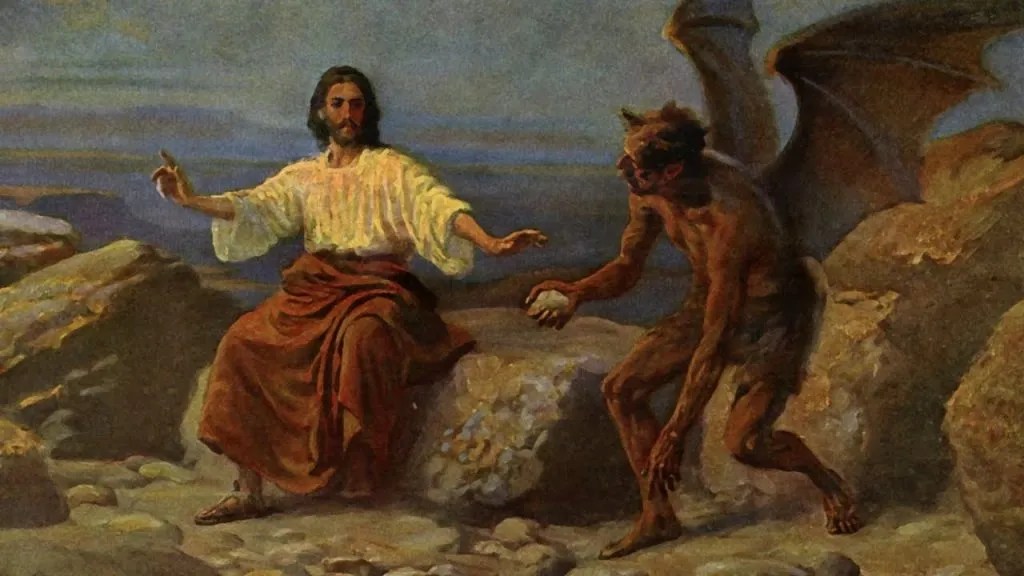
The First Sunday of Lent we deal with Jesus in the desert getting tempted. It is worth noting that our first reading is about offering one’s gift to God. Let’s look at temptation as interfering with our giving ourselves to God as gift.

The first temptation, “If you are the Son of God command these stones become bread.” He was so hungry. It would have been so easy. No one would have known. The test was being able to say no to basic appetites. If we can’t say no to our appetites, they will rule us. Think of His ministry. How many times would He have been hungry, thirsty, tired, or stressed? Being completely faithful to His

mission, His gift to the Father would mean saying no to those desires. If, every time I feel a bit hungry I immediately grab something to eat. If, every time I eat, to keep eating until I’m full, how do I know this desire doesn’t rule me? Why would I expect that I would be able to refuse my stomach? If I can’t say no to it, what is really my god? Did Jesus experience sexual temptation? Our faith tells us He was fully human, so how could we believe He did not? That would certainly have interfered with the course He was on. Of course, there is meant to be great joy in giving oneself as gift in a full, free, faithful, and fruitful relationship. Things like pornography and hookup culture are ways of seeking the thrill without giving ourselves as gift. How much destruction has the pursuit of these appetites caused in our world? How this Lent should I practice saying no to my appetites?

“I shall give you all this power and glory…if you worship me.” Matthew’s Gospel makes this the last temptation, and I figure that it is to emphasize it because of his emphasis on right worship and Jesus as Davidic King. Luke puts it second. But imagine simply being handed over power and glory without having to work or suffer for it. This is the temptation to have power without giving the gift. Jesus would work incredibly hard and suffer incredibly much so that He could transform people and the world by the power of the Pascal mystery. Imagine Him just saying “Scribes and Pharisees, you’ve done a bad job. I’m putting you in prison.” That would have been so much easier than what He dealt with, but it would have only made superficial change. As a pastor, I know that anything I do with just my formal authority is going to be superficial and can be undone just as easily. If I’m going to make profound and lasting change, It requires informal authority, which cannot be given, only earned. It requires more work, enduring more frustration, and being more patient. I long ago learned that if we want to do good, we will need to work harder than we thought for longer than we expected to achieve less than we hoped. The prize belongs to those who do not then give up. We see those who try to force change by coercion. That does not require them giving themselves as gift. We are called to make change with service, witness and sacrifice. We see in our Gospels that is what Jesus did, and he had to face much frustration, and it required everything from Him. How might we give ourselves as gift for the work of the Kingdom.

“Throw yourself down from here” (the parapet of the temple). Luke portrays this as the final temptation, emphasizing that Jesus was facing the full pain of the human condition. The desire to be protected from harm is primal, and Jesus knew He was going to have to face horrific suffering. How do we avoid pain? Do we shy away from painful conversations that we need to face? Do we use drugs or alcohol to numb ourselves? Do we keep ourselves distracted to hide from the pain in our hearts? Do we refuse to leave our comfort zones for the sake of doing God’s work? How might we be called to face things we don’t want to face, but need to?

Have a fruitful Lent,

Fr. Jim

Self Awareness

Dear Folks,

This Sunday we continue Jesus’ Sermon on the Plain (Luke 6:39-45). Jesus gives His famous “Why do you notice the splinter in your brother’s eye, but do not perceive the wooden beam in your own (6:41)?” Jesus touches on the very human reality that it is easier to see others’ faults than our own, and we tend to underestimate how serious our faults are compared to others. This is a tendency for which we must compensate to avoid constant frustration and anger.

Living alone and living with other people, I noticed that my mess was easier to deal with than other people’s messes. Language that sounds fine to me when it’s coming out of my mouth can sound offensive when someone else says it.

There are some books that can help us reflect. “Thinking Fast and Slow” by Daniel Kahneman tells us we prefer a quicker and easier style of thinking that tends to believe that what I see is all there is. In the book “I Never Thought of It That Way” by Monica Guzman she asks a question worth asking on a regular basis: “What am I missing?” “Think Again” by Adam Grant talks about the need to unlearn and relearn.

In the Gilbert and Sullivan play “Princess Ida” we meet a character, King Gama, who introduces himself singing, “If you give me your attention, I will tell you what I am. I’m a genuine philanthropist all other kinds are sham. Each little fault of temper and each social

defect in my erring fellow creatures I endeavor to correct…” He goes on to explain how he tells everyone just what is wrong with them. Then he goes, “I love my fellow creatures I do all the good I can, and yet everybody says I’m such a disagreeable man, and I can’t think why.” If we want to be an effective voice in the world, we don’t want to be like him.

Our faith has many treasures that would benefit the world, but we must be able to share them in a compelling way. For example, Thomas Jefferson thought it was self-evident that we were all created equal, but in the ancient world that was un-thought of outside the Judeo Christian tradition. Christianity was instrumental in bringing such notions to the western world. There is much more to be done in the areas of care for the poor and the outcast,

human sexuality, the meaning of being human, of being man or woman, of marriage and family, of the sanctity of life and other areas. If we can propose a vision and show by our actions that we mean it, there is hope of shifting the conversation. There will always be those voices that try to silence us by claiming we are trying to force our religion on others, even when we are simply proclaiming our vision as they are proclaiming their vision. We seek to participate in dialog in such a way that reasonable people may reject their narrative and actually hear what we have to say.

It begins with serious, deep, honest, and humble self-examination.

Blessings,

Fr. Jim

What Do You Mean by “Love”?

Dear Folks,

This is hard. If Christianity is easy for you, you’re doing it wrong. We are called to help others, and we do not ask if they are worthy of help, but rather we ask what is the most helpful.

We must never forget that having good intentions does not guarantee good actions. We may intend to do good but ultimately do harm instead. Deciding to love our neighbors, including the people we most dislike, is just the first step.

We need union with God to transform us into people who can overcome our sinfulness to love God and others. We know that in Christianity love is not a feeling, but a decision to seek the good of the other. This means understanding what is truly good. We are not the best measure of what is good for us. An alcoholic may believe that the most loving thing for someone to do is give him an endless supply of liquor, but that would not serve his flourishing. His perception is distorted by his addiction. We, because of our sinfulness, have a distorted notion of good, and so we need God’s teaching to help us understand true human flourishing. This connects everything. The Christian understanding of the human person, marriage, sexuality, family, the meaning of work, the meaning of human dignity and human rights, and other issues all connect to the command to love one another. That is why love requires we continue to learn more about our faith.

A number of issues can make loving one another very difficult and controversial. Forgiveness is not an optional part of Christianity, but in the words of C. S. Lewis, “Everyone thinks forgiveness is a lovely idea until he has something to forgive.” Forgiveness is a form of healing, and that takes time.

We must have boundaries, or we will not be able to help for long. Many learn this the hard way. That will often mean refusing to enable bad behavior, even though that can get us accused of being hateful. Loving enough to tell the truth can have the same response. If people are enjoying regular sin, it is not loving to say that sin is not sin.

Self (and other) defense, just war, and law enforcement sometimes require force and even violence. We surround these issues with strict requirements, but there continues to be challenges.

We have the challenge of stewarding limited resources. If I think of a billion people in need, and I give each one of them a billionth of my resources (if it were even possible), that would not be terribly helpful. How do we best respond?

Liturgy needs to be done in a way that best presents the mysteries at work, and not necessarily the way people prefer or are used to.

We need as much of God’s help as we can get to respond to this call.

Blessings,

Fr. Jim

Calling Sinners to Action

Dear Folks,
Our readings this Sunday show two people getting called by God (see Isaiah 6 and Luke 5). We think Isaiah was a priest, and we know Peter was a fisherman. They encountered God and His call while at work and gets their attention in a way that they would be sensitive to. Both have an experience of the divine, and it makes them powerfully aware of their shortcomings. God reassures them so they can answer the call. Notice especially they are not promised reward but given a task.
In fact, they both suffered much for their service. According to the ancient stories, Isaiah was put in a hollow tree and was sawed in half. St. Peter was crucified upside down. He said that he wasn’t worthy to die the way that Jesus died, and so the soldiers (who I presume thought they were funny) did it that way. They certainly knew that answering God’s call didn’t lead to an easy path, but I suspect they didn’t know how hard it was going to be. God strengthened them on their journeys so that they could be faithful even to their extreme endings.
I would suggest that God is testing our Church now, and our future as Church will pivot around our response to His call. Are we accepting the challenge to be coworkers in mission. We may get frustrated with the Church sometimes (I speak from experience), but rather than focus on what the Pope, various bishops and various priests should be doing (or not doing), we can focus on what we can do to further the mission in our little corner. There will always be things going on that we don’t like, that we think should be done differently. Coworkers in mission focus on how the Church can best respond to Jesus’ command to make disciples of all nations, and how we can help make that happen.
We seek to grow in holiness not just for our sake, but so that God’s light might shine more brightly through us (Mat 5:13-15). If we want a better world, the first step is always to fall more deeply in love with Jesus.
Next, we consider how we tell the Gospel story. If you take a look at this Sunday’s second reading from 1 Corinthians 15 St. Paul relates the basic message of Jesus (called “the kerygma”). How would you sum up the Christian message? Christopher West says it’s “God wants to marry you.” Another way would be, Jesus brought perfect love into the world, and by the power of that love He can conquer evil in us.
How do we work together as community? Are we inviting and welcoming? How well and how lovingly do we resolve conflict in our midst? Does it show that Jesus is at work here?
How do we worship? Do our presence and our participation show that we are doing the most important work of our week? If we are focused on giving ourselves completely to God in worship it will show. How do we help those in need? Do we amaze the surrounding community with our love in action? Jesus invites us to come and fish for His people. How do we answer?
Blessings,
Fr. Jim

Presenting One’s Gift; Presenting One’s Self

Dear Folks,
This is the Feast of the Presentation of the Lord, when Mary and Joseph present Jesus in the Temple, a familiar story. We can easily skip over the text that talks about the Law that says,
“Every male that opens the womb shall be consecrated to the Lord” calling for sacrificing “a pair of turtledoves or two young pigeons (Luke 2:23).” What’s that about? In Exodus 13:2-12 we see the command to ransom the firstborn and connects it to the exodus from Egypt and God’s saving action. The firstborn belongs to him.
We know that in those days, it was common to sacrifice one’s child to the gods, notably Molech. When we look at bad things that were going on in the Old Testament, It’s important to remember that what was going on in the surrounding cultures was worse, much worse.
We all know the story of the testing of Abraham, in which God commands Abraham to sacrifice his son Isaac but stops him at the last minute. This showed first that Abraham was completely dedicated to obeying God, whatever the cost. Second, this was God rejecting the practices of child sacrifice. In the Law of Moses, God commanded, “you shall not offer any of your offspring for immolation to Molech, thus profaning the name of your God. I am the Lord (Lev. 18:21).” In Leviticus 20:1-5, God will use stronger language and fierce sanctions. Ezekiel 16:20-21 and 20:26 tell us that the Israelites sometimes broke that commandment. Being surrounded by larger, stronger adversaries, it was tempting to think that imitating their practices would give them power. God rejected that, and in its place was the practice of redeeming the first born.
That is behind the practice of presenting the child in the temple. This foreshadows the day when Jesus sacrifices Himself for us. God Himself would give His only begotten Son for our sake.
I have already recommended Katy Faust’s book “Pro-Child Politics.” It is a series of essays claiming that many current practices sacrifice the wellbeing of children for the sake of adult desires. Each one is by someone knowledgeable in the particular area, so even if you don’t agree with every position taken, I suggest it would present a powerful challenge. If we have a hard time believing or understanding how the ancients could practice child sacrifice, let us ponder what our society accepts today.
As we reflect on Jesus’ presentation in the temple, how might God be calling for us to care for children today?
Blessings,
Fr. Jim

The Bride and the Lamb

Dear Folks,
This year most of the Gospel readings on Sunday will be from Luke, but today we slip into John to talk about the wedding of Cana. The Bible regularly uses the image of marriage for
God’s relationship with His people. We can see for instance Isaiah 62:4-5; book of Hosea, book Song of Songs, Psalm 45; Ephesians 5:29-32; Luke 5:33-35; John 3:29; Revelation 19:6-9, and Revelation 21:9-14. At the wedding at Cana, we see Mary coming to Jesus with
the problem of running out of wine. If you read Brant Pitre’s excellent book “Jesus the Bridegroom” he will explain that the responsibility for providing the wine falls to the bridegroom, so Jesus is being revealed as the bridegroom. John the Baptist will make this point in John 3:29, and then in the wedding of the bride (the Church) and the Lamb (Rev. 19:6-9; Rev. 21:9-14).
Someone once said, “If you treated your friends the way you treat God, would you have any friends?” We could ask if you treat your spouse the way you treat God, how good a marriage would you have?
I’ve recommended John Gottman’s book “Seven Principles for making Marriage Work” before. He has empirical data to back up his ideas, and they are very interesting. I wonder how some of them could be applied to our relationship with God.
Enhance your love maps. Your love map is what you know about your partner, their likes, dislikes, favorite food, favorite TV show, etc. Are we curious to know more about how God has revealed Himself and interacted with His people. This would include stories from the Bible and the lives of saints, how God calls us to worship, and what He teaches. It starts with being curious.
Nurture your fondness and admiration. What do you appreciate about your spouse? How did you first fall in love? What were good times and what attracted you to each other in the early days? How did we first come to know God? What have we found good about
Him? What have been good experiences of His work in your life?
Turn toward each other instead of away. Gottman uses the example: if your beloved calls you to the window to see a cardinal (I presume the bird) in the back yard, do you come and look, or do you roll your eyes and move on? Those experiences make a difference. How do you connect in little ways with God throughout the day? Do we let Him have a bit of attention and interest in little ways? How do we connect Him to our world?
Let your partner influence you. Have you let your partner change the way you do something, look at something, approach something? How has our relationship with God changed the way we do things?
Build shared meaning. Take the two separate life stories and weave them into one story. What is your life story? God’s story, the story of salvation, the Bible story and the story of the Church is one big tapestry. How do we see ourselves woven into it? Love relationships can be nurtured. God loves with infinite love, and we have a lot of room to grow. How might we let God have more of ourselves?
Blessings,
Fr. Jim

Baptism of the Lord: New Beginning

Dear Folks,
This is the feast of the Baptism of the Lord, the final day of the Christmas season. I believe that Epiphany was the end of the season, and celebrated the coming of the Magi, the miracle at Cana, and the baptism of the Lord, butsomeone decided that the Baptism should have its own feast day.
I challenge everyone to read Luke chapter 3 and get a sense of John’s call to renewal. Notice his images of the axe and the tree, then the wheat and the chaff. Now if you read Psalm 1, then Luke
13:1-9. We see how the Bible reinforces lessons by the repeated use and development of imagery.
The Gospel of John does some interesting teaching on baptism.
“Amen, amen, I say to you, no one can see the kingdom of God without being born* from above.” Nicodemus said to him, “How can a person once grown old be born again? Surely he cannot
reenter his mother’s womb and be born again, can he?” Jesus answered, “Amen, amen, I say to you, no one can enter the kingdom of God without being born of water and Spirit. What is born of flesh is flesh and what is born of spirit is spirit.e 7 Do not be amazed that I told you, ‘You must be born from above.’ 8 The wind* blows where it wills, and you can hear the sound it makes, but
you do not know where it comes from or where it goes; so it is with everyone who is born of the Spirit (John 3:3-8).”
The word “born” can also be translated “begotten,” as in “Abraham begat Isaac. Isaac begat Jacob…”. In Biblical times, the seed of the father determined what you were and was the key to your
identity. We see Jesus talking about this in John 8:39-44, who your father really is makes all the difference.
It is in this light, we see that baptism changes who we are, and now we are children of God.
Jesus, of course, was already the begotten Son of God, so His baptism did not transform Him. He who was without sin, took on the mantle of sinner to suffer for our sins. “But he was pierced for
our sins, crushed for our iniquity (Isaiah 53:5).” He reversed our journey to perdition so that we could be saved. We remember when people were created, they were first tested in a garden and
failed. Then with Moses, they were tested in a desert and failed. Jesus, right after His baptism, went to the desert to be tested, and passed. His journey would lead him to the garden of Gethsemane and He would pass again. Then he would be crucified to save us.
Jesus’ baptism marked the beginning of His mission, and our baptism marks the beginning of our journey as disciples, children of God. Everything follows from that. How is God calling us to renewal? What form might that take in our journey of 2025?
Blessings,
Fr Jim

Seeking the Light

Dear Folks,

This is the feast of the Epiphany. We celebrate the mystery of Jesus being opened to the larger world, and the Magi are a reminder that Jesus is for everyone. We are not meant to keep the Gospel for ourselves, but to share it with the world.

I would suggest that our future as Church depends on how deeply we understand that Catholics are not meant to be customers in the Church but coworkers in mission.

First, let’s recognize that passing on the faith to the next generation requires more than people have thought. Given that so many do not practice the faith when they grow up, it is clear that running them through the programs is not getting the job done. What does it take? Let’s keep asking that question.

Many Catholics are uncomfortable with the ideas of being missionaries and evangelists. We were not trained to do this. Two thoughts: First, how can you read the New Testament and think disciples of Jesus Christ could remain in their comfort zones? Second, we don’t have to be St. Paul. There are some simples things we can do that can start us on our way.

The American bishops put out a document called “Go Make Disciples.” I suggests three goals for sharing the faith: 1.) To bring about in all Catholics such an enthusiasm for their faith that, in living their faith in Jesus, they freely share it with others, 2.) To invite all people in the United States, whatever their social or cultural background, to hear the message of salvation in Jesus Christ so they may come to join us in the fullness of the Catholic faith,

and 3.) To foster gospel values in our society, promoting the dignity of the human person, the importance of the family, and the common good of our society, so that our nation may continue to be transformed by the saving power of Jesus Christ. That is to say, we are to grow in the faith ourselves (continue to evangelize ourselves. We are not done getting evangelized until we get to heaven). We are to evangelize other people (Invite outsiders in,

and invite insiders deeper in). We are to transform society by the power of the Gospel (evangelize the culture).

I suggest four aspects of drawing people in. First, we tell the Gospel stories. We can hone our story telling skills. Our faith involves lots of great stories: Bible stories, stories of the saints, stories of our own walk with God or others that we know, stories of the history of

the Church. Stories engage people like lectures do not, and they have helped shape thinking and culture since the dawn of the human race. Second, we can work together as community. This includes how we invite, and it includes how we reconcile our differences. If we get good at that those two things, our faith community can be a very attractive haven in a hostile world. Third we can worship God. If we worship like we really mean it, like we believe we are touching the deepest transcendent reality and the core of the meaning of our lives it will show, and it will attract those hungry for deeper meaning. Finally, we can be a mighty force for helping people in need. The more we do to help those in need, and the more lovingly we do it, the more people can see the love of Jesus is at work here.

It begins by believing that the Gospel is meant for everyone, and that it is for us to bring it to them. If we accept God’s call, He can get us from wherever we are to where He wants us to go.

Blessings,

Fr. Jim