Monthly Archives: May 2026

The Trinity Matters

Dear Folks,

This is the Feast of the Holy Trinity.  Some people gloss over this doctrine like they are checking a box, but this truth has such treasures. In the first century, the big argument was whether we were called to works of the Law of Moses or faithfulness to Jesus. The next several centuries the big arguments were about who and what Jesus is and the nature of the Trinity.

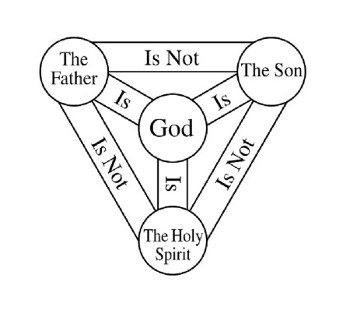
The Father is eternally giving Himself to the Son, who is eternally receiving and returning that love. The love that passes between them is the Holy Spirit. God Himself is already the perfect community of love and so has no need for creation. However, love is by nature fruitful, so God created the universe (including us) out of love.  Christianity teaches that the whole universe is a love story.   

The fullness of being alive is to receive love and give ourselves in love. We often, being human, get distracted by other things, but Jesus teaches us how to receive His gift of Himself, and how to give ourselves in return. That is all of Christian practice.  

Consider what Jesus said: “I pray not only on behalf of these, but also for those who through their word will come to believe in me. May they all be one, as you Father, are in me and I in you, may they also be in us so that the world may believe that you have sent me. The glory that you have gave me I have given to them, so that they may be one, as we are one. I in them and you in me, that they may become completely one, that thus the world may know that you have sent me. Father, allow those you have given me to be with me where I am, so that they may behold my glory, which you have bestowed on my because you loved me before the foundation of the world (John 17:20-24).” We are called to be drawn into that community of love that is Father, Son, and Holy Spirit. 

I suggest that a good thing to do on the Solemnity of the Trinity would be to read Jesus’ farewell discourse (John 14-16) and great priestly prayer (John 17). Jesus said it much better than I could. 

Blessings,

Fr. Jim
We Have been Sent

Dear Folks,

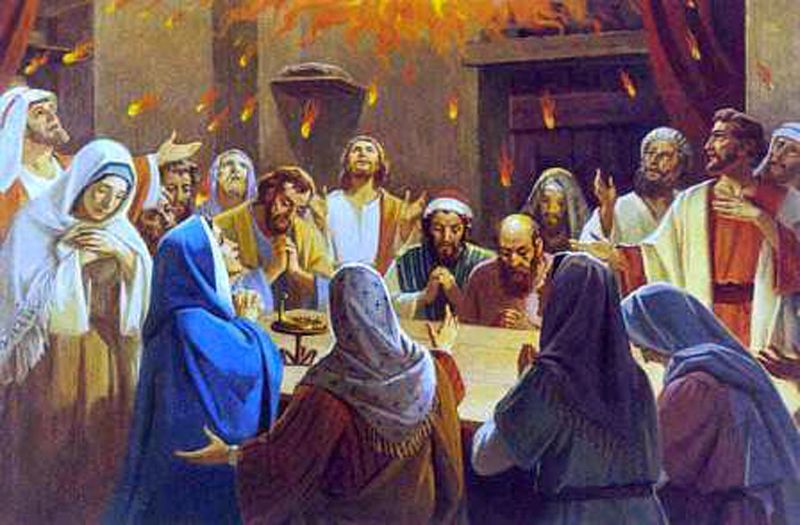
Today is Pentecost.  It is the great feast of the Holy Spirit, and the birthday of the Church. We read the Pentecost story in Acts chapter 2 and we see the first thing that the new Church does is share the Gospel with others. We see how the Holy Spirit breaks down barrios between people.

Why is it a good thing to be a practicing Catholic Christian?

How would you explain what the Gospel story is in a few minutes? 

How did Jesus get you to where you are now?

Could you do it without using religious language?

What we speak only has power if we are consistent in our lives. When people look at us, they should see “love, joy, peace, patience, kindness, generosity, faithfulness, and self-control (Galatians 5:22-23).” When they look at us, they should see people living an abundant life (John 10:10). They should see us being free (John 8:32), but not using that freedom for license to sin (Galatians 5:13).”

One thing in our favor is that God is in charge, not us. We don’t necessarily have to do the whole task of taking someone on a journey to the kingdom. We might do a small bit of the work of moving someone in that direction.  Sometimes, ever listening patiently is all we are called to do. We look at what we are given. Any encounter with another person is potential territory for sharing a bit of goodness.  Everyone we meet is beloved by God, and we may be able to spark a bit of goodness during the encounter.  

If you have been baptized and if you have been confirmed, you have also been sent. Pentecost is a good time to stop and consider how we have been sent, and how we have responded.

Come Holy Spirit, fill the hearts of your faithful, and enkindle in them the fire of your love. Send forth your spirit, and we shall be created, you shall renew the face of the earth.

Blessings, 
Fr. Jim

Don’t Forget the Holy Spirit

Dear Folks,

One thing we better not forget about Acts of the Apostles is the Holy Spirit. In fact, it has been called the Gospel of the Holy Spirit. We tend not to talk much about the Holy Spirit because he is generally at work in the background.  

It is helpful to think of the Gospel of Luke and Acts of the Apostles is one work (just as it is useful to see the Gospel of John and the Book of Revelation as one book). 

The Gospel of Luke will show the Holy Spirit active from the beginning of the Gospel story.  

“Even when he is still in his mother’s womb, he will be filled with the Holy Spirit (Luke 1:15b).”

“The angel Gabriel answered, ‘The Holy Spirit will come upon you, and the power of the Most High will overshadow you. Therefore, the child to be born will be holy, and he will be called the Son of God (Luke 1:35).’” 

“When Elizabeth heard Mary’s greeting, the babe leaped in her womb. Then Elizabeth was filled with the Holy Spirit, and she exclaimed with a loud cry, ‘Blessed are you among women, and blessed is the fruit of your womb (Luke 1:41-42).’” 

“Then the child’s father was filled with the Holy Spirit and prophesied: ‘Blessed be the Lord, the God of Israel, for he has visited his people and redeemed them (Luke 1:67-68).’”

The brief story of Simeon at the temple had three mentions of the Holy Spirit (see Luke 2:25-27).

All four Gospels (Matthew 3:16; Mark 1:10; Luke 3:22; John 1:32-33) show Jesus having a new relationship with the Holy Spirit at His baptism. 

By the way, we will also see the Holy Spirit in the farewell discourse of the Gospel of John (See John 14:15-17 and 16:7-15). I would also point you to the Book of Revelation 22:1 “Then the angel showed me the river of the water of life, bright as crystal, flowing from the throne of God and the Lamb.” This is the Trinity. “God and the Lamb” was pre-Nicean language for God the Father and God the Son, while the water of life is the Holy Spirit (John 7:39).

Acts of the Apostles, in the intro, shows Jesus just before He ascends, talking to the “apostles He has chosen” and “giving instructions through the Holy Spirit (Acts 1:2). He talks to them one last time and twice promises the Holy Spirit (vv. 5 and 8). 

Then we see the story of Pentecost in chapter 2.   I dare you to read Acts 2 and consider that in your baptism you received the Holy Spirit for rebirth, and in confirmation you received that Holy Spirit for mission.  How is God calling you to mission?

Blessings,

Fr. Jim

Responding to God

Dear Folks,

One of the things we see in Acts of the Apostles is the theme that being justified (in right relationship with God) comes though faithfulness to Jesus, not from works of the Law of Moses. This pivots around Acts 15 which describes the council of Jerusalem making that decision by the power of the Holy Spirit.  We can read more on that in the works of St. Paul, especially Romans and Galatians. Romans 4 argues that Abraham was justified before being circumcised, and so the uncircumcised can receive the gift too, and it is not dependent on following the precepts of the Law. 

There is some confusion here, and we must understand correctly. “By faith Abraham, when put to the test, offered up Isaac. He who had received the promises was ready to offer up his only son (Hebrews 11:17).” “By faith Rahab the prostitute did not perish with those who were disobedient, for she had received the spies in peace (Hebrews 11:31).” James 2:14-26, especially 23-25: “Thus, the words of Scripture were fulfilled that say, ‘Abraham believed in God, and it was credited to him as righteousness,’ and he is called the friend of God. You can see, then that a man is justified by works and not by faith alone. Likewise, Rahab the prostitute, was she not also justified by works when she welcomed the messengers and sent them away by a different road?”

If you look at Kittel’s Theological Dictionary of the New Testament you find a lot written on the Greek pisteuo which is generally translated “I have faith” in the Bible. It carries meanings like trust, hope, faithfulness, obedience, a personal relationship with Him, etc. (It’s a long section). 

I would suggest that what St. Paul and the author of Hebrews mean by “faith” James means by faith and works. The Jews thought more in terms of the whole person, while the Greeks thought in term of parts. We have been influenced by Greek thought. James was writing to the twelve tribes in the dispersion (v 1:1) and who would have been more Hellenized (Greek thinking) and so when they heard that righteousness comes with faith they would have thought “Great, all we have to do is believe.”  James corrects that. 

God offers us the gift of salvation. This is a free gift, all grace. Our acceptance of that gift is a total personal response to Him, choosing Him over the promises of the world. Even the ability to respond is only possible because of His grace. It does not depend on us accomplishing anything before He will accept us, but if we have the chance, we are called to use it in response to Him. God calls each of us. How will we respond?

Blessings,

Fr. Jim

God Surprises

Dear Folks,

As we go through Acts of the Apostles, we see that people are working but God is in charge.

In Acts 10 we see Peter getting a lesson, and at the same time, people get sent to him to use that lesson. We see Paul getting a lesson in chapter 9 and also calls Ananias to heal him. Acts 9 we see Saul of Tarsus being converted by Jesus, and then Ananias gets sent to take him the next step. I expect that neither St. Peter nor St. Paul expected God to intervene in their lives that way, nor the direction their lives would take after. We see this is often how God works. I expect when the virgin Mary woke up on the day of the annunciation, her mental to do list might have included things like “do laundry” and “go to market.” I expect it did not include “have a chat with an angel about the possibility of having a baby.”   Imagine what was going through the minds of the guys who make a hole in Jesus’ roof (Mark 2:1-12) in order to get a paralyzed friend to be healed, then Jesus responds with “Your sins are forgiven.”  Jesus had His own priorities, and it often did not match the agendas of others.  The healing of the man’s paralysis seems to happen because it served Jesus’ larger purpose. 

This is not about our personal longevity or connivence, but about the mission. We see James suddenly put to death (Acts 12:2) and God does not intervene, but we see Peter and Paul saved a number of times before they are put to death. John, according to ancient stories, was not killed at all, but died naturally on the prison island of Patmos.  Each one served the mission in different ways. 

I know in my own life, God has had a number of surprises for me. I went to Michigan Tech as a sophomore in chemical engineering, I had plans. I wanted a job that involved no human contact because I found people to be illogical and annoying.   God, however, did not have the same plans. It became obvious (in retrospect) that I was not made to be a chemical engineer, but was called to the priesthood, which made no sense. I had less than zero peoples skills.  I learned people skills bit by bit. I came to realize that my interest in science is not as a scientist but as a storyteller.  I want to see how things make sense and fit together.  I came to see science as a part of a larger story.  This took me many years to see it. 

Are there parts of your story that don’t make sense now? Are there parts of you story that didn’t make sense until years later? We remember that God is in charge, and we are walking by faith, not by sight (2 Corinthian 5:7). I suggest that there will be some things we won’t understand in this life, but we trust God is at work and is writing a story of which we are a small part.  Some day we shall see.

Blessings,

Fr. Jim