I have never thought it proper for me to use my position to endorse a particular politician. I have focused on teaching principles of Catholic social teaching, and thought that was not only more correct, but more effective. However, I do not believe that any faithful Catholic could object to this, and I think we all agree, there are many politicians who need prayer. Some people might get together and pray regularly for certain public officials who especially need it. Who knows what might happen. God clearly loves to take terrible sinners and make them great saints. https://www.catholic365.com/article/9502/6-sinnersturnedsaints-and-what-we-can-learn-from-them.html
Dear Folks, Our Gospel today (John 3:14-21) is cause for rejoicing but also raises some questions. We rejoice in “For God so loved the world that he gave his only Son, so that everyone who believes in him might not perish but might have eternal life. For God did not send his Son into the world to condemn the world, but that the word might be saved through him (John 3:16:17).” We read elsewhere that God “wills everyone to be saved and come to knowledge of the truth (1 Timothy 2:4).” This is great. God is not simply an objective judge who is content to send us to hell if we don’t measure up to some arbitrary standards. God wants us to be saved, wants it very much. Then things get interesting. “Whoever believes in him will not be condemned, but whoever does not believe has already been condemned, because he does not believe in the name of the only Son of God (John 3:18).” This is serious. What does that mean? Does it mean that all who are not explicitly Christian are going to hell? Does it mean that affirming the right doctrines guarantees me salvation? The Catholic Church would say no. “And this is the verdict, that the light came into the world, but people preferred darkness to light, because their works were evil (John 3:19).” If, by God’s grace, one chooses light as best as one can understand it, that may be saving faith. The Second Vatican Council’s Constitution on the Church (Lumen Gentium) says, “those who have not yet received the Gospel are related to the People of God in various ways (LG 16).” “Nor is God remote from those who in shadows and images seek the unknown God, since he gives to all men life and breath and all things (cf. Acts 17:25-28), and since the Savior wills all men to be saved (1Tim 2:4). Those who, through no fault of their own, do not know the Gospel of Christ or his Church but who nevertheless seek God with a sincere heart, and moved by grace, try in their actions to do his will as they know it through the dictates of their conscience—those too may achieve eternal salvation (LG 16).” We see in 1 Timothy 4:10 that “we have set our hope on the living God, who is the savior of all, especially of those who believe.” Make no mistake, anyone who gets to heaven does so by the grace of God through the one sacrifice of Jesus on the Cross. Without Jesus’ sacrifice, none of us would be saved: we would all be toast (extra crispy). There would be nothing we could do about it, nothing at all. It is possible to believe in Jesus like I believe that Carson City is the capital of Nevada. I believe it’s true, but it doesn’t affect my life in any way. That is not faith in the Christian sense. It is possible to go to church, say all the right things, and still have more faith in sin to make me happy, that is, prefer darkness to light. On the other hand, if one has been taught such a bad imitation of the Christian faith that one cannot see the goodness, beauty or truth of it, one would not be blamed for rejecting that caricature. I suggest that people who believe a feeble imitation of the Gospel are far more common than most people think. So, whom should we evangelize? Everyone, with no exception, including ourselves. Our faith is imperfect, and we can all wander off if we are not attentive. St. Paul said, “I drive my body and train it, for fear that, after having preached to others, I myself should be disqualified (1 Corinthians 9:27).” If he was not smug, how much less should we be? That shows the seriousness of his warning that “whoever thinks he is standing secure should take care not to fall (1 Corinthians 10:12).” We should never despair of anyone, and we should never be complacent. We may someday find that a small act of sharing light may make all the difference. Lent is serious. Blessings, Fr. Jim
Dear Folks, We never outgrow reviewing the basics. This week we read the Ten Commandments (Exodus 20, see also Deuteronomy 5). Pope Saint John Paul said that the Ten Commandments formed a foundation, and the Beatitudes were a structure to be built on that foundation, reaching higher and higher with no limit. To have a sound structure, we must regularly attend to the foundation. We begin: “I, the Lord, am your God, who brought you out of the land of Egypt, that place of slavery. You shall not have other gods besides me. You shall not carve idols for yourselves in the shape of anything in the sky above or on the earth below or in the waters beneath the earth; you shall not bow down before them or worship them.” The first principle is Who is God and who is not. We want to be in charge and do things our way. From the beginning, there has been temptation to do things our way rather than God’s way (see Genesis 3 about the Fruit Incident, and Genesis 11 about the Tower of Babel). It forbids carving idols, not because God hates sculpture (He doesn’t: see Exodus 25:17-22; Numbers 21:4-9), but because of the danger of thinking they could possess God. This goes back to who is in charge. This was a problem with the Temple as well. There was a sense that God was uniquely located in the temple (see Psalm 18:7), and some people thought that as long as the temple was in Jerusalem God would take care of them no matter what they did. Jeremiah said, “Do not put your trust in these deceptive words ‘The temple of the Lord! The temple of the Lord! The temple of the Lord!’ (Jeremiah 7:4).” If they didn’t do things God’s way, there would still be consequences. Imagine thinking that a St. Christopher medal would protect me so I don’t have to drive carefully: it isn’t going to work. Do not take the name of the Lord in vain. Nowadays, cancel culture has sometimes raised language policing to ridiculous levels, but it is true that how we talk matters. Our talk should always contribute toward reverence for God. Keeping holy the sabbath day means that we break from the usual routine to focus especially on God. Of course, central to that is worshipping at the Eucharistic Liturgy. When people need to get tasks done and not doing them would cause hardship, we remember it is supposed to liberate, not strangulate. Sometimes people must work on Sundays, but still, it is important to find some way to break the usual pattern so it is not just another day. Honoring Father and Mother is a particular case of respecting authority. That is part of the recognition that our understanding and our perspective is limited. It also means putting what we think and what we want in second place. In our society, that is a radical idea. Do not kill. This means respecting all life, from conception to natural death. It includes standing up for the lives of others and helping those who cannot sustain themselves. This also means respecting each person’s dignity. This is a huge job. Where people are viewed as objects or commodities, standing up for life is a battle. We have a lot of work to do. Do not commit adultery. God made marriage, sexuality, and family core to what it is to be human, and they are sacred beyond words. Revering how God made us is an enormous part of protecting human dignity. We have a lot of work to do, and it begins with learning more about theology of the body. You shall not steal. The right to property is a part of human dignity, and we are called to honor that. You shall not bear false witness against your neighbor. This would include passing on rumors and memes that are harmful and that we don’t know are true (but we want them to be because they match our prejudices). Even recognizing that much would be a great step forward for our society. You shall not covet your neighbor’s wife (or husband) and you shall not covet your neighbor’s stuff, two distinct but related commandments. If it is sinful to do something, it is also wrong to enjoy fantasizing about doing it. There is a part of our brain that doesn’t distinguish between fantasy and reality (which is why we are sad when a fictional character we like dies in a story). It may seem harmless because it is in our heads, but that is the most crucial territory of all. When we entertain ourselves by fantasy about doing bad things, it rewires our brains to believe, bit by bit, that it is not so bad, that it is good and friendly, and then, even if we do not act it out, it means our hearts are less and less in doing what is right. Much housecleaning to do. Blessings, Fr. Jim
Dear Folks, This week we talk about the testing of Abraham, in which God tells him to sacrifice his son, his only son, the son whom he loves. There is a lot to be said about this, but many people ask how could Abraham do this? Why would he believe that God wanted him to do such a terrible thing? It is important to remember that in Abraham’s time, what God was asking was not at all unusual. It was very common for people to sacrifice their first-born sons to Moloch, presumably in the hopes that they would get more children. What was remarkable at the time was not that God demanded such a thing, but that He stopped it. What was remarkable at the time about Abraham’s response was that Isaac was the son of his old age, and it was a miracle (literally) that he was there at all. It was an incredible act of faith. We tend to think that moral principles that seem obvious to us have always been obvious to everyone, but much of what we take for granted had to be learned and developed over time. In the Old Testament we see gradual development of thought. The Hebrews started out being very like the people around them (as could be expected), and God lead them along with more refined principles. It is easy now to look down on the notion of an eye for an eye and a tooth for a tooth, but we remember it was a big step up. In Genesis 4:24, Lamech says he will be avenged “seventy-seven times.” God had to include in the Law of Moses “You shall not offer any of your offspring for immolation to Molech, thus profaning the name of your God. I am the Lord (Leviticus 18:21).” It was not something that could be taken for granted. And it was not always followed (2 Kings 3:27, 16:3, 17:17, 21:6. See Isaiah 57:5; Jeremiah 7:31; Jeremiah 32:35; Ezekiel 20:26,31; Ezekiel 23:37). It is amazing how often that comes up. Offering the first fruits of one’s produce to God is a Biblical concept (e.g. Exodus 34:26). The first-male of the livestock were to be offered, and the first-born sons were to be consecrated and redeemed (Exodus 13:1-16). The presentation of Jesus in the Temple (Luke 2:22-39) was in fulfillment of this command. The problem is when people see their children more like products or possessions than people. I once had a conversation with a woman in which we were discussing the ancient Aztec practice of offering human sacrifice, cutting their still beating hearts out of their chests and offering them to their god. She said that she couldn’t understand how people could do that, that there would be something inside them that would say no. I said that we humans have quite an ability to accept all sorts of things and mentioned how many abortions there were every year. She said, “Oh, you’re against abortion? I’m not. We won’t talk about it.” I didn’t push it, but I figured that she had definitively refuted her idea. We can be led to accept anything if we are not careful (and perhaps even if we are). Looking at history, there have been many times societies have set apart groups of human beings as not worthy of respect, dignity, or empathy. The danger of this can hardly be overstated. During our journey of Lent, perhaps we should be reflecting on how that works, and how that might be happening now. Blessings, Fr. Jim
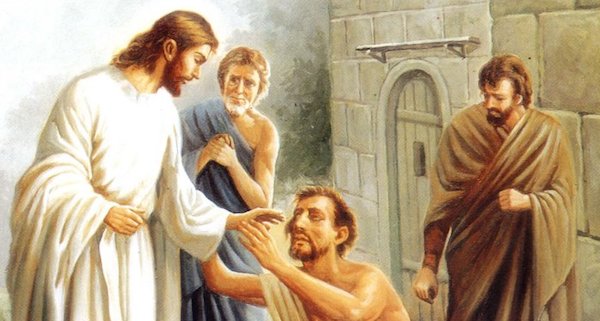
Dear Folks, Today Jesus heals lepers. I’m always in favor of physical healing, but I would suggest that when Jesus heals, He is also teaching something deeper. We do not look at someone suffering and conclude they are being punished by God. Jesus closed that door (John 9:3). However, leprosy does teach us some things about the effects of sin. Our foundational teaching about sin is the infamous Fruit Incident in Genesis 3. After sinning, they were alienated from their own selves/their bodies (v. 7), from God (v. 8), from one another (v. 12) and from nature/the earth/work (vv. 16-19). A leper experiences similar alienations. Their bodies became their enemies. They were not able to enter the temple or the synagogue, and so were cut off from much of the practice of their religion. They could not be with their families, friends or community. They could not engage in any trade to earn a living and couldn’t even draw water from a well. When Jesus healed a leper, He not only cured the disease, He restored their lives. They could reenter the Temple and the synagogue. They could reconnect with friends and family, with the community. They could earn a living again. Their bodies became home again and not a prison. When people go to heaven, God glorifies their bodies (1Corinthians 15:35-49; Philippians 3:21). People of every tribe and tongue and nation will be gathered around the divine throne (Revelation 7:9). There will be a new heaven and a new earth (Revelation 21:1). We shall know God face to face (1 Corinthians 13:12; 1 John 3:2). The challenge now is to live like people longing for that future. In a couple of days, we start Lent. It is a time for examining ourselves and repenting of our sins. Through prayer, fasting and almsgiving, we shall have a chance to see ourselves in a clearer way. We seek to know our sinfulness so that we can better repent and follow Jesus more faithfully. It is a time to grow in our desire to become more like what God made us to be. It would be good to consider the four areas of healing: • Relationship with God: Do we treat God at least as well as our best friend? Where do we need to grow in trust? Is He welcome in every aspect of our lives? • With others: Where do our relationships need healing? Is there something we can do? Are there situations where the other person will not try, and we just need to keep ourselves as safe as we can, pray for them, and avoid giving into hate? • With nature and labor: Balance between work and rest? Care for the environment? How are we focused on leaving the world better than it would have been without us? • With ourselves: Are we growing in chastity? Are there times we look upon others as objects rather than beloved children of God? Do we treat our bodies with at least the care and respect we give our smart phone or our car? Do we engage in destructive self-talk? When we fail or make a mistake, do we spend time and energy berating ourselves, or do we learn from it and strategize how to do better? Obviously, these questions are not a complete list, but just a few examples. What might God be calling us to become in the four aspects of ourselves? How can we better receive God’s gift of Himself, and better give ourselves as gift to Him? Blessings, Fr. Jim
Dear Folks, “Behold, I am sending you like sheep in the midst of wolves; so be shrewd (clever/cunning/ crafty) as serpents and simple (innocent) as doves (Matthew 10:16).” The greater the evil that we fight, the more important to hold ourselves to a higher standard of behavior. On Amazon I saw a book called “In Defense of Looting” that apparently suggested that looting was an effective tactic of protest. (Wasn’t Amazon the group that de-platformed Parler? But they allow this?) If we say that our tactics are justified because our cause is so right and just, we want to remember that Everyone’s cause is right and just in their minds, and those tactics may be used for causes we don’t approve of. Many have pointed to those who defended the rioting last summer as making it easier for others to believe they should break into the capital. I highly recommend Ann Garrido’s book “Redeeming Conflict.” Her habit
4 is “Undo the knot of intention.” Good intentions do not guarantee good actions. The
scribes and Pharisees who opposed Jesus certainly thought of themselves as the good guys, but they lacked self-reflection. They had a mighty lens for seeing any hint of fault in others, but were blind to their own shortcomings, or dismissed them because they considered themselves so good. Of course, the Bible has some helpful stuff. Ephesians 4: 26 “Be angry but do not sin; do not let the sun set on your anger, and do not leave room for the devil.” James 1:19-20 reminds us to be “quick to hear, slow to speak, slow to wrath” and that our wrath “does not fulfill the righteousness of God.” Matthew 12:36: “You shall be held accountable for every idle word that you utter.” When we are about to say something or type something, imagine talking with Jesus on the last day and explaining how this comment is serving the kingdom and showing His goodness. Jesus was sometimes fierce, but He wasn’t mean for the sake of being mean, no matter how much someone deserved it. Jesus was very angry in Matthew 23, but he didn’t stay there; he moved to sadness and mourning for Jerusalem. Then He went to work. In Martin Luther King’s “Letter from Birmingham Jail” he says, “In any nonviolent campaign there are four basic steps: collection of the facts to determine whether injustices are alive, negotiation, self-purification, and direct action.” He knew that their efforts needed to be based on facts that would stand up to skeptical scrutiny. He did not just grab a few tidbits of information that seemed to support his narrative. He describes their purification like this: “We started having workshops on nonviolence and repeatedly asked ourselves the questions, ‘Are you able to accept blows without retaliating?’ and ‘Are you able to endure the ordeals of jail?’” This was disciplined and they held themselves to a very high standard. They showed their power not with physical force but by imitating Jesus. After the murder of George Floyd, there was a lot of consensus in this country, and a great moment to have some serious conversation about how to prevent such things in the future. There could have been serious steps taken so people could be confident that when they interact with the police their lives would be protected and their dignity respected, as well as the police being confident that if they do their jobs wrong there will be consequences and if they do their jobs right their superiors and the community will stand by them. Then there were riots night after night. The country was divided, and the moment was thrown away. That may be the greatest tragedy of all. I think we can heal as a nation. It will take a lot of self-examination. It will take many deciding to look beyond their anger at what is wrong, to some well thought out strategies for solving problems. It will require being clever as serpents and innocent as doves. Blessings, Fr. Jim
Dear Folks, In the Gospel of Mark, Jesus’ first miracle is casting out an unclean spirit. He had just been in the desert facing temptation by Satan, then He started preaching, called the first disciples, and now this. It was the first blow in a battle that would culminate on the cross. He did not come merely to fight this evil or that evil, but evil itself. Ultimately, our enemy is not people who do evil, but evil itself. How much the devil is personally involved and how much is just human sinfulness is not a question to spend time with (too much interest in the devil is a bad idea: he is the greatest of all seducers). There is no doubt there is much evil in our society today, and that we are broken into factions that are getting farther apart, more hostile and more suspicious of each other as time grows on. How can we fight this evil? How can we bring healing? How can people who disagree have constructive and fruitful dialog? I have some thoughts. Our greatest weapon against evil is our relationship with God (Ephesians 6:10-17). If we want a better world, the first step is to fall more deeply in love with God. It is very human to believe that what seems obviously true to me is obvious to everyone else, if they will only admit it. Until we recognize (and keep reminding ourselves) that intelligent people of good will can see things differently from us, we cannot have good dialog, and we will tend to get louder and angrier instead of increasing understanding. It is easier to see faults in others than in ourselves (Matthew 7:1-5). This is an unconscious thumb on the scale. If we do not remember that and compensate for it, we will keep talking past each other. When we call out the faults of people on our side more energetically than the those on the other side, it will be a great step forward for dialog and healing. Also, we are not called to judge the state of their souls but call out bad ideas and bad behaviors. Arguments that support our point of view seem stronger. Arguments against our point of view seem weaker. This is another unconscious thumb on the scale. We can have better dialog if we keep it in mind. It is easy to look back on atrocities committed in the past and say with hindsight we would not have participated; we would have resisted. Oh really? We have the advantage of knowing what we know and being raised by and surrounded by people who support our point of view. How do we know that if that were different, we would not be different? Dr. Philip Zimbardo was involved in the Stanford Prison Experiment, in which they simulated a prison setting and observed people’s behavior. Many behaved quite differently from how they expected. Dr. Zimbardo came to Aquinas College and talked while I was there. I remember his final comment was that the more people thought they were immune to being influenced, the more easily they were influenced, and the more concerned they were of being influenced, the better they could resist. Humility is called for. I strongly recommend the book “Love Your Enemies: How Decent People Can Save America From the Culture of Contempt” by Arthur C. Brooks. He reminds us that dialog with people who disagree with us is a gift. It helps improve our ideas and sharpen our perspective. I know I have failed many times: I have spent most of my life picking up bad habits. I suspect I’m not alone. If we work together, we can do great things. Part 2 Next week. Blessings, Fr. Jim
Dear Folks, Pope Francis has designated today as Sunday of the Word of God. Until I die, I never want to miss a chance to encourage people (especially Catholics) to get to know the Bible better. It is such a wonderful, powerful treasure, and so easily accessible, that we can all reap great benefits. I have spent many, many hours reading Marvel comic books, and I enjoyed the movies. They have constructed a pretty elaborate universe, and there is much to learn about it. However, there is only so much depth there to explore. A part of me was a bit surprised people kept making movies after “Endgame.” It’s like, “What more is there to do?” The Bible has infinite depth, and there will always be more there. The more deeply you go, the more you discover new riches and the more it beckons you forward. The sayings and stories speak to the meaning of our lives and can touch us in ways we do not expect. A thousand lifetimes would not be enough to drink in that richness. We must remember it is not just about learning information, but about encountering God personally. When we love someone, we want to be with them as well as learn more about them. For a deep relationship, we must spend time together. This is a way to spend time with our Beloved God, so we can grow to love Him more. Many Catholics (and I suspect some other Christians as well) see the Bible the way people saw the North American continent before the journey of Lewis and Clark). It need not be that way. We have more resources now than ever before. Fr. Mike Schmitz is doing “The Bible in a Year.” He is a great teacher, and I have heard good things about this program (I’m sure he won’t mind if you start later than January 1). The Great Adventure Bible Series, also called The Bible Timeline, is a wonderful program. It helps people understand the plotline of the Bible from creation to the last judgment and how all the stories connect into one big story of salvation. These are things that can help people go from being like foreign tourists in the Bible to being at home in the Bible. The seventh and eighth graders at St. Charles school have memorized the names of all 73 books of the Bible. This makes me very happy. This will help them learn more about the Bible for the rest of their lives. What we memorize, we always have with us. I would challenge everyone: never let twenty-four hours go by without you encountering some Scripture. Some have a study program. Some a prayer schedule. Some read the daily Mass readings (that will get you a lot of the Bible). If you do not connect to any of those, I would suggest reading a bit of one of the Gospels every single day. A little bit every day is better than a big bunch one of these days. If you do that, it will become a part of you, and Jesus will be more on your mind. Imagine if everyone did that. Blessings, Fr. Jim
Today we celebrate the Baptism of the Lord. If I understand correctly, the Feast of Epiphany used to mark the coming of the Magi, the Baptism of the Lord, and the miracle at Cana, and that marked the end of the Christmas season. It was apparently decided that the Baptism needed its own feast, and this marks the end of the Christmas season, so tomorrow we begin good old Ordinary Time. When Jesus was baptized, He was not, of course, repenting of sin. He was sanctifying baptism and it will be by the power of His pascal mystery that Christians will be born again in baptism. It begins His saving work: His life as a manual laborer is over, and now He is beginning the journey that leads to the Cross. He will refer to His death as a baptism (Mark 10:38; Luke 12:50) (see Catechism of the Catholic Church #536). John 3:5 says, “Amen, amen, I say to you, no one can enter the kingdom of God without being born of water and Spirit.” The Church has always understood this to refer to baptism. Baptism has never been treated as a detail, and it is not an option or a matter of preference. In Jesus’ final commissioning of His disciples at the end of the Gospels of Matthew and Mark, Jesus’ very concise instructions include baptizing as a core part of the work (Matthew 28:19 and Mark 16:16). This leads to a question: what about those who are sincere but were not baptized. What about children who died before baptism? This led to a theological theory called limbo. Although the Baltimore catechism taught limbo as if it were a fact, limbo has never been the official teaching of the Catholic Church. Pope Benedict finally laid it to rest and said it is not a part of the Catholic faith. We now understand John 3:5 to be a mandate on us but not a restriction on God. The God we have gotten to know in the New Testament is not about keeping people out of heaven because of something they couldn’t control of have not been properly taught. Unfortunately, in the meantime, many Catholics have come to see getting sacraments as the ultimate end of the faith (sometimes literally the end, when they drop out after getting confirmed because they are “done”). They have come to see the practice of the faith as a pale shadow of what it is meant to be. The great danger is of people being sacramentalized but not evangelized. They have helped convince a lot of other people that Catholicism is superficial, mechanical and legalistic. Seeing the fruits of this is one of the most heart-breaking things about being a priest. How should we look at sacraments? St. Paul sees baptism as something we must live out. “What then shall we say? Shall we persist in sin that grace may abound? Of course not! How can we who died to sin yet live in it? Or are you unaware that we who were baptized into Christ Jesus were baptized into his death? We were indeed buried with him through baptism into death, so that, just as Christ was raised from the dead by the glory of the Father, we might live in newness of life (Romans 6:1-4).” Our belonging to Jesus is meant to make all the difference. It is as drastic as dying. It is meant to be the controlling, defining reality in our lives, by which all other things find their meaning. We hand God our lives and invite Him to do whatever He chooses with us, holding nothing back. Our faith and our response to God is, of course, imperfect, but if our faith is real, our goal is nothing less than being completely His. Peter Kreeft’s book Jesus Shock gets deep into this. A question for 2021 is, “How are we living our baptism?” Blessings, Fr. Jim
Dear Folks, In these two weeks we celebrate the Holy Family and the Epiphany, and they touch on the root of God’s whole work. We see a pattern where God makes family, and when it falls apart, to bring things together. It begins in Genesis, with the story of Adam and Eve. In this story, God makes Adam and Eve and calls them to be the beginning of family. Then things fall apart. The story of the Tower of Babel is a story of God’s people being dispersed and alienated from each other because they tried to do things their way instead of God’s way. Noah and the ark is a story about trying again. God picks a family, not a village, not a nation, but a family. From there comes the new beginning. God’s plan to gather His people together as one reaches a new phase with the beginning of the nation of Israel. When God begins the nation of Israel, he starts with a family, the family of Abram and Sarai (later Abraham and Sarah). From them will come a people from whom the plan will unfold. Everything is laying the groundwork for the Gospel. The people of Israel get scattered, and Isaiah prophecies God gathering them together (see, for example Isaiah 60:4), and also starts talking about the gathering of all the nations (see Isaiah 2:2-5). The Gospel Story begins with a family: Jesus, Mary, and Joseph, the Holy Family. The Magi represent the nations, those beyond the nation of Israel, who are called to be part of God’s people. They were drawn by the star because they were open to goodness, beauty and truth. (Herod wasn’t.) We the Church, God’s family, are meant to be light to draw the nations. If we do our job right, those who are open to goodness, beauty and truth will be drawn to Jesus by our light. In short, we are called to be stars. Family is key. It is in family we are meant to learn empathy, responsibility, and what it means to be part of something larger than ourselves. That is where we need to learn to manage our emotions and be aware of how we affect one another. We are meant to learn the difference between right and wrong and taught in practice to put our own will in second place for a greater good. These are the sorts of virtues that enable a civilization to thrive. Everything I’m hearing and reading says that we as a society are experiencing a decline in all these things, and an increase in violence. If we want to turn that around, one place to start, perhaps the place to start, is to strengthen the family. For several generations in the western world, the understanding of family has diminished until it is seen as just a lifestyle choice based on personal desires. The current arguments about what is marriage and what is family are just the latest symptoms. How to begin to rebuild it? There are three resources that I’ve encountered this year: “The First Society,” a book by Scott Hahn unpacks what this is about and what it is not about (for example, it is not about nostalgia for “Leave it to Beaver”). “Defending Marriage” is a book by Anthony Esolen. His approach is more literary, and rather than making rock-solid arguments for each of his positions, he weaves together a vision for us to imbibe, and lets us consider if this speaks to us. He is not concerned at all with using politically correct language, so let the reader beware. For those who have access to Formed.org there is a very good one hour talk by Trent Horn called “How to Talk about Marriage and Same-Sex Unions.” He lays out what would be the basis of any productive discussion on the issue. The human project is filled with striving for ideals that we cannot completely fulfill in this life. If we lose sight of those ideals and we are left to follow our feelings and preferences, then civilization crumbles. If we strengthen our sense of our highest ideals and strive to live up to them as best as we can, we will be a light to all who seek. Blessings, Fr. Jim