Category Archives: Church

Strength in Weakness

Dear Folks,

In our Gospel today, Jesus speaks of the Father revealing to the childlike, things hidden from the learned and the clever. This reminds us that the Gospel is not just a call to be a

little nicer, a little kinder, and a little more virtuous. It is not just tweaking our lifestyle. It is turning our vision of life upside down. What seems obvious to the world is opposite in the Gospel. We see some examples in the Scriptures: 2 Corinthians 12:9-10 “but he said to me, “My grace is sufficient for you, for power is made perfect in weakness. I would rather boast most gladly of my weaknesses, in

order that the power of Christ may dwell with me. Therefore, I am content with weaknesses, insults, hardships, persecutions, and constraints, for the sake of Christ; for when I am weak, then I am strong.” Matthew 16:25 “For whoever wishes to save his life will lose it, but whoever loses his life for my sake will find it.” (See Mark 8:35 and Luke 17:33). Matthew 23:11 “The greatest among you must be your servant.” (See Luke 22:24-27) Matthew 23:12 “Whoever exalts himself will be humbled; but whoever humbles himself will be exalted.” (See Luke 14:11) In our second reading St. Paul speaks of flesh vs. Spirit. To live according to the flesh is to do what seems natural for fallen humanity: seeking power, pleasure, wealth, and honor. To live according to the Spirit means seeking the cross, seeking to be servants, considering it a privilege to be persecuted for the sake of the Gospel. To do this, we need to be transformed

by grace: “I urge you therefore, brothers, by the mercies of God, to offer your bodies as a living sacrifice, holy and pleasing to God, your spiritual worship. Do not conform yourselves to this age, but be transformed by the renewal of your mind, that you may

discern what is the will of God, what is good and pleasing and perfect (Romans 12:1-2).”

When we are so transformed, we don’t entirely fit in this world. “Beloved, I urge you as aliens and sojourners to keep away from worldly desires that wage war against the soul. Maintain good conduct among the Gentiles, so that if they speak of you as evildoers, they may observe your good works and glorify God on the day of visitation (1 Peter 2:11-12).”

Michael Frost (an evangelical Protestant) wrote a couple of short but interesting books, “Surprise the World” and “Keep Christianity Weird”. He suggested we be careful about the desire to fit in. We are called to be misfits.

Blessings,

Fr. Jim

The Most Important

Dear Folks,

Old Riddle: Where does an eight-hundred-pound gorilla sleep? Answer: Anywhere he wants to.

“Christianity, if false, is of no importance, and if true, of infinite importance, the only thing it cannot be is moderately important.” ― C.S. Lewis. We remember Jesus’ words in Revelation 3:15-16 (what He said about luke-warm Christians, ouch!). Either Jesus is the

ruling reality, the eight-hundred-pound gorilla in our lives, or we are not doing Christianity.

There are lots of factors in life we can’t control, but there are choices we can make, and how we make them tells the story. Life has hard choices. Sometimes it means choosing against something that is very, very good for the sake of something more important. What we tell ourselves we believe, what think we are like, what we claim to be about is one thing. What do our choices say about us? That is the reality (“By their fruits you shall know them [Matt 7:16]).”

One youth minister told me, “Never ask people to choose between God and sports, because God will lose every time.” What does that say about the culture of that parish, the beliefs that had come to be common there? Would Jesus be happy about how they were doing

church?

When there isn’t enough time to do everything, even everything really, really important (which is generally always) what gets cut and what gets protected? When there isn’t enough money for everything, even everything really important, what gets cut, and what gets protected?

Prayer is hugely important, and we would (I hope) agree that it is an essential part of being a disciple of Jesus. It is also the easiest thing to put off when the crunch comes. “Half an hour’s meditation each day is essential, except when you are busy. Then a full hour is

needed.” ― St. Francis de Sales

God calls us to work with less than perfect situations. If we wait until things are how we think they should be, it will never happen. If God asks us at the end of our lives how we have served the Kingdom, it would not be good to have to say, “I would have done great things, God, but I was just too busy,” or “the pastor was such a jerk,” or “the church had so many hypocrites,” or any such thing. I’m not envisioning that being a happy conversation.

In times and places where people are being put to death for being Christian, the choices can be clear and stark. At other times and places, it may make be easier to let it get fuzzy in our minds. If it has been a long time since we had to choose against something we really, really wanted for the sake of the Kingdom, maybe it’s time to do some inventory.

Is Jesus our 800-pound gorilla? Or is something else? There can only be one.

Blessings,

Fr. Jim

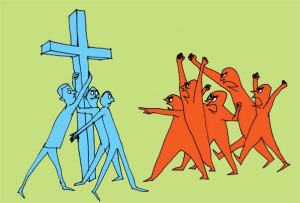
Being Christian in a Hostile World

Dear Folks,

Matthew chapter 10 deals with the challenge of being Christian in a world hostile to Christianity. I have read that North Korea, Somalia, Yemen, Eritrea, Libya, Nigeria, Pakistan, Iran, Afghanistan, Sudan, and India are the most dangerous places just to be Christian. We need to pray for them.

In Europe and North America, it is not so dangerous just to be known as a Christian, but sometimes people get attacked for standing by Christian beliefs that are not popular. Those who hold to Christianity in general and Catholicism; in particular beliefs about the sanctity of life, sexuality, and family may get attacked verbally, have their property vandalized, and their careers be destroyed. Some people who are hypersensitive about how others talk

about things they hold dear will degrade and ridicule things precious to Christians and brush off any concerns. This leads to the question of where it will go from here.

Jesus said, “Behold, I am sending you like sheep in the midst of wolves; so be shrewd (wise, prudent, clever, cunning, crafty) as serpents and simple (innocent) as doves (Matthew 10:16).” I hold on to that verse tightly. We don’t know what the future will bring,

but there are some things we can do to prepare.

1. Know our story. One of the reasons so many are against the faith is that when they were told about it, it was told very poorly. There is a YouTube video “Bishop Barron on ‘Dumbed Down” Catholicism” https://www.youtube.com/watch?v=vZkPH1rOAG0 in which he speaks about Catholics being taught on a level far below the level of other subjects. There are some prominent Catholics who fiercely and aggressively oppose some aspects of Catholic teaching and

speak boldly about how devout they are.

2. Deepen the roots in our relationship with Jesus. We are not going to win this by our own power.

3. Practice choosing the Kingdom over the world. Prayer, fasting and almsgiving are all ways to choose the Kingdom over the world, and we can look at the practical decisions we make in life.

Not every Christian is called to be martyred for the faith, but every Christian is called to be ready to be martyred for the faith, and it starts with small decisions. “The person who is trustworthy in very small matters is also trustworthy in great ones; and the person who is dishonest in very small matters is also dishonest in great ones. What in our day-to-day decisions says that we are ready (or getting ready) to choose the kingdom over the world?

Bishop Barron also did a YouTube video “Why Modern Men Look Elsewhere for Spiritual Wisdom” https://www.youtube.com/watch?v=avROODXQlhE and he basically concluded that we have made Christianity too easy and convenient. The Gospel is meant to push us to greatness, and that can’t be done if you

shave off the difficult parts in the name of making it friendlier. If we read the Gospels and take them seriously, there can be no doubt that Jesus calls us to be willing to give our lives in one way or another, to be willing to suffer, to follow whatever the cost. We don’t know what will be asked of us tomorrow. How will we answer?

Blessings,

Fr. Jim

The Harvest is Abundant

Dear Folks

There are two essential thoughts in our Scriptures this Sunday: that God has given us many great gifts, and the harvest is abundant; laborers are few.

There are a number of sad conversations going on now. Churches are closing. Churches that used to have one or two priests are now sharing priests. Many churches can do less than they used to. Many are struggling.

Many people feel helpless. We are not helpless. God has given us many gifts, and there is so much we can do to make our churches thrive.

What if God is testing us, to see how we will respond to this challenge. To make church happen requires the participation of a lot of people. The question is, how many will respond

to this call? There are some who prioritize participation in the church, helping to make good things happen. The question is how many of our people are willing to do that? How many Catholics see themselves as customers and how many see themselves as coworkers in mission?

If a parish is truly building disciples, it will be common for people to see themselves as sharing responsibility for making church happen, and eagerly respond to God’s call. If people see that responding to God’s call is central to life, that the work of the Church is a huge part of responding to God’s call, and that their participation makes a difference, then a parish can thrive.

Trying to do good things in the Church can be frustrating, and I know that as well as anyone. That is part of the challenge. When we are faithful in the midst of obstacles (including annoying and infuriating obstacles), God uses those occasions to deepen our

commitment and our holiness. We are called to work with the Church we have, with all its flaws. That is part of discipleship.

As for more priests, we all have a role to play. I would suggest that if a young man grows up surrounded by adults (he sees more than his parents) who are zealously dedicated to growing in holiness, deeply in love with the Eucharist, ravenously hungry to learn more

about the faith, and energetic is supporting the mission of the Church, we will have to build a fence around the seminary to keep it from being overrun with applicants.

Part of this is helping direct people’s energy. Many do not read my bulletin articles (sigh), and so how others spread the vision is key. When people express complaints about the state of things or worry about the future, it is important to direct the conversation towards action that can help, even incrementally. Enough drops of water make an ocean.

The harvest is abundant. How many laborers will we have? Our future can be glorious.

Blessings,

Fr. Jim

Eucharist: Looking Beyond Appearances

Dear Folks,

The is the Feast of the Most Holy Body and Blood of Christ. You have heard a good deal (I hope) about the Eucharistic revival. We have heard about the majority of those who call

themselves Catholic who don’t believe in the Church’s teaching on the Real Presence. I consider this to be a part of a larger problem of so many Catholics being led to believe that the Catholic faith is much, much less than it really is. Given that, it should not surprise us that so many people stop going to church. Without much profound reason to come, a bad experience or just apathy can trigger a departure. I would suggest a lack of Catholic belief in the Eucharist has three causes: casual practice, careless talk, and mushy teaching. Many of us are trying to build a greater sense of reverence in our practice and how we talk about the mysteries, and today I want to address what we are taught.

Many people’s formation so emphasized Mass as our family meal, there was not much talk about what made it different from other meals, and how it is so much, much more than a meal.

Some of our Evangelical brothers and sisters say that we are mistaken in our belief and claim that Jesus was speaking metaphorically when He spoke of eating His body and drinking His

blood. They point to other times that Jesus used metaphors and say that this teaching follows that pattern. Since most Catholics (including priests) are not prepared to respond, that is often the

last word on the subject, and the skeptics feel confirmed, and the Catholics feel insecure. It is time for that to end. We can look closer at the Biblical text (something I’m always in favor of) and see how Jesus’ talk about the Eucharist is very, very different from His use of metaphors.

When Jesus used metaphors, they were in line with the Old Testament imagery. “I am the good shepherd (John 10; see Ezekiel 34 and also Psalm 95). “Rivers of living water (John 4; John 7;

Ezekiel 47; Psalm 1; Jeremiah 17).” “I am the vine; you are the branches (John 15:1-10; Isaiah 5).” By Contrast, the metaphor of eating someone’s flesh in the Old Testament is not about

believing in someone but conquering and destroying them. “When evildoers come at me to devour my flesh, these my enemies and foes stumble and fall (Psalm 27:2; see also Zechariah 9:15 and Ezekiel 39:17-20).” Jesus built His teaching on the Old Testament; he did not toss it out and start from scratch. Foreshadowing of the Eucharist can be found in the manna in the desert and the eating of the Passover lamb, and these are not metaphors but realities that meant life or death.

When there was confusion about Jesus’ figures of speech, either He or the Gospel writer would clarify. “Lazarus is dead (John 11:14).” “He was speaking of the temple of His body (John 2:21).” When Jesus speaks of giving living water (John 4 and John 7) it is clarified that “He said this in reference to the Spirit that those who came to believe in him were to receive (John 7:39a).”

Jesus never said, “I am this vine” or “I am this door” but He did say, “this is my Body” while holding it is His hands “Matt 26:26-28; Mark 14: 22-24; Luke 22:19-20; 1 Corinthians 11:24- 25).

None of the instances’ of Jesus metaphors lead to most of His followers who believed in Him walking away and not coming back (John 6:66). There is no parallel of disciples walking away

saying “This nut thinks he’s a sheepgate.”

The Bread of life discourse in John 6 bears closer examination. The guts of the talk is in two sections vv. 35-47 and vv. 48-58. The first emphasizes belief, and if that were all there was, I would say a case could be made that “I am the bread of life, whoever comes to me shall not hunger, and whoever believes in me shall not thirst (v. 35)” is a metaphor for believing in Jesus. The second section, however, responds to their skepticism by doubling down, and does not talk about belief but eating His flesh and drinking His blood (the blood came out of nowhere). He says, “My flesh is true food, and my blood is true drink.” (These two sections echo the liturgy of the Word and the liturgy of the Eucharist.). If one is still skeptical, I would ask, what could Jesus have said that would convince you that He really meant it?

It really is the Body and Blood of Jesus, as Bishop Barron teaches, not in “a reductive physicalist sense (we’re not talking about a piece of meat here)” but a more Jewish framework, in which the flesh and the blood are the person (hence Catholic teaching that every particle of the Eucharist is the complete Jesus, body, blood, soul, and divinity). We, of course, remember that Jesus is Jewish and not Greek.

Given how unique this teaching is, the price Jesus paid is losing most of His followers, and how it is referred to in all four Gospels and Paul, how important was it to Jesus? How important was it to the early Church? How seriously should we take it? What should our response be?

Blessings,

Fr. Jim

Build a Better World

Dear Folks,

Talking about developing a less violent world, I think we need to look at the power of personal agency. So often, it can feel like what we do doesn’t make much difference in the larger world. It is a terrible feeling to think that the world and other people can make marks on us quite easily, but there is nothing we can do to make our mark on the world. This is a feeling I lived with for a lot of years, and it can lead to desperation. If we can help people learn better to channel that energy, that can lead to lead to more productive activity and less desperation.

This can involve developing a vision. If things are not good as they are now, what improvement do we want? It is good to be specific. Then we need a path between here and there.

We need to learn skills: learn to make a case for what we think should happen and making it effectively, both for the goal and the way to get there. Just because it seems painfully obvious to us doesn’t mean it will be obvious to others, in fact, we can count on someone thinking it is completely wrong, and that can be frustrating. Seeing things from others’ point of view is a good first step. We need to recognize that if people do change the way they think, it can be a slow process, and we need patience. I find however much patience I think I’ve learned God seems to think I need more. If we get attention, it needs to be in a way that helps people see things from our point of view.

We can cultivate more realistic expectations. This can keep people from giving up when things take a long time and get difficult. I don’t know much about farming, but I think people take for granted that when they plant seeds, it will take months for the crop to be ready. On the other hand, if I put coffee in the microwave and it takes months for the coffee to get hot, I’m throwing that microwave away. Making profound, meaningful changes in society is long, slow work, often spanning generations. Getting people to change the way they think takes time, especially when ideas are deeply rooted and intertwined with their basic world view. I suggest lower expectations short term, higher expectations long term. Before we try to justify quick and dirty tactics, remember the other side might use them too, and they tend not to win people over.

Boundaries are essential! Just because we have good intentions does not mean our behavior is justified. We as a society need to reject excusing people’s bad behavior because we think it is for a good cause (remember, everyone thinks they have a good cause). If protesters behave badly, it hurts the credibility of their cause. Jesus said, “Behold, I send you forth as sheep in the midst of wolves. Be as clever as serpents and innocent as doves (Matt 10:16).”

We must support those who help make it a less violent world. This starts with law enforcement. We need to recognize the great risks and sacrifices that they make, and how much we depend on them. We need to remember many of the decisions, especially shoot/don’t shoot situations, must be made in a fraction of a second, and if they get it wrong, they often die. They want to go home at the end of their shift like everyone else. Yes, we need to get rid of bad actors, but when there is an incident, we need to give the officer the same benefit of the doubt that we would want for ourselves. When people commit a crime, there should be quick and consistent consequences as much as possible. Lax or selective enforcement encourages more crime.

Let’s not disparage thoughts and prayers. Yes, they are not a substitute for action, but action can follow from focusing our hearts. We can always invite people to action, and this is an opportunity to make our case.

Blessings, Fr. Jim

The Holiest Week

Dear Folks,

Today we begin Holy Week. Holy Week is the super bowl of the Catholic faith, and we get to the center of the Christian story. It begins with the triumphal entry into Jerusalem, the last

supper, the crucifixion, the time in the tomb, and the resurrection. Everything before this is leading up to this, and everything after this is because of this. During this week we try, as much as we possibly can, to avoid other meetings and other projects so that we can focus on this, our central mystery.

It begins with Palm Sunday. Jesus comes into His city as a triumphant king amid hosannas, but humbly, on a donkey instead of a mighty horse. We bless palms to be used throughout the year,

a sign of praise to Jesus, and for next Ash Wednesday we will burn them, a reminder of the fragility of our devotion (how quickly humans can go from “Hosanna” to “Crucify Him”). We

read the passion narrative from the Gospel for the year (this year, of course, is Matthew).

On Tuesday at the Cathedral, we will celebrate the Chrism Mass. Traditionally this was done on Holy Thursday morning, but it is celebrated on Tuesday evening so that more people can

participate. Even so, we can only have a cathedral full of people attending (as a priest, I get an automatic seat; it’s one of the perks of being a priest). We will bless the holy oils we use throughout the year. We have three holy oils (Don’t let anyone tell you they are WD40, 10W30, and Oil of Olay: that is not true). The oil of the sick is a sign of God’s healing, and is used for anointing the sick, and I keep a small container of it in my car just in case. The oil of

catechumens is a sign of God’s strength to fight evil and is used for people preparing for baptism. The Sacred Chrism is the holiest of the oils and is a mixture of olive oil and balsam perfume. It is a sign of the Holy Spirit, and is used at baptism, confirmation and the ordination of priests. During the Chrism Mass, the priests renew their priestly commitment, and the bishop reminds the people that priests need lots of prayers (he is not wrong).

On Holy Thursday we begin the Triduum, and that is one celebration that takes place over three days. It begins with Mass of the Lord’s Supper, celebrating the institution of the Eucharist, as

well as the institution of the priesthood. The Gospel is the washing of feet, and often the celebrant washes people’s feet at Mass. After the prayer after communion, we usually have a procession with the Blessed Sacrament, place it in a reserve chapel, adore Him, and leave in silence (don’t forget the silence). We don’t have a closing blessing because the liturgy does not end; it simply pauses until the next day.

Good Friday is the one day of the year we don’t have Mass. We begin in silence. We read the passion narrative from the Gospel of John. We have solemn intercessions. We show special respect and affection for the cross upon which Jesus won our salvation. We have a communion service with hosts that were consecrated on the previous day. We depart in silence. Then on Saturday we have the Easter vigil. By Church law it begins after sundown. I shall not

describe it; one should witness it, if at all possible. It’s the greatest night of the year.

I encourage as strongly as possible, for everyone to attend to Holy Week as best as their situation allows. What we celebrate is the center of everything.

Blessings,

Fr. Jim

Jesus Is More Than They Thought

Dear Folks,

Today we our Gospel talks about the Transfiguration.

The Bible looks at mountains as a place to encounter God and especially receive instruction. “The Lord said to Moses, ‘Come up to me on the mountain and, while you are there, I will give you the stone tablets on which I have written the commandments for their

instruction”, Exodus (24:12). We remember he also goes back up the mountain for backup copies after Moses smashes the originals in response to the Golden Calf business (Exodus 34). Elijah gets marching orders on Mount Horeb (Mount Horeb is another name for Mount Sinai) in 1 Kings (19:8). Isaiah prophesied that “the mountain of the Lord’s house” will be a place of instruction (see Isaiah 2:2-3). Jesus goes up the mountain to give the Sermon on

the Mount (Matthew 5:1).

We see that Jesus only takes Peter, James, and John up the mountain. It appears that not all disciples are equal, and certain gifts are given to some and not others. Galatians 2:9 tells us

that Peter (“Cephas” is Aramaic for “rock”), James, and John were considered the “pillars” of the early Church. We see that they get special moments with Jesus, but we also see particular stories of their failures. Only Peter, James, and John were brought to witness the raising of the daughter of Jairus (Mark 5:37). Peter gets out of the boat when Jesus is walking on water (score one for him), but his faith wavers and he fails (Mat 14:28- 31). Jesus rebukes James and John for wanting to call down fire on an inhospitable Samaritan town (Luke 9:54-55). Right after the third prediction of the passion (!) James and John want the best seats next to Jesus in the Kingdom (Mat 20-28). They still didn’t get it.

We all remember Peter’s denial of Jesus three times on Good Friday (Mat 26:69-75). Peter, James, and John are the three that Jesus takes with Him to the Garden of Gethsemane (Matthew 26:36-46), and they fall asleep. Once again, they fail. We learn that some gifts and some spiritual experiences are given to some but not others. If

we see others getting things we didn’t get, we have no cause to be jealous: they don’t necessarily have an easier road. We have no cause to be ashamed either: it doesn’t mean we have failed. If we get some great mystical experience or some great gift, we have no cause to be proud: we didn’t earn it. We just follow Jesus however we can (see John 21:18-23).

What is this great instruction that is given on this great occasion? First of all, it is the appearance of Jesus Himself, shining like the sun and clothes unnaturally white (Mat 17:2). A voice from the cloud says, “This is my beloved son, with whom I am well pleased; listen to him (Matthew 17:5).” That’s it. The great revelation is Jesus Himself. He is the new Torah, the new Law, the great revelation of God, the way to live in covenant with God.

How does this fit into our Lenten journey? During Lent, we want to focus especially on Jesus. We can spend extra time reflecting on the Gospels. We can spend extra time before the Blessed Sacrament. We can spend extra time reflecting on Jesus’ presence in the midst

of our activities through the week, as we try to make what we do acceptable gifts to offer through Him. However important we thought Jesus was, He’s more important than that.

Blessings,

Fr. Jim

What Does Jesus Mean?

Dear Folks,

The Gospel readings from last Sunday and this Sunday have Jesus issuing some serious challenges. How do we respond in practice? There are some big questions. People might look at His words and say they are not practical, and then they skip over them. That would be very bad. If we can be unaffected by Jesus’ words, we are a failing at discipleship.

Jesus talks about anger: “But I say to you, whoever is angry with his brother will be liable to judgment…(Matt 5:22).” Does this mean we should never be angry? We read what Jesus said in Matthew 23, and He sounds pretty angry to me. When Jesus flips over tables and drives the money changers out of the temple, He seems pretty angry then too. What are we to think? We read in Ephesians 4:26-27: “Be angry but do not sin; do not let the sun set on your anger, and do not leave room for the devil.” There is a right way to be angry, when it is based on love, and we see our loved ones doing self-destructive things. This leads to seeking to help if one can. In Matt 23, after Jesus is angry, He weeps over Jerusalem. Under loving anger there is profound sadness.

Jesus speaks about divorce, and we see parallels in Matt 19:1-12, Mark 10:1-12 Luke 16:18, and 1 Corinthians 7:10-11. Only Matthew has the clarification that it is not applicable to illicit unions, which we find expressed in the Church’s practice of declaring certain unions did not achieve a permanent sacramental bond. This happens when something was defective in the way the union was formed. It is controversial and very messy, but the best way we know to find justice and hold to the truth. The key takeaway is approach marriage with all the seriousness that can be mustered. It’s doing something that cannot be undone.

We come to the issue of self-defense. In Matt 5:39, Jesus says, “Offer no resistance to one who is evil…”. If we take it the way it first sounds, not only do we then renounce war and self defense, but never call the police, lock our doors, or use password on our computers, for they are

all resistance to those who are evil. This can’t be right. Letting the world be ruled by predators, terrorists, and bullies does not seem like loving all people. Not only does that mean a lot (awful lot) of innocents get hurt, but the perpetrators are encouraged to lose their souls.

In 1Samuel 25, Abigail prevents a war between David and her husband Nabal (Abigail is a Biblical heroine worth knowing about). In verses 33-35 David seems happy and relieved that he did not do all that killing. It sounds like he didn’t want to but felt compelled to. I think that was common in Biblical times (and is not unknown in our time) when the cycle of revenge did so much harm and neither side really gained. Jesus liberates people from that compulsion.

The Catholic Church has held the right of just war, of enforcing the law, and of sometimes a right, even a duty to defend self or another against an unjust aggressor. Violent defense is always the last resort, and we still have concern for the good of the unjust aggressor. That is why, when even the most horrible villains are caught, we must still respect their human dignity. Their lives are still sacred. We don’t torture them, whatever they have done. This is why the Church has been leaning away from capital punishment since the time of Pope Saint John Paul. It is better they be alive so they can repent (see Ezekiel 18). If I had my may, the worst criminals would be put into a cell and then pipe in EWTN, Word on Fire, and Augustine Institute videos. Victory over evil is greatest when a sinner becomes a saint. That is our goal.

Blessings, Fr. Jim

Reaching for the Sky

Dear Folks,

There has been a lot of conversation about the relationship between the Old Testament and the New Testament. Some have even claimed that the Old Testament has a God of wrath, and the New Testament has a God of love, even though there is a good deal of love in the Old Testament and a good deal of wrath in the New Testament.

There is also paradox about the Law. Jesus says in our Gospel this Sunday, “Do not think that I have come to abolish the law or the prophets. I have come not to abolish but to fulfil (Matthew 5:17),” but the letter to the Ephesians says, “For he is our peace, he who made both one and broke down the dividing wall of enmity, through his flesh, abolishing the law with its commandments and legal claims, that he might create in himself one new person in place of two, thus establishing peace (Ephesian 2:14-16).” Does this pit the Gospels against the epistles? No. A paradox is an invitation to look deeper into the texts and the issues they are dealing with so we can have a deeper understanding.

We remember that God started with a very rough, barbaric tribe and formed them over time. We see development of thought in the Old Testament from earlier writings to the later ones. In the earlier writings, there is an emphasis on being separate from the other nations so as not to be contaminated by their evil ways and being very harsh about it. Later writings would talk about compassion for other peoples, and Mount Zion being a beacon for all the nations (See the book of Jonah, Isaiah 2, and Psalm 87).

When a plant takes root underground, it is preparing for what is to come. When it breaks out above the ground, it is not abandoning its root, but building on it. Jesus’ teaching on the Mount was built on Old Testament foundations. For example, if we read Psalm 24, we see that “Blessed are the clean of heart, for they will see God” was not an entirely new idea. Reading Psalm 37 we see that “Blessed are the meek, for they will inherit the land” was also familiar.

The law says that parents are required to feed their children and are sanctioned if they neglect to do so. The parents I know, however, aren’t motivated by the law or its sanctions, but by love for their children, and it would be unthinkable not to feed them. They are beyond they law, not that they would break it, but because they are following a higher, even more demanding principle.

We remember the Old Testament and the New Testament are the work of the same God and part of the same plan of salvation. It does not represent God changing His mind, but rather Him taking us to a new level of development. We start out learning very basic principles, and expectations get greater as we grow. In Jesus, God’s plan is unveiled, and we are called to something that is humanly impossible. It is literally impossible to live the Christian life by our own power. We are completely dependent on God’s grace. We must come to Him constantly to transform us, and then it is wonderfully possible (see Matthew 19:25-26). In that way, we can reach for the sky.

Blessings,

Fr. Jim